
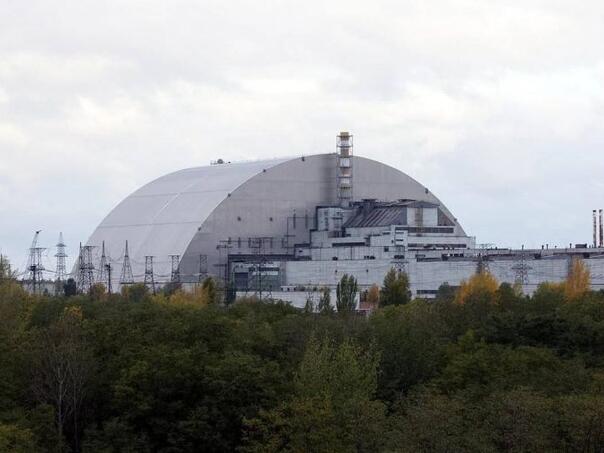
In written statements, Ruslan Kravchenko described in detail previously unreported Russian military activities near Ukrainian nuclear facilities. Ukraine marks the 40th anniversary of the 1986 Chernobyl disaster on Sunday.
In addition to the one closed at Chernobyl, Ukraine has four other nuclear power plants, including the largest in Europe located in the southern region of Zaporizhzhia and under Russian occupation since the beginning of the 2022 invasion.
– Both Chernobyl and the Khmelnytskyi nuclear power plant with two reactors in western Ukraine have been in the path of Russian Kinzhal supersonic missiles since the beginning of the invasion, said Kravchenko.
– In an area of 20 kilometers from the two power plants, 35 such missiles were detected, and 18 of them passed within that radius, he added.
– Such launches cannot be explained by any military reasons. It is obvious that flights over nuclear facilities are conducted solely for the purpose of intimidation and terror, Kravchenko believes.
The Russian Defense Ministry did not respond to Reuters’ request for comment.
The International Atomic Energy Agency (IAEA) said it regularly reports on military activity near nuclear power plants and attacks on electrical substations critical to nuclear safety.
The Director General of the IAEA, Rafael Grossi, has repeatedly expressed his deep concern about the risks and dangers that these military activities represent for nuclear security, the agency said in a statement.
Kinžal is a supersonic air-launched missile that can carry a 500-kilogram warhead and travels at a speed of 6,500 kilometers per hour.
Kravchenko said the daggers fell in three separate cases within an area roughly 10 kilometers away from the Khmelnytskyi power plant.
It is not clear why the missiles fell, but the state attorney said their wreckage showed no indication that they had been intercepted.
The explosion in Chernobyl in 1986 spread radiation across Europe and prompted the Soviet authorities to mobilize a huge number of people and equipment to clean up the consequences of the accident.
The last active reactor of the power plant was closed in 2000.
Russia occupied the Chernobyl power plant for more than a month in the first weeks of the invasion as its forces tried to advance on the capital, Kiev, before withdrawing.
Kravchenko added that since July 2024, when Russia began heavy drone attacks on Ukraine, radars have detected at least 92 Russian drones flying within a five-kilometer radius of the Chernobyl power plant’s protective sarcophagus, installed to prevent further radiation leaks.
The actual number of overflights, Kravchenko said, is almost certainly much higher than 92, because tracks visible on Ukrainian military radars can indicate more than one drone, and sometimes the aircraft do not appear at all.
In February last year, an object identified by Ukraine as a long-range Russian drone struck the Chernobyl facility, breaching the protective sarcophagus.
At the time, the Kremlin denied Russian involvement, stating that its forces were not targeting nuclear infrastructure and that Ukraine probably carried out the attack itself as a provocation.
– The investigation by Ukrainian state prosecutors estimated that the Russian attack was probably intentional, said Kravchenko.
He added that the Russian military is likely using Chernobyl as a route for drone strikes to try to bypass densely covered areas of Ukrainian air defenses.