While the largest European economies continue to struggle with slow growth, the countries of the Adria region stand out as one of the few bright spots on the continent.
Domestic demand as a driver
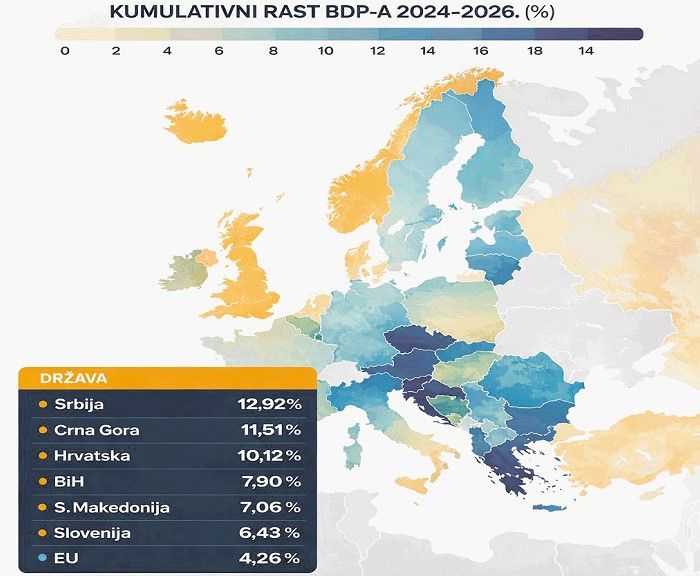
According to the autumn forecast of the European Commission for the year 2024, the cumulative growth of the gross domestic product in the period from 2024 to 2026 in the countries of the Adria region will amount to an average of 9.32 percent, while at the level of the European Union in the same period a growth of only 4.26 percent is expected. In such circumstances, the Adria region becomes a kind of engine of economic growth in Europe, especially at a time when Germany, Italy and Austria are experiencing stagnation or only a symbolic recovery.
The European Commission forecasts the highest cumulative growth in the region for Serbia – 12.92 percent by 2026, which is the second highest growth among EU member states and candidate states, right after Malta. Montenegro follows with 11.51 percent, while Croatia should grow by 10.12 percent, making it one of the most economically successful countries in the European Union in the post-pandemic period. Bosnia and Herzegovina, North Macedonia and Slovenia will also grow faster than the EU average, but noticeably slower than the leading countries in the region.
The main driver of growth in all countries of the Adria region will be domestic demand, primarily strong growth in personal consumption. This will simultaneously lead to an increase in imports, which is of particular importance for the large EU economies with which the region has strong trade ties. In the context of the possible introduction of tariffs on imports into the USA, which could hit European exporters hard, the growth of consumption in the Adria region represents one of the few stable pillars of European economic growth.
Croatian economist Branimir Perković points out that stronger growth in the region stems from known economic laws. As he explains, the key factor is relative underdevelopment compared to Central and Western Europe.
– Less developed countries naturally grow faster than developed ones – we call that effect convergence – says Perković, stressing that high growth rates still depend on institutional convergence with developed countries.
According to him, companies prefer to invest in countries with an efficient judiciary, protected property rights and a stable regulatory framework.
– That is why political rapprochement with the European Union is crucial, because it implies institutional rapprochement, which is a prerequisite for economic convergence and reducing differences in standards – Perković points out. He cites nearshoring as an additional growth factor, i.e. moving part of the production from Asia to geographically closer countries, which benefits the countries of the Adria region.
Escape from corruption
Bosnia and Herzegovina remains the weak point of the region. Although with cumulative GDP growth of 7.9 percent it will grow faster than the EU average, the European Commission warns that this is too slow given the deep gap in living standards.
Political instability and institutional dysfunctionality are cited as key problems, with the assessment that further political tensions could further slow down economic progress. Unemployment should remain above 12 percent, while personal consumption will grow more slowly than in the rest of the region.
Significant potential
In conclusion, the Adria region has significant economic potential, but the main drivers of growth in the coming years will be Croatia, Serbia and Montenegro.
Growth rates below three percent per year, as expected in Bosnia and Herzegovina and North Macedonia, are not sufficient for quickly reaching the standards of the European Union, and the key obstacle still remains the weak quality of institutions and political instability, he writes. Avaz.