
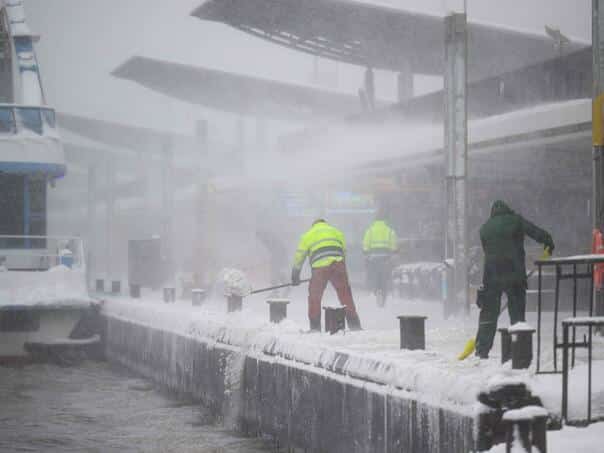
In France, “the winds are weakening”, but “the showers that form behind the disturbances are accompanied by strong gusts of wind”, warned Météo France, reports HINA.
Authorities continue to recommend restricted movement, and numerous downed trees are disrupting road and rail traffic.
#LATEST he Arctic blast across Europe:
– The winter hazard, along with snow and ice, has swept across many areas, such as the UK, France, Germany and the Netherlands
– Widespread traffic chaos has been caused, with hundreds of flights cancelled, including in Paris and Amsterdam… pic.twitter.com/geit2f0LH8— CGTN (@CGTNOfficial) January 7, 2026
According to the power grid manager, 380,000 households were without electricity on Friday.
Wind gusts of 213 kilometers per hour were recorded in the Manche department (northwest), where schools are still closed.
Most of the interventions related to fallen trees and damaged electrical lines and roofs. In the north of the country, one person was seriously injured.
The port of Dieppe (northwest) was closed due to rising sea levels from the storm, which also caused “significant flooding” in Étretat and Fécamp (northwest), authorities said.
Storm Goretti, accompanied by heavy snowfall, also affected the United Kingdom from Thursday evening. Wind gusts of almost 100 miles per hour lashed south-west England and Wales overnight, leaving tens of thousands of homes without power, bringing down trees and disrupting travel.
After a red gale warning for the Isles of Scilly and much of Cornwall in south-west England on Thursday, much of the country moved to a yellow warning on Friday. Heavy snowfall, sleet and rain is expected in Scotland, Wales, Northern Ireland and northern England.
La tempête Goretti a frappé la Normandie dans la nuit du 8 au 9 janvier. Des vents violents, dépassant les 200 km/h sur le littoral, ont causé d’importantes déjàuts. De nombreux arbres ont été arrachés et des coupures d’électricité ont touché plusieurs milliers de foyers. #JT13H pic.twitter.com/hDpZaKeT5A
— franceinfo (@franceinfo) January 9, 2026
However, according to the British meteorological service Met Office, the impact of these weather conditions should not be particularly serious.
About 57,000 households are still without power, energy supplier National Grid said. More than 250 schools remain closed in Scotland. All rail traffic in Cornwall has been suspended.
London escaped the worst consequences. Around fifty flights were canceled at Heathrow Airport.
In Germany, several northern cities, including Hamburg and Bremen, closed schools due to the passage of storm Elli, which was accompanied by snow and strong gusts of wind.
German railways Deutsche Bahn suspended, “at least until noon” on Friday, long-distance train traffic in the north of the country, because it is “no longer possible”.
The largest car manufacturer in Europe, Volkswagen, closed the plant in Emden (northwest), where about 8,000 workers work, on Friday, a company spokesman confirmed.
According to the German meteorological service DWD, the storm should particularly affect the north and northeast of the country, where up to 15 centimeters of snow is expected, with constant gusts of wind favoring the creation of snowdrifts.
During the weekend, temperatures could drop to 10 degrees Celsius below zero, and locally even to minus 20, DWD said.
#Storms pummel northern #Europecausing travel mayhem and power cuts
Read more: https://t.co/OVJFRW3Pcs #AletihadNewsCenter #Weather #WeatherUpdate #stormgorreti #France #Germany #Russia pic.twitter.com/wxFnVxbXyi
— Aletihad English (@AletihadEn) January 9, 2026
According to Bild daily, hospitals are full of people injured on icy roads. The paper also reported major disruptions to public transport and road traffic around Hamburg.
In Russia, heavy snowfall hit Moscow on Friday morning. More than 300 flights were delayed or canceled at four airports in the Moscow region due to snow, RIA Novosti reported.
In the Balkans, which was hit by heavy snow and torrential rain at the beginning of the week, killing at least two people, floodwaters began to recede on Friday. However, ice and snow warnings are still in place for much of the region, including Serbia, where some western parts have been without power for several days after the snowstorm.
In Hungary, significant disruptions in rail traffic continued for the fifth day in a row. The meteorological station in the north of the country recorded a temperature of minus 32.7 degrees Celsius during the night in the mountain basin.
Snow made traffic difficult in the Czech Republic, especially in Prague, on Friday morning. The management of the electricity network CEPS announced on platform X that on Thursday, due to the cold, the highest consumption of electricity in the last five years was recorded.
In Romania, about 4,000 households were without electricity on Friday morning, announced the Minister of Energy Ivan Bogdan.
In Moldova, the Ministry of Education announced that around 600 schools will postpone the start of classes until Monday. Thousands of households were without power on Thursday, but power was restored on Friday, according to the Ministry of Energy.
(Vijesti.ba)