
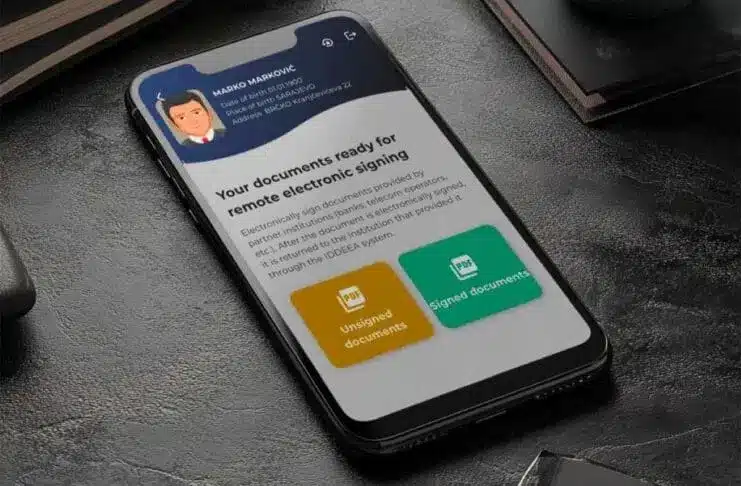
From July 1, 2024, citizens of Bosnia and Herzegovina will be able to use electronic signatures, 18 years after the adoption of the Law on Electronic Signatures in Bosnia and Herzegovina.
Almost two years later, although most citizens have heard of digital identity, i.e. digital representation, and electronic signature, the N1 survey shows that many have never used them. IDDEEA says that the main challenge is still the insufficiently developed number of digital services in the public sector.
As summer approaches, the citizens of Bosnia and Herzegovina are once again witnessing a well-known daily routine: endless lines in front of counters in municipalities, police departments and other institutions where they take out personal documents, register their residence or complete other administrative duties. Instead of a simple procedure, many are still greeted with crowds, insufficiently clear instructions and walking from counter to counter for payments and forms. It is in this kind of everyday life that the issue of an electronic signature becomes more important than ever, but it also raises a logical question: if it exists, why hasn’t it replaced the counter yet?
The answer, at least according to the results of the survey and the responses of the Agency for Identification Documents, Records and Data Exchange of Bosnia and Herzegovina (IDDEEA), lies in several reasons: few institutions offer real online services, activation still requires a physical visit, and many citizens do not yet have enough opportunities to use electronic signatures in everyday administrative procedures.
According to the results of the survey, 91 percent of the participants stated that they had heard of digital identity and e-signature, while nine percent were not familiar with these services.
However, when it comes to actual usage, the numbers show a much more modest picture. Only 17 percent of the respondents answered that they use the e-signature regularly, 29 percent several times, while 34 percent said that they never used it. An additional 20 percent state that they know about this possibility, but have never used it.
This means that formal information is high, but that there is still a serious gap between the knowledge that the service exists and its actual use.
IDDEEA: About 20,000 citizens activated the e-signature
IDDEEA states that the number of users is growing.
“Until today, about 20,000 citizens of Bosnia and Herzegovina have activated a qualified electronic signature. We note a continuous increase in the use of these services, especially after the launch of the e-IDDEEA mobile application, which enables citizens to quickly and easily digitally present themselves and access services,” they told N1.
They add that they are getting more and more positive reactions from users.
“Increasingly, we receive direct positive feedback from users, which confirms that the services are not only activated, but also actively used in practice,” the IDDEEA points out.
However, the results of the survey show that for a large number of citizens, this system is still more of a possibility than a real tool in everyday life.
The biggest problem: Too few institutions offer this option
The most important data of the survey refers precisely to obstacles. When asked what they see as the biggest problem, 48 percent of respondents answered that too few institutions and companies accept e-signatures.
This is confirmed by the IDDEEA itself.
“The use of the services itself is simple and user-friendly. However, the biggest obstacle to wider application is the insufficient number of digital services in the public sector. The more institutions introduce electronic services, the greater will be the use of digital representation and e-signatures,” the agency states.
Among the other problems mentioned by the citizens in the survey are insufficient information, complicated activation and the feeling that the system in practice is not yet widespread enough to really facilitate everyday administrative duties.
What can an e-signature be used for today?
When asked what the e-signature was most useful for, 19 percent of respondents answered that they use it to sign requests or forms, 11 percent to log in to electronic services, and only three percent to communicate with institutions. At the same time, 50 percent of survey participants stated that they did not use this service at all.
Citizens most often cite time saving as the biggest advantage. 29 percent of them emphasize exactly that, 18 percent faster communication with institutions, and 15 percent fewer trips to the counter.
Perhaps the most important data of the entire survey is the answer to the question whether they would use e-signature and digital identity more often if more institutions offered online services. As many as 88 percent of respondents answered yes. This shows that the problem is clearly not that citizens reject digital services, but that they are not yet widely available.
Physical attendance is still mandatory
One of the obstacles remains the activation of the service itself. IDDEEA notes that physical presence is still necessary.
“Physical presence is currently necessary due to high security standards and legal requirements for reliable user identification when issuing a qualified electronic signature,” the agency points out.
However, they add that simpler models are being considered for the future.
“In the future, remote identification models are being considered, in accordance with European practices, in order to further simplify the procedure”, they state.
More than 30 registration offices, expansion is planned
Today, citizens can activate this service in several locations across the country.
“Currently there are more than 30 registration offices throughout Bosnia and Herzegovina. Further expansion of the network is planned in order to provide as easy access as possible to all citizens, regardless of place of residence, and thereby further encourage the use of digital services,” the IDDEEA points out.
As stated, users most often contact us for technical and administrative issues, such as changing their registered e-mail address, and such requests are generally resolved quickly.
A step forward, but not a complete change
When the results of the survey and information from the Agency for Identification Documents, Records and Data Exchange of BiH are collected, a clear picture emerges: electronic signature in BiH is no longer an unknown concept, but it is not yet a standard either. Citizens generally know it exists, see its advantages and would largely use it more often, but the system is not yet developed enough to really replace counters, paperwork and complicated procedures.
In other words, Bosnia and Herzegovina has taken an important step towards digitization, but it has not yet reached the stage where citizens could say that their administration has really moved from queues, payment slips and counters to clicks and e-signatures, he writes. N1 BiH.


