
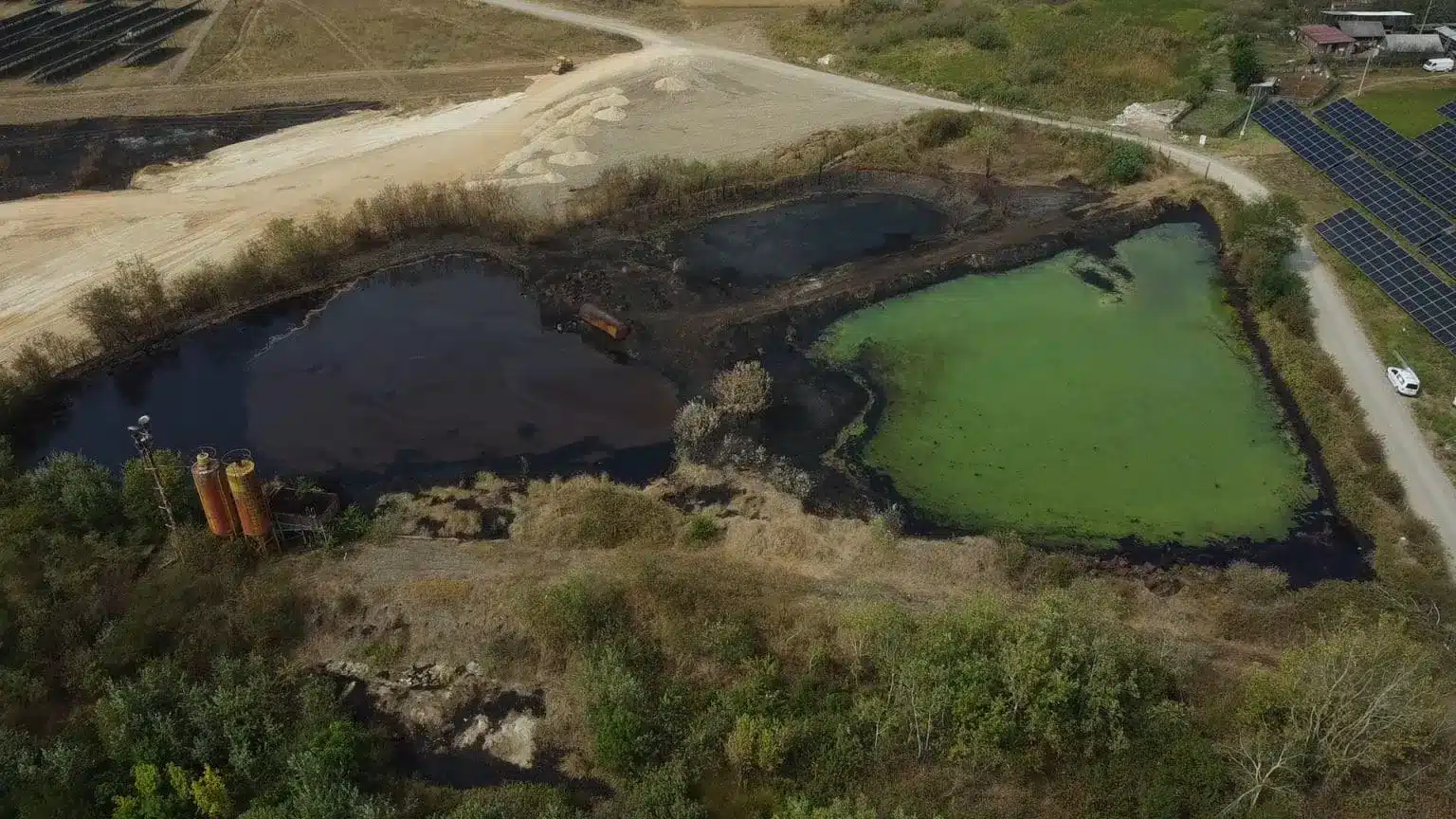
Just a few tens of meters from the first houses in the Modriča 5 settlement, there is a place that experts have been calling an ecological bomb for years. Behind the overgrown vegetation, earthen embankments and improvised fences, there are more than 20 thousand tons of dangerous industrial waste, acid tar, a by-product of waste oil processing, which has been buried in the ground for decades.
In summer, when temperatures exceed 35 degrees, a heavy, bitter and greasy smell spreads from the ground. Residents close their windows. Children enter the houses before dark. Some go to relatives until the air clears. Those who stayed in Modriča 5 say that they are used to the stench, but not to fear.
The problem has existed for more than two decades, but there is no solution. After the fire that engulfed the vegetation in the immediate vicinity in August 2024, only questions remained for institutions that issued permits without implementing measures, questions about privatization, after which the responsibility remained between the state and the company. About the fires that warned that disaster was only a matter of time. And about people who live right next to a place that experts have labeled as high-risk for years.
Let’s visit the Modrič oil refinery, which was one of the most important industrial plants in the region. In the period from 1967 to 1992, waste motor and industrial oils from the former Yugoslavia were collected in this facility. After that, the oils were treated with re-refining using concentrated sulfuric acid and active clay. In this process, a dangerous by-product acid tar was created. For years, waste was disposed of in lagoons created by the exploitation of gravel, in the area of today’s Modriča 5 settlement. The decision on disposal was made in 1966, in accordance with the regulations of the time. According to estimates, there are between 20 and 25 thousand tons of hazardous waste on the site. In 1996, the Modriča oil refinery stopped using the technology of processing waste oil with sulfuric acid, and since then acid tar is no longer produced. But the problem of the waste that was stored in previous decades has never been solved. At that moment, no one could have guessed that a few decades later, a settlement with more than two thousand inhabitants would arise around that location.
Privatization and the disappearance of responsibility
After privatization in 2007, the Modriča Oil Refinery, together with the Brod Oil Refinery and the network of pumps, became the property of the Russian state company “Zarubezhneft” through the company “Neftegazinkor”. Then began the multi-year transfer of responsibility. The company claimed that the waste was not created at the time it took over the refinery, which is why it does not consider the problem to be its responsibility. At the same time, the local community and institutions have been trying for years to find a model of financing and permanent disposal of waste.
In 2011, the Ministry of Spatial Planning, Construction and Ecology of the Republika Srpska submitted a project for the resolution of tar pits to the Delegation of the European Commission through IPA funds, but the initiative did not receive support. In the following years, efforts were made to find a solution through various feasibility studies and international partners. There were no results.
One of the key problems in the whole case is the fact that the institutions have been issuing and renewing environmental permits for years, even though measures for the permanent disposal of tar have not been implemented.
According to data from the Center for Civil Initiatives (CCI), in the first environmental permit issued to the new owner of the Modriča Oil Refinery, there was a precise obligation of the company to rehabilitate the inactive Gudron pit at Garevac within five years. Later permits no longer contained a clearly defined obligation.
On May 20, 2015, the Ministry of Spatial Planning, Construction and Ecology issued a renewed environmental permit valid until May 2020. The permit stipulated measures to prevent and reduce waste, as well as the obligation to dispose of tar waste and remediate contaminated land.
The plan foresaw: research into the possibility of acid tar processing, choice of technology, provision of financing, procurement and installation of equipment, and the start of project implementation by 2017.
None of that was realized.
A new environmental permit was issued in 2020, although it was noted that the previous measures were not implemented. The permit was valid until May 2025. According to the Rulebook on the Procedure for Revision and Renewal of Environmental Permits of the Republika Srpska, the permit must be revised if the pollution poses a serious threat to human health and the environment.
The CCI warns that the Ministry was obliged to initiate a review of the environmental permit immediately after the August 2024 fire.
According to official data from the Modriča Territorial Fire Department, firefighters intervened as many as 37 times in the period from 2014 to 2024 at the site of Gudronska Jama or in its immediate vicinity. This data shows that the problem has been going on for years and that the institutions had enough warnings.
The President of the Local Community of Modriča 5, Pane Kostadinović, tells BUKA that the situation after the fire was dramatic.
“The fire that engulfed the low-lying vegetation not far from Gudron spread so quickly that it engulfed the Gudron pit and two pools were on fire. With some kind of reaction from the firefighters, we managed to rehabilitate it and save the settlement. The drainage channels that were under the ground continued to smolder for the following days. There was an unbearable stench here and you couldn’t breathe the air for seven to ten days. We had cases where families left the settlement,” says Kostadinović.
The residents of Modriča 5 today live in a kind of daily uncertainty. The settlement that was created in the post-war period was developed right next to the site where dangerous chemicals were dumped for decades. Many built houses without knowing what was under the ground. Today they say they feel forgotten.
The greatest fear among residents is the possibility of long-term health consequences. According to the data of the Institute of Public Health, which were provided to the activists by the competent institutions, from 2020 to 2025, more than 700 cases of two types of malignant diseases were registered in the Modriča area, while more than 800 were registered in the Šamac area.
Although the direct connection with the Gudron pit has not been officially proven, among residents there is a serious suspicion that long-term exposure to pollution may have consequences for people’s health. The fact that there is a school in the immediate vicinity and that children pass through the area every day, which was exposed to large amounts of toxic gases during the fire, is of particular concern.
Institutions without answers
After the fire, the local authorities sent alarming warnings to the institutions of the Republika Srpska and Bosnia and Herzegovina. Letters were sent to the highest officials, the Republican Administration of Civil Protection and relevant ministries. According to claims from the local community, there were no answers.
Mayor of Modriča municipality, Jovica Radulović, tells BUKU that the local community does not have the capacity to solve a problem of this scale on its own.
“What is still alarming, and which has been a problem for years, is the fact that this waste is still present and that, as can be seen on the ground and in the videos, it penetrates into the ground. What is now becoming unfathomable are the consequences and the question of how it will all be remedied, bearing in mind that there is a real danger that the pollution will reach the waterways. In that case, we would be talking about a serious environmental disaster. That is why we are trying, together with the relevant ministry, to do everything to prevent that from happening. After the fire, sampling was done with the support of UNDP, and the latest information we have is that we are waiting for the results of various analyses, “I want to remind the citizens that the fire extinguishing in Modriča was organized by the government of the Republic of Srpska, which had the capacity to intervene our request and insistence, considering that Gudronska jama is located on the cadastral parcels owned by the Oil Refinery and the Republic of Srpska. After that, the municipality received the bill as the contractor for the emergency situation. We had to record it in the budget, but the government paid two-thirds of the costs, while the municipality acquired the right to claim the funds Oil refineries and the Government of Republika Srpska. We addressed the Refinery, but we do not have a common position on this issue,” says Radulović.
Plans, permits and lack of funds
The Ministry of Spatial Planning, Construction and Ecology of the Republic of Srpska states that the obligations are defined by the environmental permit.
“Obligations related to the rehabilitation of the Garevac tar pit in Modriča are determined by the decision that issued the environmental permit for the Modriča Oil Refinery. In accordance with that decision, the following is prescribed: The disposal of the tar waste of the Modriča Oil Refinery (pools within the refinery and at the site “Garevac”), created during the period when used oil regeneration technology was applied in the refinery, as well as the remediation of contaminated soil from the substrate and the immediate environment, must be be carried out in accordance with the Plan for the final disposal of tar waste”, it is stated in the press release of the relevant ministry, and they state that “the preparation of the Plan for the remediation of the tar pit in Modriča is in progress. This process is being implemented at the initiative of the Ministry, within the project Portfolio for accelerating the green transition in Bosnia and Herzegovina, in the Pollution Reduction component, organized by UNDP in Bosnia and Herzegovina and the Swedish Chemicals Agency (KEMI).”
When asked why the location, although known for decades, has not yet been repaired, and what was the key reason for the delay, the Ministry states that the main reason is the lack of financial resources. They also point out that the Tar Pit Remediation Plan is defined in detail in the decision that issued the environmental permit for the Modriča Oil Refinery.
At the same time, activists, locals and representatives of the local community warn that the problem is not only financial, but also institutional.
!I believe that no amount of money is too great when it comes to solving this problem. The Government of Republika Srpska, especially recently, has been allocating significant funds for various infrastructure projects in local self-government units. I believe that a serious intervention could solve this problem permanently. Especially considering that the location is located on the territory and cadastral parcels owned by Republika Srpska, this would actually mean that the state is solving a problem that is its own. This would benefit not only Modriča, but also the entire region, because pollution is present and can be felt, especially in the summer months, through evaporation and high temperatures!, says Radulović.
In its analyses, the CCI warns of possible failures by institutions and suspicions of abuse of position.
“According to the Law on Waste Management of Republika Srpska, the Government of Republika Srpska, relevant ministries, Environmental Protection Fund, local self-government units and other competent institutions are responsible for waste management.”
Activists warn that the competent authorities have not taken effective measures for years despite warnings and frequent fires. According to available data, after the fire in 2024, the Inspectorate did not publicly declare concrete measures. At the same time, the Doboj District Public Prosecutor’s Office received a report against one person for causing general danger.
However, key questions remain open: Who is responsible for decades of non-implementation of measures? Why are environmental permits not conditioned on concrete results? And how is it possible that a site with 25 thousand tons of hazardous waste has been functioning for years without a permanent solution?
The political dimension of the problem
The fire in August 2024 also opened up political issues. The local authorities in Modriča claimed that after the declaration of a state of emergency, they did not receive an adequate reaction from the republican level. In the background of everything is the political relationship between the local government led by the SDS and the republican government led by the SNSD.
Two years after the big fire, Gudronska pit is still an open wound in the center of Modriča. There is still no final rehabilitation plan. There is no precise deadline. There is no answer as to who will finance the waste removal. There is no clear answer as to who is legally responsible. There are only studies in preparation, new sampling and announcements of future solutions.
And under the ground, a few tens of meters from the houses, there are still more than 20 thousand tons of hazardous waste, he reports NOISE.


