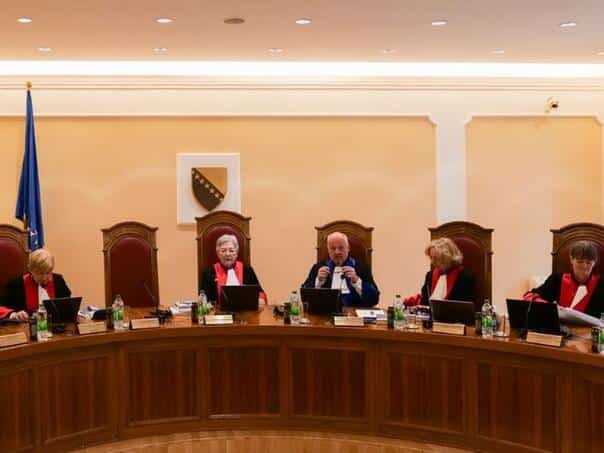
The Constitutional Court found that the Law on Inoperation of the Law and Prohibition of the Exercise of Bosnia and Herzegovina, the Law on Admission of the Criminal Code of Republika Srpska, a decision on measures and tasks arising from unconstitutional decisions and the procedures of the exquisive institutions of Bosnia and Herzegovina and Tač. 3, 5. and 6. Conclusions of the National Assembly of the Republika Srpska adopted at 17. A special session held on 26. February 2025. not in accordance with Art. I / 2. and III / 3.b) Constitution of Bosnia and Herzegovina.
The Constitutional Court put the laws and decisions out of force of AB INITIO and determined that they cease to be valid from the day of their publication in the Official Gazette of the Republika Srpska “number 19/25, and Tač. 3, 5. and 6. Disputed conclusions from the day of their adoption.
In the explanation of the Decision, the Constitutional Court pointed out its own practice regarding the issue of division of competencies between the entity and the state of Bosnia and Herzegovina arising that issues that are not explicitly listed in Article III / 1. They are not necessarily in the exclusive competence of the entities because the Constitution of Bosnia and Herzegovina is prescribed in other provisions (eg Art. I / 1, II / 7, III / 1.A), III / 5.a), IV / 2, V / 1. and v / 3.a)).
It is also pointed to the practice according to which the competencies of Bosnia and Herzegovina in the field of judiciary and security were established on the basis of Article III / 5.
Constitution of BiH in accordance with the Constitution of Bosnia and Herzegovina. Finally, the “Returning” procedure for the entities of the competencies previously established as the competence of Bosnia and Herzegovina under Article III / 5 has been pointed out. The Constitution of Bosnia and Herzegovina is not the opposite of the Constitution of Bosnia and Herzegovina, but the question is exclusively the competent parliamentary assembly of BiH.
Analyzing the constitutionality of the disputed law on the laws of the law and prohibition of the performance of Bosnia and Herzegovina, the Constitutional Court has fully excluded the implementation of the Law on the BiH Public Investigation and Prosecutorial Council and the Law on the BiH Court of BiH. It was pointed out that in this way de facto and de jure revokes the sovereignty of the state of Bosnia and Herzegovina in one part of its territory and jurisdiction in the field of judiciary and security essentially “returns” the entity Republika Srpska.
However, the “Return” Entities of the competencies previously established as the competence of Bosnia and Herzegovina under Article III / 5. The Constitution of Bosnia and Herzegovina has already been said, in the exclusive competence of the BiH Parliamentary Assembly. The Constitutional Court emphasized that unilateral actions of one of the entities (withdrawal of the Laws regulating the same matter, etc.) Unable to establish the competence of the entity for the area in which the state of Bosnia and Herzegovina has been established on the basis of Article III / 5. Constitution of Bosnia and Herzegovina.
Therefore, the adoption of the disputed law on inapplications of the law and prohibition of the activities of the Vanustavni institutions of Bosnia and Herzegovina did the National Assembly of the Republika Srpska outside its powers.
For the stated reasons, the Constitutional Court concluded that the disputed entity law must be declared unconstitutional aspects because it is normatively regulated by the Constitution of Bosnia and Herzegovina under the jurisdiction of that entity, and there is no constitutional basis.
For the same reasons, the Constitutional Court concluded that the point were. 3, 5. I 6. The disputed conclusions of the National Assembly of the Republika Srpska adopted on 26. February 2025. Years of measures and tasks arising from the non-acting institutions of Bosnia and Herzegovina, which are legal acts that initiated the adoption of the disputed law on the law, entirely contrary to Art. I / 2. and III / 3.b) Constitution of Bosnia and Herzegovina.
Considering the constitutionality of the disputed Law on Republika Srpska, which prescribes the new criminal offense “of the Republika Srpska’s decisions,” the Constitutional Court has indicated the company’s general values (last resort) if the protection of these values cannot be achieved otherwise.
The Constitutional Court accepted the position that the respect for the decisions of the institutions is the general value of a democratic society whose realization would, in certain cases, could require criminal coincidence. However, it was pointed out that the prescribing of criminal liability for the non-execution of these decisions must be compatible with the principle of the rule of law referred to in Article I / 2.
The Constitution of Bosnia and Herzegovina implies that all entity and cantonal constitutions, laws and other regulations that are made must be harmonized with constitutional principles. The Constitutional Court pointed that the disputed legal provision was formulated so widely involve criminal responsibility for the non-execution of any decision of any institution or the bodies of the Republika Srpska, regardless of which social values in the specific case endangered. In this way, they are derogated by the existing ways of resolving non-execution of the decisions of the institutions or bodies of the Republika Srpska, which is contrary to the principle of legal certainty.
In addition, that the formulation of the disputed legal provisions arises that the decisions of the Republika Srpska are binding, regardless of whether these decisions are constitutional and laws, which endangers the principle of the rule and constitutional business control of the Republika Srpska decisions.
Finally, the disputed provision introduces the competitions of the Serbian republics against the decisions of state bodies and institutions, which are in the legal nomenclature, and regulates the issue of employees in Bosnia and Herzegovina’s institutions. Given the stated, the Constitutional Court concluded that the disputed legal provision does not meet the quality standards and is contrary to the principle of the rule of law referred to in Article I / 2. Constitution of Bosnia and Herzegovina.
(Vijesti.ba)