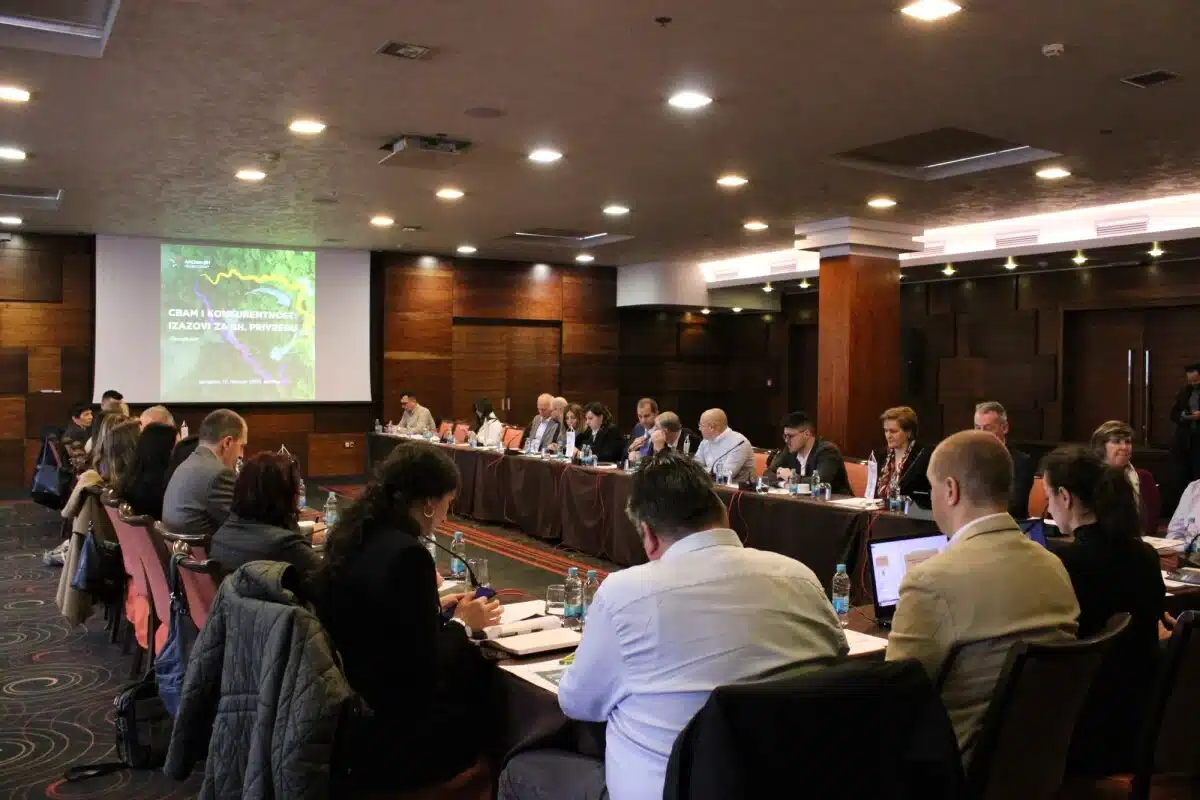
This meeting, organized by the American Commercial Chamber in BiH (Amcham BiH), aimed at the analysis of the current CBAM implementation status in BiH, seeing its consequences for the economy and identify possible solutions to mitigate the negative effects of this impetus.
CBAM is the mechanism of the European Union that prevents “carbon leak” by moving production into countries with milder ecological standards. From 1. January 2026. It became mandatory for EU importers, iron, steel, aluminum, fertilizer, electricity and hydrogen outside the EU, which will have to buy CBAM certificates for CO₂ emissions. The CBAM operates in parallel with the European Emissions System (ETS), ensuring that the imported goods are subject to the same environmental standards. Although the obligation is formal on importers, the cost is expected to be transferred to BH. Exporters, thus reducing their competitiveness in the EU.
BiH faces challenges in the implementation of CBAM due to the high share of fossil fuels in the energy mix. A special problem is the fact that the products from the sector in the initially covered CBAM in 2023 were about 15 percent of the total bh. Exports to the EU.
Given that BiH has not yet introduced the emission trading system (ETS) or alternative emission reduction mechanisms, domestic businessmen will not have the opportunity to recognize possible carbon taxes in BiH as compensation when calculating CBAM. This increases the cost of import bh. Products in the EU, reduces their competitiveness and endanger the EU market in the long term.
Conclusions from the round table:
Bh. Exporters will from 1. January 2026. Pay to CBAM tax on products such as iron, steel, aluminum, cement and electricity.
EU Importers BH. Products covered by CBAM from 1. January 2026. will need to buy CBAM certificates, as BiH has no national emission calculation model.
Bosnia and Herzegovina has opted for the implementation of the EU ETS system, but its introduction will not be possible by 2026. years, and it is planned until 2030. years. The process has slowed down due to the inconsistencies of the Roadmap for the Establishment of MRV and ETS models by the Council of Ministers of BiH, although the deadline was the end of 2024. years.
Bh. Exporters in sectors covered by CBAM by then will remain exposed to this impetus, which will be charged for imports in the EU.
Funds collected through CBAM will remain in the EU budget, instead of reinvesting in decarbonization and modernization of BH. Economy.
It is necessary to provide emergency financial and regulatory support measures for BiH. exporters to mitigate the negative effects of CBAM. This includes subsidies to reduce emissions, investments in decarbonization and facilities for adjusting production processes, in order to bh. Companies could remain competitive in the EU. All previous reforms have largely increased operating costs, and it is crucial to develop mechanisms for the support for the economy in transition to sustainable business.
The BiH Energy Policy should enable industries to access more competitive and cleaner electricity to reduce their carbon imprint and exposure to CBAM. Key steps include increasing production from renewable sources, improving energy efficiency and regulating electricity trafficking between economic entities. Currently, companies that have invested in renewable sources cannot sell excess energy, which limits market flexibility. By facilitating green energy purchase and enabling its sale, business costs would reduce and increase bh resistance. Economic to the EU climate regulations.
Given the complexity of CBAM adaptation and high, irreparable costs, all participants of the round table agreed that it is necessary to urgently establish public dialogue between government and BH. Exporter, work on simplifying procedures and ensure access to financial mechanisms that will enable them to be competitiveness.
The round table gathered representatives of key institutions, the EU Delegation to BiH, the Ministry of Foreign Trade and the Economic Relations of BiH, Both Entity of the Republika Srpska, the FBiH Employers’ Association, Foreign Trade Chamber of BiH, FBiH Chamber of Commerce, as well as the representatives of the private and financial sectors. The goal was to analyze the impact of CBAM and ETS on BH. to the economy and identify the possible directions of action.
AmCham BiH will continue to support bh. Businessmen in navigating through new regulatory challenges and encourage relevant government institutions that the voice of production companies and expansion is involved in the decision-making process at the national level.