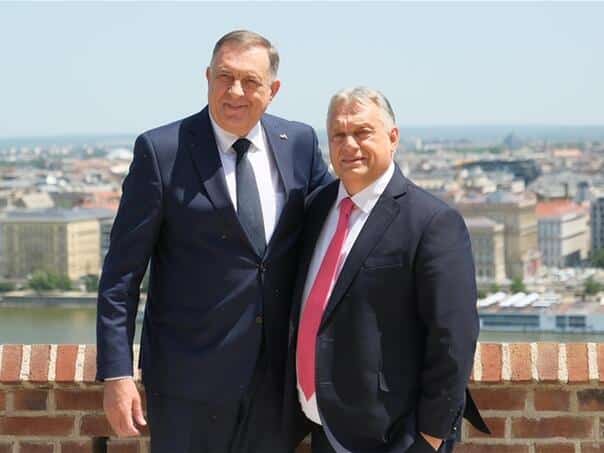
The weakening of Orbán’s influence would particularly affect the position of Milorad Dodik, president of the Alliance of Independent Social Democrats (SNSD), who enjoyed Budapest’s open support, from blocking sanctions within the European Union (EU) to financial and political assistance at key moments.
Without such support, the space for more decisive action by the European Union towards the crises in Bosnia and Herzegovina could be significantly expanded. This means a more realistic possibility of sanctions, stronger pressure to respect the rule of law, but also clearer conditions for the continuation of the country’s European path. At the same time, the probability of political adventures that previously counted on protection from Budapest is decreasing, according to the Atlantic Council (AC) analysis.
Peter Magyar’s coming to power could further change the approach, with an emphasis on the fight against corruption and strengthening of relations with the EU and NATO, which implies a distancing from the previous policy of supporting destabilizing actors in the region. With this, Bosnia and Herzegovina could receive a clearer European framework, but also stronger demands for reforms.
At the regional level, the change of government in Hungary most affects relations with Serbia and its president Aleksandar Vučić. The previous partnership, which included energy, infrastructure and Chinese investment, could weaken, especially if the new government in Budapest reconsiders previous projects and political ties, according to AC.
This comes at a sensitive moment for Belgrade, where Vučić is already seeing a decline in popularity. The weakening of support from Hungary could affect the political stability in Serbia, but also the dynamics of the upcoming elections, as well as the implementation of projects related to Russian energy.
In a broader context, the turn in Budapest could open up space for redefining energy and geopolitical relations in the region. Moving Hungary away from Russian energy sources would put additional pressure on existing arrangements, but also strengthen alternative supply routes, including projects in which Croatia could play a more important role.
At the same time, the potential disappearance of the Hungarian veto within the EU could speed up decision-making on the Western Balkans. The European Union could thus find itself under pressure to define its enlargement policy more clearly and offer more specific deadlines for membership, which could change the dynamics of the integration of the entire region in the long term.
(Vijesti.ba)