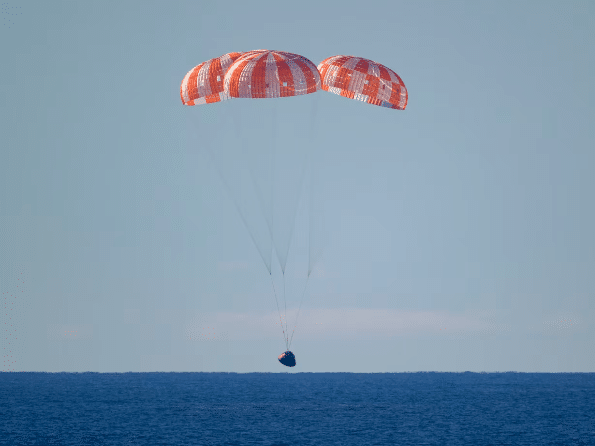
The four-person Artemis II capsule passed through Earth’s atmosphere and landed safely in the Pacific Ocean on Friday after spending nearly ten days in space, marking the first human trip near the moon in more than half a century.
NASA’s teardrop-shaped Orion capsule, dubbed “Integrity,” gently descended by parachute into the calm sea off the coast of Southern California shortly after 5:07 p.m. Pacific Time (00:07 GMT Saturday). It ended a mission during which the astronauts, four days earlier, had reached a distance of 252,756 miles from Earth, deeper into space than anyone had flown before.
NASA’s Artemis 2 crew capsule has successfully landed back on Earth pic.twitter.com/QJGe93a8UN
— Latest in space (@latestinspace) April 11, 2026
The Artemis II flight, which covered a total of 694,392 miles (1,117,515 kilometers) through two Earth orbits and a key flyby of the Moon at a distance of about 4,000 miles from its surface, was the first manned test flight of the Artemis program. The goal of this series of missions is the return of astronauts to the surface of the Moon, planned from 2028.
The ocean landing, under partly cloudy skies, was streamed live via a NASA webcast.
“A perfectly precise landing for Integrity and its crew of four,” said NASA commentator Rob Navias immediately after the descent.
– We are stable, all four crew members are in good condition – announced mission commander Reid Wiseman immediately after landing, confirming that the capsule is in the correct position and that the astronauts are fine.
BREAKING: Astronauts Christina Koch, Victor Glover Jr., Jeremy Hansen and Reid Wiseman have exited the Orion capsule after a successful Artemis II splashdown.
Follow live updates: https://t.co/obevyEPTg6 pic.twitter.com/6h3l2mzWr7
— ABC News (@ABC) April 11, 2026
It took NASA and US Navy teams less than two hours to secure the capsule on the sea surface and extract the crew – American astronauts Wiseman, 50, Victor Glover, 49, and Christina Koch, 47, as well as Canadian astronaut Jeremy Hansen, 50.
All four of the Artemis II astronauts have been successfully extracted from the Orion spacecraft following splashdown and are now on the USS John P. Murtha. Next up, they will be escorted to the medical bay where they will undergo post-mission medical evaluations. pic.twitter.com/v96RFKEUNN
— NASA (@NASA) April 11, 2026
The crew’s return was the riskiest part of the mission and a key test of the Lockheed Martin-built Orion spacecraft, confirming that its heat shield could withstand the extreme conditions of reentry from lunar orbit.
The capsule entered Earth’s atmosphere at 32 times the speed of sound, with friction heating its heat shield to about 5,000 degrees Fahrenheit (2,760 degrees Celsius). The spacecraft was enveloped by a layer of ionized gas, which caused a planned interruption of radio communication lasting more than six minutes during the most critical phase of entry into the atmosphere.
(Vijesti.ba)