
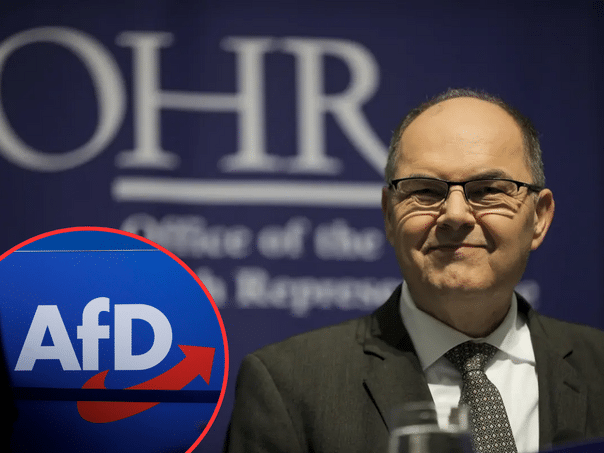
In the request that have invested JAN Wenzel Schmidt and the AFD Parliamentary Group states that Schmidt in May 2021. Appointed the Board of Directors of the Peace Implementation Council (PIC).
The Parliamentary Group of the Land Network Alternatives for Germany (AFD) submitted a parliamentary issue in the German Bundestag regarding Christian Schmidt’s role in Bosnia and Herzegovina, and requested the legitimacy of the Leader of the UN Security Council, as well as the rejection of Russia and China to confirm Schmidt’s appointment.
In the request that have invested JAN Wenzel Schmidt and the AFD Parliamentary Group states that Schmidt in May 2021. Appointed the Board of Directors of the Peace Implementation Council (PIC).
– However, this appointment has not been confirmed by the UN Security Council, which, in the opinion of the applicants, is suspected of an international legal legitimacy of his function and his decisions. Despite that, the High Representative, according to the legal understanding of the applicants, brought several binding decisions that deeply interferes with the constitutional order of Bosnia and Herzegovina. Applicants have serious suspicions that these decisions exceeded the competence of the High Representative envisaged by Annex 10 of the Dayton Peace Agreement, according to.
Then follow questions for the Federal Government:
1. Has the Federal Government form an attitude on Christian Schmidt’s international legitimation as a high representative in Bosnia and Herzegovina, given the lack of approval of the UN Security Council, and if so?
2. What consequences, the Federal Government draws out the fact that the Russian Federation and China refused to confirm Christian Schmidt as a high representative in the UN Security Council?
3. According to the Federal Government, the Legal Binding Decisions, the High Representative brought in 2022. and 2023. years, did the Federal Government form a position on these decisions and what is he?
4. Does the Federal Government see the override of the competencies that the High Representative has under Annex 10 of the Dayton Agreement, and if not, why not?
5. What consequences does the Federal Government see the stability and sovereignty of Bosnia and Herzegovina due to these measures?
6. Did the Federal Government take steps to confirm the appointment of Christian Schmidt in the UN Security Council, and if so, which, that is, if not, why not?
7. Does the Federal Government plan for the reform of the Mechanisms of the Naming High Representative to strengthen its international legitimacy, and if yes, in what way?
8. Did the Federal Government address whether political processes in Bosnia and Herzegovina – especially against representatives of Republika Srpska – politically motivated, and if, what knowledge is available and which measures the Federal Government undertakes, if there are, to secure equity and transparent processes?
9. Has the Federal Government form an attitude to whether the High Representative’s decisions may lead to further political destabilization of the region, and if so, what is the position?
10. Has the Federal Government form an attitude on how he assesses the effect of the High Representative in the context of the sovereignty and independence of Bosnia and Herzegovina, and if so, what is that attitude?
11. Has the Federal Government form a position on whether the action of the High Representative is Valuable Support, Even if local actors and international partners are considered legally questionable, and if so, what is that attitude?
12. Has the Federal Government form an attitude on various international positions regarding the appointment and operation of the High Representative, and what is that position?
13. Does the Federal Government keep interviews with international partners to develop a common position on the role of the High Representative, and if yes, with which partners and what topics?
14. Has the Federal Government form a view of what the consequences of the High Representative’s decision have in the economic stability of Bosnia and Herzegovina, and if so, what is the point?
15. Does the Federal Government see the possibility of economic support from the EU to reduce tensions in the region, and if yes, what one?
16. Does the Federal Government plan to help Bosnia and Herzegovina in the implementation of EU integration reforms, and if yes, which?
17. Does the Federal Government believe that the current role of the High Representative contributes or interferes with the long-term peace process and the political stability of the country, and if yes, in what way?
18. Has the Federal Government form a position on the influence of the High Representative’s decision to protect human rights in Bosnia and Herzegovina, and if so, what is that attitude?
Recall, although the UN Security Council has not officially appointed Christian Schmidt, according to the procedures and the provisions of the Framework Agreement for Peace, the Board of Directors of the Peace Implementation Council is in accordance with the UN Security Council Resolutions.
(Vijesti.ba)


