
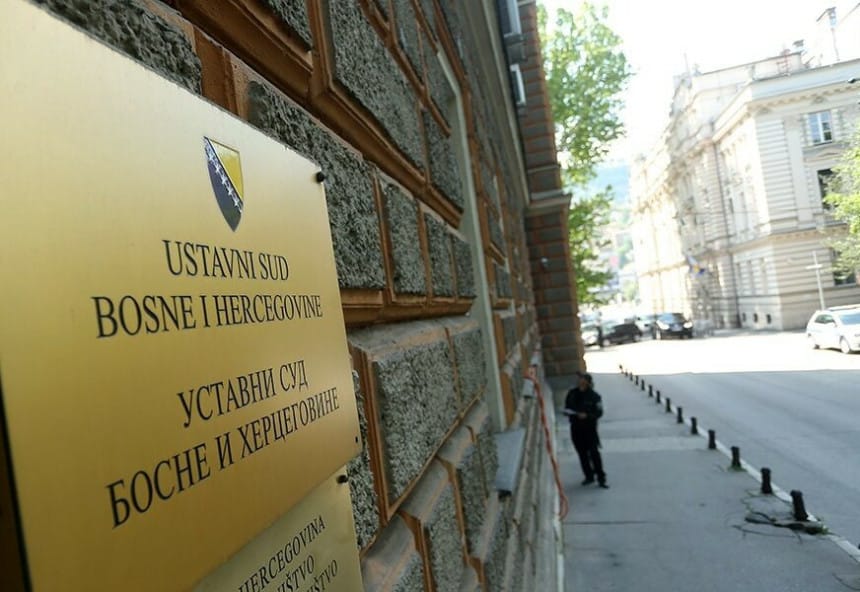
A member of the Collegium of the House of Peoples of the Parliamentary Assembly of Bosnia and Herzegovina and one of the more experienced politicians from SNSD, Nikola Špirić, marked the Constitutional Court of Bosnia and Herzegovina as a new target and obviously tried to open the issue of this key institution for the stability of the state.
“It would be healing for Bosnia and Herzegovina if, after Schmidt, the foreign judges of the Constitutional Court of Bosnia and Herzegovina also retire, which requires a complete sobering up of political Sarajevo,” Špirić said.
Politicians from the Republika Srpska, mostly from the SNSD, are the loudest in calling for a return to the original Dayton Agreement, which they interpret as the cancellation of all reforms that came after the war, even though the “original” Dayton Agreement itself created the conditions for reforms.
What is especially duplicitous in Špirić’s request for the “withdrawal of judges” is that it is written in the “original” Dayton Agreement: “The Constitutional Court of Bosnia and Herzegovina consists of nine members. Four members are elected by the House of Representatives of the Federation of Bosnia and Herzegovina, two members are elected by the National Assembly of Republika Srpska, and the remaining three are elected by the President of the European Court of Human Rights after consultation with the Presidency of Bosnia and Herzegovina.”
The Constitution foresees the possibility that the law adopted by the Parliamentary Assembly of Bosnia and Herzegovina changes the method of electing judges appointed by the President of the European Court of Human Rights. However, the Constitution does not say that it is possible to change the character of judges, but only the manner of their election.
Therefore, the request to remove foreign judges from the Constitutional Court of Bosnia and Herzegovina is also a request to change the Dayton Agreement, and its opening would have to entail the resolution of many other issues that prevent the progress of Bosnia and Herzegovina.
It can be assumed that in this matter too, politics from the RS would approach like a “buffet table”, creating crises in institutions where simple blockades are not possible.
Ruling politicians from Republika Srpska tried to present the recent session of the UN Security Council, the departure of Christian Schmidt and the new positioning of American policy towards Bosnia and Herzegovina as their own great success, although, among other things, American Ambassador Tammy Bruce emphasized respect for the decisions of the Constitutional Court of Bosnia and Herzegovina as one of the proofs that the country is stable.
Although the politicians from the RS hope that the geopolitical circumstances are now favorable for them to launch an attack on this institution, i.e. to the attempt to introduce a certain type of ethnic voting, it could be a double-edged sword. Obviously, the excuse for less American engagement in Bosnia and Herzegovina is the stability guaranteed by the Constitutional Court, and the attacks on it destroy that “stability”.
Špirić’s statement given in the context of current political events is a hint of SNSD’s political priorities, but the Constitutional Court of Bosnia and Herzegovina has already been a target of constant challenges to decisions, as well as the refusal of the National Assembly of the RS to appoint two judges, which is mandatory according to the Constitution of Bosnia and Herzegovina and the Dayton Agreement.
At the conference organized by the Constitutional Court of Bosnia and Herzegovina, the president of the court, Mirsad Ćeman, underlined this problem.
“Elect the missing judges on time, don’t let anyone question the legitimacy of the Constitutional Court. Don’t let anyone, motivated by anything, question the constitutionality, legality and legitimacy of the court,” Ćeman said.
Judge Angelika Nußberger emphasized that foreign judges in the Constitutional Court are based on the Constitution of Bosnia and Herzegovina and that it is up to the citizens of the country to change the Constitution and that foreign judges will be the first to accept it.
The Constitutional Court is a hindrance to those who attack the institutions of Bosnia and Herzegovina
In an interview with Klix.ba, a delegate in the House of Peoples and a former member of the Presidency of Bosnia and Herzegovina, Šefik Džaferović, said that the Constitutional Court has been under attack for a long time by those political forces that are an obstacle to it, because its legal work in accordance with the Constitution is an obstacle to the achievement of their goals.
“And their goals are known. Therefore, the reduction of the capacity of the institutions of Bosnia and Herzegovina, secession and other illegal activities. Therefore, this is nothing new. However, they must know that the Constitutional Court of Bosnia and Herzegovina is composed, and the manner of its work, structure and jurisdiction are in accordance with and in connection with the other provisions of the Dayton Peace Agreement. Therefore, it is all part of this package: entities, a complete state, the continuity of the Republic of Bosnia and Herzegovina, the entity structure within Bosnia and Herzegovina and, of course, the Constitutional Court of Bosnia and Herzegovina, which can respond the task of interpreting and preserving the Constitution as it is,” Džaferović said.
He reminds that the constitutional system provides numerous opportunities for those who want to abuse it, for boycotts and blockades, and for taking actions that are not in accordance with the Constitution of Bosnia and Herzegovina and that the Constitutional Court is actually composed in such a way that it can respond to that situation.
“The Constitutional Court of Bosnia and Herzegovina is a court that is positioned as a completely independent court in the Constitution of Bosnia and Herzegovina and the Dayton Peace Agreement. The only provisions concerning the Constitutional Court of Bosnia and Herzegovina, which are passed by the Parliament, are in fact the Constitution of Bosnia and Herzegovina itself. No law is needed for its functioning and it is not possible to pass any law for the functioning of the Constitutional Court. It functions on the basis of the Constitution, and the Constitution gave it the authority to regulate the rules by which it will work. This reflects the specificity of the Constitutional Court of Bosnia and Herzegovina. Its difference in relation to the constitutional courts of some other countries is a consequence of this constitutional arrangement and a kind of response to it. Anyone who thinks that they can change the nature of the Constitutional Court and its position, and bind it to the law that would regulate its behavior, must know that this is encroaching on the Dayton Peace Agreement, and only then should we discuss it.”
He underlines that the only way to talk is through a change in the Constitution of Bosnia and Herzegovina, and such a change that will remove all mechanisms of boycotts, blockades and all risks to the state of Bosnia and Herzegovina.
“If someone thinks to keep entity voting, entities and everything else, and change the nature of the Constitutional Court of Bosnia and Herzegovina and its competences, he is encroaching on the so-called Dayton balance, and that is simply not possible,” said Džaferović.
He points out that the position of the Constitutional Court must be preserved as it is positioned now and that is why the unity of all pro-Bosnian political parties within Bosnia and Herzegovina is necessary.
“We have shown that we have unity, for example in the House of Peoples, in the Bosniak Club. There we have four political parties and we have acted unitedly when it comes to the Constitutional Court of Bosnia and Herzegovina. This goes beyond the question of position and opposition, it is a question of the state, and we should act unitedly here. There were attempts to change the character of the Constitutional Court, while keeping everything else the same. We, of course, considered it an unconstitutional proposal that represented an attack on Bosnia and Herzegovina and it was withdrawn from the parliamentary procedure, but we took steps because of that – we didn’t want to come to the sessions because we thought it couldn’t be a topic for discussion,” says Džaferović.
He emphasizes that delegates, representatives or anyone else cannot propose laws that destroy the state of Bosnia and Herzegovina, and then ask to participate in the debate on such laws.
“We will not participate in discussions that destroy the state. It was not a boycott, nor was it a denial of a quorum, such a topic simply cannot be on the agenda. Deputies and delegates have the right and obligation to propose laws, but they also have a clear obligation that it must be in accordance with the Constitution of Bosnia and Herzegovina and that the state of Bosnia and Herzegovina must be respected. Everything that goes beyond that cannot be a topic, we did not even consider it a topic, and that is why we did not come to the sessions. that, four political parties, five of us. I think that this is such an important and important issue for everyone in Bosnia and Herzegovina, which can be discussed at length and at length, but unity is something that is absolutely necessary”, said Džaferović.
About foreign judges
Džaferović says that as far as foreign judges are concerned, which are the judges appointed by the president of the European Court of Human Rights, he does not know who in Bosnia and Herzegovina can mind if the structure of the Constitutional Court includes people who are related to the European Court of Human Rights, and we want to become a member of the European Union.
“Regarding them and their position, the existing Constitution of Bosnia and Herzegovina prescribed the possibility that five years after its entry into force, the Parliamentary Assembly of Bosnia and Herzegovina may by law prescribe a different method of electing those judges. Therefore, it is not about the departure of those judges, but about the method of election. Now they are elected by being appointed by the President of the European Court of Human Rights, in consultation with the Presidency of Bosnia and Herzegovina. Therefore, the Parliamentary Assembly had the possibility five years after Dayton to consider a different method of election, therefore, not their departure, but only the method However, it is obvious that the conditions for that have not been met either, because there are constant attacks on the Constitution of Bosnia and Herzegovina, so it is not possible to change the way of their election either”, said Džaferović.
Džaferović emphasizes that we cannot talk about their departure from the Constitutional Court, but only about the method of election as prescribed by the Constitution.
“With the law that was in the parliamentary procedure, the circles that are constantly attacking Bosnia and Herzegovina strive to change the character of the Constitutional Court and the way of decision-making, so that the state’s hands are simply tied when it comes to this vital institution. Therefore, the conditions have not been met even for changing the way of elections”, concluded Džaferović, he states Klix.


