
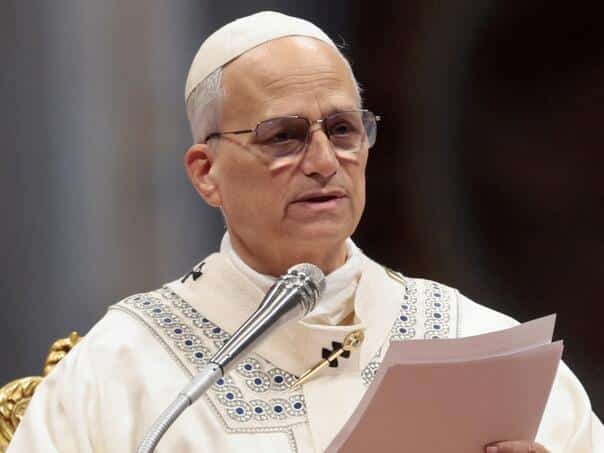
On Monday, the head of the Roman Catholic Church, Leo XIV, will publish a long-awaited manifesto on artificial intelligence (AI), which he wants to address the ethical and social challenges that this technology is rapidly bringing to the world.
The American Pope will personally attend the presentation of the encyclical “Magnifica Humanitas” (Magnificent Humanity) in the Vatican, which represents a precedent for the Catholic Church.
In addition to Vatican officials, experts will also participate in the presentation, including the co-founder of the American startup Anthropic, one of the key players in the rapidly growing AI sector.
Anthropic is currently in a legal dispute with the US military after it refused to change an internal policy that prohibits the use of their Claude model for autonomous lethal warfare or mass surveillance.
Leo XIV condemned the race to develop military artificial intelligence, warning that “leaving life and death decisions to machines” was part of a “destructive spiral”.
Since his election a year ago as America’s first pope, he has repeatedly warned of the dangers of artificial intelligence, including “the gradual replacement of reality by its simulation.”
He also criticized the “ecological devastation” caused by the “frenzied race” for rare metals necessary for modern electronics.
“Wake Up Call”
According to the United Nations, artificial intelligence could be worth as much as $4.8 trillion by 2033, a 25-fold increase in a decade, while profits could remain concentrated in the hands of a small number of companies.
UN Secretary-General Antonio Guterres warned last year that “the window for shaping artificial intelligence – for peace, justice and humanity – is closing.”
Leo XIV made this question one of the foundations of his pontificate, dedicating his first encyclical to it – a document that lays the groundwork for church teaching and long-term discussion.
Experts believe “Magnifica Humanitas” could have an impact similar to Pope Francis’ 2015 encyclical “Laudato Si”, which sparked political and social backlash around the world over the issue of climate change.
The Vatican sees the new document as a continuation of the Church’s social teaching on “the protection of people in the era of artificial intelligence”.
The encyclical was signed on May 15, the 135th anniversary of Pope Leo XIII’s 1891 encyclical, which laid the foundations of the Church’s social teachings during the Industrial Revolution.
– The industrial revolution changed the labor market, people’s lives, power relations and hegemony – said Marijana Grbeša, professor of political science at the University of Zagreb and participant of the AI conference in the Vatican.
– Then it was necessary to train people to use tools. The same is true today: we have to educate and train people – she told AFP.
She added that the pope will emphasize that “education is no longer enough today.”
– This is a wake-up call for the entire civilization – she said, stressing the need to “use these tools sensibly”.
Shaping reality
Pope Leo XIV emphasized the need for “digital literacy so that people understand how algorithms shape our perception of reality.”
In April, he warned against the use of artificial intelligence to fuel “polarisation, conflict, fear and violence”. In January, he expressed concern about the “lack of transparency in the creation of the algorithms” that govern the operation of the various chatbots whose use is rapidly expanding around the world.
The publication of the document “Magnificent Humanity” comes after several years of study of technologies related to artificial intelligence within the Church.
Back in 2020, the Vatican launched the “Roman Appeal for the Ethics of Artificial Intelligence” initiative, calling for new technologies to respect human dignity.
Leo XIV’s predecessor, Pope Francis, spoke frequently on this topic, calling for the regulation of artificial intelligence and warning that it could further deepen social inequalities.
(Vijesti.ba)



Chat readers
Join the discussion