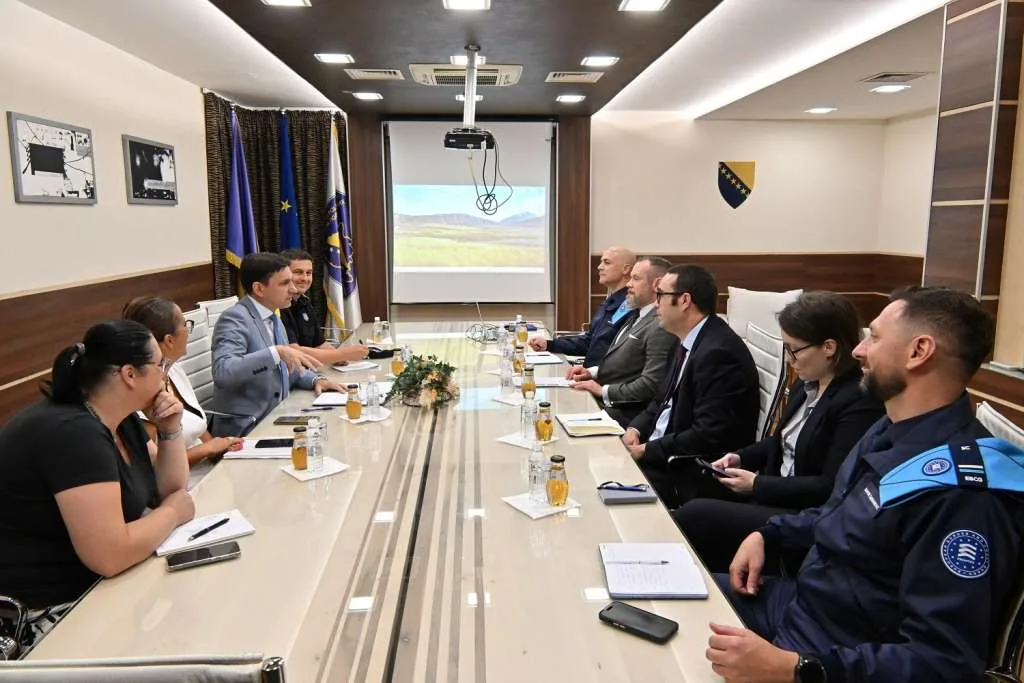

EU Delegation and EU Special Representative in BiH, attended by signing two grant agreements in total value of EUR 5.8 million, through which the EU is financing the energy efficiency in Tuzla Canton in Sarajevo Canton. These EU grants provide an additional 33m euros of favorable loans from the European Bank for Reconstruction and Development (EBRD). Contracts signed the Minister of Finance and Treasury of Bosnia and Herzegovina Srdjan Amidžić and Elena Gordeeva, the director of the EBRD’s Infrastructure Team for Europe, in the presence of Soreca Ambassador.
“By improving energy efficiency in public facilities and ensuring a reliable approach to clean water, we are helping community life. This is another concrete EU commission. The European Union is not only the largest donor in Bosnia and Herzegovina, but also Her most trusted partner. We work together with institutions at all levels in the improvement of everyday life, the opening of the transition to a green, modern and integrated economy. Our vision is clear – stable and prosperous Bosnia and Herzegovina with the future in the European Union, “ He emphasized Ambassador Luigi Sorec.
Improving energy efficiency in Tuzla Canton is carried out under the regional energy efficiency program (REEP), designed to help the countries of the Western Balkans in the decarbonization of their economies through the promotion of investment in renewable energy efficiency. Reconstruction of 173 buildings of administrative, educational and health institutions, including schools and sports halls is planned. The works will include thermal insulation of walls, roofs and ceilings, as well as replacing windows, heating and modern lighting. With the EU Grant worth 2m euros, the EBRD provides a loan in the amount of EUR 8 million. The result of activities is to reduce the costs of energy and maintenance of facilities, which will lead to significant energy savings.
Outdated water supply network in the Sarajevo Canton area is currently in the phase of extensive reconstruction and optimization that will help improve water supply in six municipalities of cantons. In addition to the EU Grant of 3.8m euros, co-financed through the EU IPA 2020 for BiH, the investment is financed by the EBRD loan in the amount of 25m euros. The project has been going on for several years and now enters its final phase, with more than 1,100 kilometers of the Distribution Network. The water supply network, which suffers losses in a percentage of 70%, will improve measures that will drastically reduce losses. The investment includes a comprehensive replacement or rehabilitation of dilapidated pipelines, pumping stations and wells, which will enable about 4,000 new households to join the system.
Minister Amidžić pointed out that the signed contracts represent the continuation of successful cooperation with the European Bank for Reconstruction and Development and the European Union, and an important step towards the realization of priority infrastructure projects. Their realization will enable specific investments that will contribute to the modernization of public infrastructure, increase energy efficiency, improving the quality of public services and improving the living standards and the country’s development priorities and strategic interests.
Gordeeva has emphasized: “Improving the energy efficiency of facilities and water supply is one of our key priorities in Bosnia and Herzegovina. We are grateful to support these investments to help Sarajevo resolve one of its burning problems and enhancement of public buildings in Tuzla Canton.”
In addition to the water supply grant in the Sarajevo Canton, the EU has also provided half a million euros for technical assistance for the supervision, through the Western Balkans investment framework (WBIF).
Energy efficiency projects in Tuzla, as well as water supply projects in Sarajevo, are harmonized with the obligations of Bosnia and Herzegovina according to the Green Agenda for the Western Balkans and contribute to the country’s gradual harmonization with the EU standards, environmental and energy. These investments will bring direct benefits to citizens, reduce operational costs for the authorities and contribute to the objectives of climate change alleviation.