
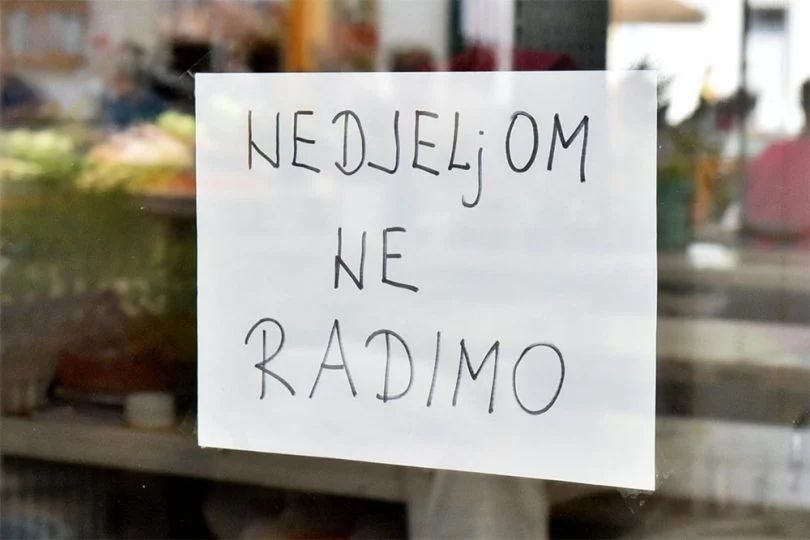
The Government of the Federation of Bosnia and Herzegovina passed a decision rejecting the requests of eight local communities for exemption from the application of Article 18 of the Law on Internal Trade, which prescribes the ban on the operation of sales facilities on Sundays and during holidays.
The requests were rejected for the municipalities of Stari Grad Sarajevo, Drvar, Tešanj, Ustikolina, Velika Kladuša and Sapna, and for the cities of Visoko and Konjic, and the decision was made on the proposal of the Federal Ministry of Trade.
Approval of Exemption
In the explanation of the Government, it is stated that the submitted proposals did not meet the objective criteria prescribed by the decree that regulates the possibility of exemption from the non-working Sunday. According to the current law, traders can independently determine the working hours of sales facilities from Monday to Saturday, for a total duration of up to 90 hours per week, while sales facilities are necessarily closed on Sundays and holidays. Nevertheless, the law leaves the possibility for the Government of the Federation of Bosnia and Herzegovina, upon the proposal of the city or municipal council, to approve an exemption for a certain local community.
Economist and representative in the Parliament of the Federation of Bosnia and Herzegovina, Admir Čavalić, in an interview with “Avaz”, warns that the way in which the law is currently applied opens up a series of legal and economic dilemmas. He considers the fact that some requests of local communities have been waiting for months for a decision to be particularly problematic.
– These are requests that were submitted back in 2024, and they have been waiting for a very long time. All this time they were kept in a drawer, so that decisions would be made only now. Such an approach seriously undermines the legal security and predictability of the business environment – believes Čavalić.
A legal paradox
He also warns of the legal paradox that has arisen in the application of this law. Namely, while the Government claims that no local community has met the criteria for exemption, the municipality of Orašje already has permission to operate shops on Sundays without having to meet any criteria.
– We have a situation in which the criteria for exemption were adopted only after Orašje had already been approved for a different work regime. This raises a serious issue of equality before the law and creates the impression of selective application of the rules – says Čavalic.
He adds that such practice can lead to legal uncertainty and potential disputes.
– It is very possible that employers or local communities who are considered injured will try to challenge this model before the courts, and eventually before the Constitutional Court of the Federation of Bosnia and Herzegovina – he states.
Critics claim that the state administratively determines the working hours of private companies in this way, instead of leaving the decision to the market, that is, to the relationship between employers, workers and consumers.
Provide evidence
The regulation stipulates that local communities must submit data on a possible drop in turnover in the trade sector compared to the same period in 2023, a reduction in the number of employees in that activity, as well as an explanation of the seasonal nature of the request if a temporary exemption is requested. According to the Government’s explanation, such criteria were not met in the requests of municipalities and cities that have now been rejected, it says Avaz.


