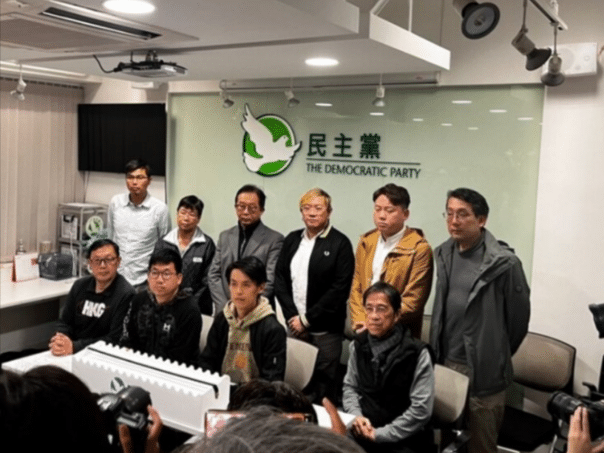
The Democratic Party has been the leading opposition force in Hong Kong since its founding, three years before the global financial metropolis was returned from British to Chinese rule in 1997. Over the years, it achieved significant electoral success, dominated the legislative bodies and openly demanded democratic reforms and the preservation of civil liberties.
The situation changed dramatically after massive pro-democracy protests in 2019, which Beijing assessed as a threat to national security. In response, China introduced a sweeping national security law that severely limited political activity, freedom of expression, and space for opposition.
The president of the Democratic Party, Lo Kin-hei, confirmed to journalists that the members at the extraordinary assembly voted to dissolve the party and enter the liquidation process. Out of a total of 121 votes, 117 were in favor of dissolution, while four members abstained.
“It has been our greatest honor to make this journey over three decades, side by side with the people of Hong Kong. We have always put the welfare of Hong Kong and its people first,” said Lo.
Senior party officials have previously said they have been subjected to direct and indirect pressure from Chinese officials, with messages that the party must disband or face serious consequences, including possible arrests.
The principle of “one country, two systems”, which was supposed to guarantee Hong Kong a high degree of autonomy, has been seriously questioned in recent years. The authorities, citing security laws, detained numerous opposition politicians, shut down civil society organizations and closed down independent media.
An additional blow to the opposition came in 2021, when China changed the electoral system in Hong Kong, allowing candidacy only to people who had previously been assessed as “patriots”. With that, the Democratic Party was practically kicked out of political life.
Earlier this summer, the League of Social Democrats also announced its dissolution, citing “enormous political pressure” as the reason.
Prominent members of the Democratic Party, including Wu Chi-wai, Albert Ho, Helena Wong and Lam Cheuk-ting, are in prison or detention under the 2020 National Security Law.
Western countries, including the United States and Great Britain, have repeatedly criticized these measures, warning that they stifle basic freedoms. China, on the other hand, claims that no freedom is absolute and that the new law has brought stability to Hong Kong
(Vijesti.ba)