
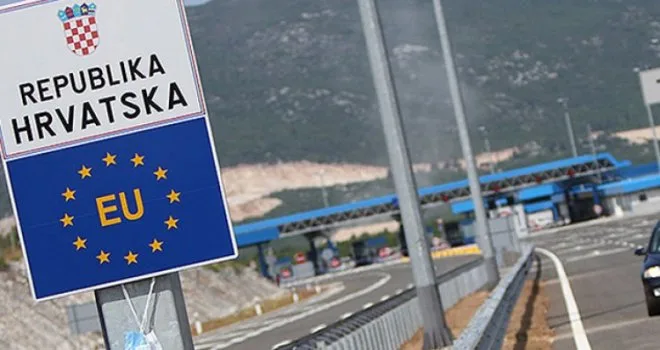
Due to the registration of passengers according to the new Entry/Exit System in the European Union (Entry/Exit System – EES), longer delays at the border crossings between BiH and Croatia have been recorded for months.
The system collects biometric data of all citizens of third countries, including BiH citizens, when entering and exiting the European Union. Although EES increases security, at the same time it slows down border crossing. Many BiH citizens complain that they wait up to five hours to enter Croatia, writes Večernji list BiH.
Security reasons
When third-country nationals enter Croatia for the first time, biometric data is collected – fingerprints of four fingers and a photo of the face – which are stored in the system and used at all subsequent border crossings. Border police officers check the collected data and compare the passenger’s facial image with the data stored in the system. The system does not apply to citizens of EU member states, who still cross the border with a passport or identity card, without providing biometric data. Croatia is the external border of the Schengen area towards Bosnia and Herzegovina, Serbia and Montenegro. This means that EES is not only applied at airports, but also at road border crossings, which during the summer are traditionally burdened by tourist traffic, diaspora arrivals, weekend trips and workers who often cross the border.
According to the competent institutions, EES was introduced to increase the security and efficiency of border control, but its application led to longer waiting times. Nine European countries – Belgium, France, Germany, Greece, Italy, Malta, the Netherlands, Portugal and Switzerland – asked the European Commission to extend the possibility of temporarily suspending the system beyond September 6 in cases where there are large crowds at the borders. Namely, the regulation on the Entry and Exit System (EES), which began to be implemented in April, foresees the possibility of partial suspension of biometric checks, i.e. fingerprinting and photography, in case of excessive crowds.
According to the current rules, this possibility expires on September 6, i.e. after the end of the main tourist season. The system records the time and place of entry and exit, the duration of the permitted stay and any refusal of entry. At the first entry, biometric data is also collected – a photo of the face and four fingerprints. Croatian Minister of the Interior Davor Božinović stated that Croatia has no problems with the implementation of the automated entry and exit system at border crossings because it has prepared well for its implementation and considers it very useful. He pointed out that there are no major difficulties at the Croatian borders thanks to the good preparation and engagement of police officers. “This is a huge step forward. Although in some countries there are certain difficulties at the beginning of implementation, there are none in Croatia,” said Božinović. He added that around 110 million travelers have been registered at the EU level so far, while more than 50,000 people have been denied entry due to security reasons.
In Croatia, there were more than five thousand such cases, which is about 11 percent of the total number at the EU level. “It is a direct contribution to the security of European citizens, because these persons, for various reasons, represented a security risk,” said Božinović.
Crowds towards the sea
With the arrival of summer, longer queues were recorded at the entrance to Croatia from Bosnia and Herzegovina, especially on the routes towards the sea, including the Izačić, Doljane/Metković, Osoje/Gornje Vinjane, Aržano and Nova Sela/Bijača border crossings. Croatia and Bosnia and Herzegovina tried to alleviate some of the pressure by temporarily opening additional border crossings. From June 1, the Dvorine–Subašići and Aržano Pazar–Vinica border crossings are temporarily open 24 hours a day for international passenger traffic. The decision is valid for three months and should relieve the existing crossings, especially Kamensko and Vinjane Gornje.
Božinović also said that Croatia is ready to introduce ETIAS, the European system for prior approval of travel to the Schengen area, similar to the American ESTA system. Travelers who can travel to the European Union without a visa will have to fill out an online form and pay a fee of 20 euros before traveling. Once issued, the authorization will be valid for three years. Although the start of the application of ETIAS was planned for this autumn, it is expected that its introduction will be delayed until the beginning of next year. NOISE.


