
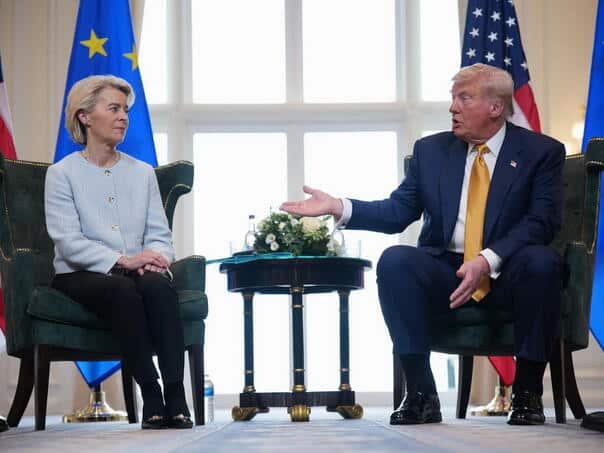
Only a few days before Roka 1. August, the President of the European Commission Ursula Von Derald Trump agreed to prevent a duty of 30 percent to the IMP., AFP, ANSA, BTA, DPA, EFE, Hairdryer, Lusa, sta in the European Newsrooma.
Did Von Der Leyen prevent the burning scenario or is Trump, as he said always critical Hungarian Prime Minister Viktor Orbán, “eaten for breakfast”?
It was agreed, but what exactly?
EU exports will be subject to unique, comprehensive customs duties of 15 percent to most products, which is more than before Trump’s return to the White House, but significantly less than 30 percent. Customs shall enter into force 7. August, or a week later than the original scheduled deadline.
– The EU will abolish significant customs, including the fully abolition of customs industrial goods exported to the European market, thus opening great opportunities for American products and agricultural cultures to compete and win in Europe – a release of the White House on the customs agreement.
The European Commission, however, in the explanation published after the meeting, emphasized that the agreed details were only “key parameters” and the “first step in the process”.
It is stated that the duties of 15 percent apply to almost all exports of the EU, which is currently subject to reciprocal customs, including cars and auto parts, which are currently affected by duties of 25 percent. Customs also relate to possible future customs on pharmaceutical products and semiconductors.
However, customs aircraft (sections), some chemicals, medications and raw materials return to the level before the Trump inauguration in January. The EU also promised a better approach to the EU market for American fishing products and certain agricultural exports. For example, ketchup and biscuits are mentioned.
Some of the key details are still unknown. According to the White House statement, the EU also committed to significant purchases of American energy and military equipment. The European Commission has only confirmed the first point.
It is stated that the EU is planning to buy liquefied natural gas or oil worth 700 billion euros ($ 750 billion) during the next three years and encourage the investments of European companies worth about 550 billion euros ($ 600 billion).
While the White House claims that the duties on steel, aluminum and copper remain at a level of 50 percent, the EU claims the contrary. “The EU and the United States will establish customs export quotas on historical levels, which will reduce the current customs out of 50 percent,” the Commission said.
The Commission also stated that the agreement is not legally binding and that further negotiations will follow.
How bad is it?
The EU leaders did not express great satisfaction with the agreement, but most reluctantly acknowledged that this was probably the best possible outcome at this time.
– One hundred percent I am sure that this Agreement is better than the Trade War with the United States – said EU Commissioner for Moroš Šefčovich.
The President of France Emmanuel Macron said that the European Union was not “sufficiently scary” in trade negotiations, promising that it would be “firm” in the next rounds of the conversation.
– This is not the end of the story. Europe is still not perceived as a force. To be free, you need to be scary. We were not intimidating enough – said Macron Ministers during the Government’s session, according to the participant, but he admitted that the agreement preserved France and European interests in important export sectors.
German Chancellor Friedrich Merz warned that a compromise would hardly guess the German economy based on exports.
– German economy will suffer significant damage because of these customs – said Merz on Monday. Although he was not satisfied, he said it was “the best thing that could be achieved in the given circumstances” and stood in the defense of the Commission.
Italian Prime Minister Giorgia Meloni welcomed the agreement.
– I always considered, and I still think that trade escalation between Europe and the United States would have unpredictable and potentially devastating consequences – she said, but she pointed out that the details needed to study. The Deputy Prime Minister and Foreign Minister Antonio Tajani promised to help companies affected by customs.
Prime Minister Portugal Luís Montenegro said the agreement “brings predictability and stability, which is crucial for Portuguese companies and the economy.”
Slovenia is restrained in an official reaction. The Ministry of the Economy also analyzes the content of the agreement, but also highlights the importance of predictability and stability, especially for key sectors such as the automotive and pharmaceutical industry.
Winners, losers and those between
Analysts agree that the United States has generally come out as a winner, for example, because the car exporters will not pay customs duties in exporting to the EU. But American consumers could face higher prices of imported goods because companies will transfer the cost to them. Merz warned that neither will turn out all the time.
– We will see the consequences of this trade policy and in America. In addition to inflation, a general transatlant trade disorder will come. These customs, I am convinced, are neither in the interests of the United States. Time will show it – Merz added.
Germany is far the largest exporter of goods in the United States, and the most exports cars, steel and tool machines. Total exports amounted to 161.2 billion euros in 2024. years. Ireland and Italy with exports worth 72 billion, respectively, and 64 billion euros, according to Eurostat data.
France is less exposed, although it has important sectors such as aviation, food industry, wine and luxurious goods that could lose their market share. According to Eurostat, the EU exports 20 percent of its goods in the United States as a whole.
The effect of the US Customs largely depends on the exposure to the US market:
At one end of the spectrum, Portugal, whose exports is mainly focused within the EU, especially in Spain. Exports in the United States consists of only 5 percent of total exports. Despite this, the Portuguese government promised full cooperation to mitigate the negative consequences of the Agreement and supported national companies, especially in the textile, footwear, wine and metal processing industry.
On the other hand is Germany, especially its car industry. The Association of the German Industry (BDI) warns that the customs of 15 percent would have a huge negative impact on an export-oriented economy. According to the German Covenant of the Automotive Industry (VDA), annual costs for German automotive companies could reach billions of euros.
Ireland has a separate position: has the largest trade surplus between EU countries and more than a quarter of the goods exported to the United States. This is mainly attributed to the presence of large American pharmaceutical companies. Ireland also has European seats of American technology giants like Apple, Google and targets, which attracts the Irish tax system.
All in all, the most imposed sectors are the food and wine industry (eg Spain), the French Aviation and Luxury Goods, and the Italian Automobile Sector. The manufacturer of stellantis, which combines Fiat and Peugeot, has stopped financial forecasts in April due to uncertainty.
While the EU is still complying with the terms of the customs agreement, Bulgarian exporters already feel the consequences and correspond to the diversification strategy. The example is caviar. Bulgaria is now one of the leading European black caviar manufacturers.
According to Emil Arabadjiev, the President of the Association of Black Caviar Deals in Bulgaria, the Earth annually exports more than 15 tons. He believes that higher prices will not reduce the demand in the US due to the lack of products, but points out that the exports to new markets such as Australia, Canada and Spain enters the stability in the industry.
It could have been worse
For the country, the candidate of BiH, duties of 30 percent to all products come into force on 7. August.
The BiH Foreign Trade Chamber estimated that American customs will be the hardest to hit the purpose industry, which makes more than 60 percent of exports to the United States. Although the United States participates with only 1 percent in the overall trade of BiH, indirect effects could be significant, especially for companies whose products are completed in the US market. The largest shock is expected in the metal and the car sector, with possible consequences for employment and inflation.
Within the state authorities, there are initiatives for the fully abolition of customs in American products, mainly as an attempt to approach Trump administration.
What are still agreements in the game?
The United States is the largest trading partner of the EU, but Bruxelles is also negotiating with numerous other agreements. But for their assembly it takes time.
The EU is currently conducting negotiations or updates agreements with India, Indonesia, Malaysia, Philippines, United Arab Emirates, Australia, Singapore and Thailand.
Economic and partnership agreements in the proceedings are adopted or ratifications with the countries of the South American Block Mercosur, Mexico and more than ten African countries. The Interim Agreement with Chile entered into force 1. February. Agreement with Mercosura (Argentina, Brazil, Paraguay and Uruguay) is the most comprehensive of all. Spanish strongly pushes his adoption despite the opposition of the European Agricultural Sector.
– We have no choice. We must absolutely achieve an agreement between both trade blocks – Spanish Prime Minister Pedro Sánchez said during the visit to Uruguay in July.
And there is also China. Although each other’s second largest trade partners in goods, EU relations and China are all tense. Brussels is concerned about a record trading deficit greater than 300 billion euros last year and Chinese limits of rare countries used in electric motors and sensors.
(Vijesti.ba / Fena)