
Czech economic magazine E15.CZ has published the text entitled “Ten European countries in which debt drops at a record rate. The winner of the table is an unexpected outsider”, in which the European countries fight the growing debt.
“While most countries continue to burden their public finances, some managed to significantly reduce their national debt, according to the World Bank,” the text is stated.
In the tenth place, Denmark stated for which one of the two Nordic countries that have been able to reduce the amount of debt, and the key factors of a successful debt reduction were the long-term responsibility of public expenditures and strong economic results that quickly recovered after the pandemic.
In the ninth place is Serbia. The country reduced its debt in the observed period for almost nine percent. This helped a strong economic growth supported by domestic demand and export, as well as public finance reform, while the government also attempted to limit budget deficits.
However, the country faces challenges such as geopolitical tensions in the region, structural weaknesses in the labor market and the needs for investments in infrastructure and the environment.
The eighth is the Netherlands where they state that the decrease in debt ratio confirms the long-term prudent fiscal policies. In accordance with other mentioned countries, the decline is enabled by the revived economy after pandemic, but also stable budget deficits, which are the Dutch governments under control during the observed period.
In the seventh place, Iceland who managed to keep public finance stability and gradually reduce their debt, mainly thanks to consistent fiscal policy and later economic recovery. Fisheries and exports of aluminum, for example, also played an important role, bringing a country of stable income from international trade.
Greece, which a few years ago, with its debt crisis, endanger the stability of the entire eurozone, in the observed period reduced debt by almost 17 percent. On the other hand, the country is still with the highest debt and GDP ratio in Europe. Last year, he reached 154 percent. The decline in recent years is the result of the financial assistance program, after which Greece continued to implement reforms to improve their fiscal discipline.
In the fifth place is Portugal that reduced its debt ratio by almost 19 percent, which reached its total debt last year 94.9 percent of GDP.
The result reflects the continuation of the consolidation trend that the country began after the debt crisis of the eurozone. Significant improvement is encouraged by strong GDP growth after pandemic, mainly recovery of tourism, export and stable domestic demand.
There is Albania in the fourth place. Albania has been a tourist hit in recent years. Thanks to this improvement of public finances, stable growth in revenues from tourism was encouraged, for example, tax reforms.
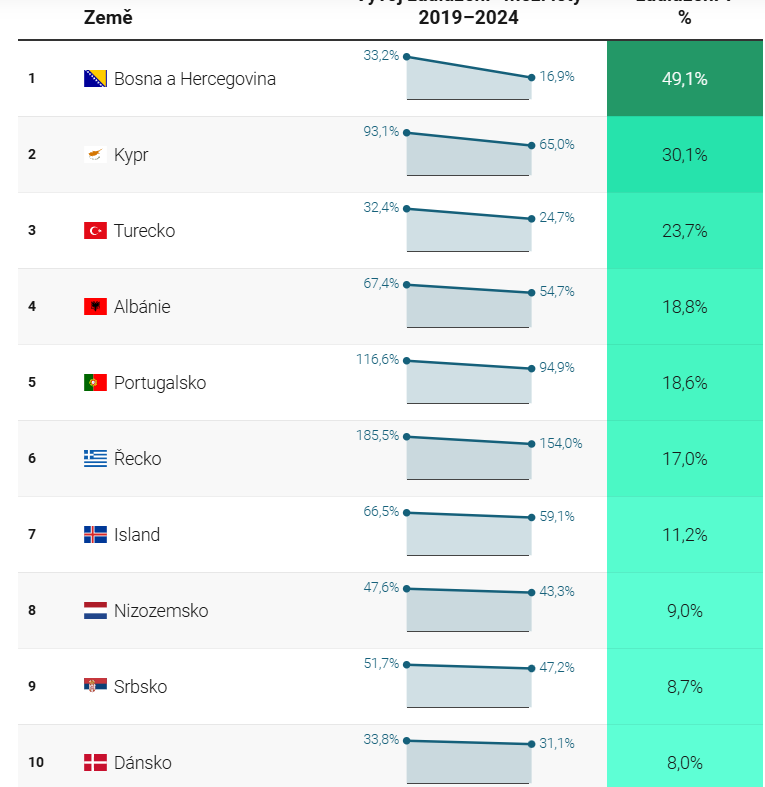
Turkey has taken third place. Turkey reduced its debt ratio for more than 23 percent points to 24.7 percent of GDP. However, this decline is the result of economic imbalances, not reducing consumption or budget surplus. The imbalances caused a sharp increase in nominal GDP due to high inflation and currency weakening.
Unlike other countries, the impact of these events on the Turkish economy is mixed. On the one hand, the decline in relative debt improves statistical indicators and can strengthen the trust of some investors in the short term. On the other hand, high inflation rates, low confidence in monetary policy and the pressure on foreign exchange reserves still exist. In addition, debt servicing costs remain high due to high interest rates.
Second place took Cyprus. In the last five years, Cyprus reduced its debt for almost a third, thus reaching the total debt of 65 percent of GDP. economic growth and strict fiscal policy.
After the financial crisis, which was mostly hit by the local banking sector more than a decade, Cyprus passed through significant consolidation. As in other countries, tourism recovery after the pandemic played an important role.
Finally, the first place was taken by Bosnia and Herzegovina, which they state not only has the lowest debt and GDP ratio in Europe, but also managed to reduce it in the last five years.
“With a debt ratio of 49 percent, it is up to this table. This exceptional result is mostly due to 16.9 percent of GDP, but in the case of Bosnia and Herzegovina, the result should be observed with caution. The country continues to face high unemployment, poor public efficiency sector and a slow pace of reforms. The low level of public debt therefore reflects the limited fiscal capacity of the Government, not an active consolidation strategy “, writes E15.CZ.


