
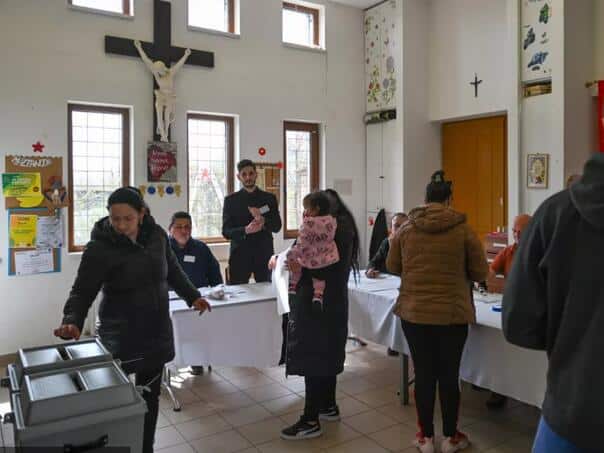
According to the data of the National Election Office, nearly half a million Hungarian citizens can vote by mail from other countries, mostly from Romania and Serbia.
By 11 a.m., the turnout was 37.98 percent, the Hungarian Election Commission announced.
This is significantly more than in the previous parliamentary elections – in 2022, the turnout was 25.77, and in 2018, it was 29.93 percent by 11 a.m.
Hungarian Prime Minister Viktor Orban voted at a polling station in Budapest. After voting, he said he “came to win.”
“Tisa” party leader Peter Magyar voted in the 12th district of Budapest.
“Hungarians are choosing, fateful elections are underway. We are deciding between East and West, propaganda and honest public speech, corruption and clean public life, further decline and collapse of public services or the return of European funds and the start of the Hungarian economy. We are choosing between an existential crisis and a decent life,” said Peter the Hungarian after the vote.
Polling stations in Hungary open at 6 a.m. and close at 7 p.m.
According to public opinion polls, the main rivals are the Fidesz party of current Hungarian Prime Minister Viktor Orbán and the pro-European Tisa party, led by Peter the Hungarian.
In the elections, which are held in 106 constituencies, 199 members of the National Assembly of Hungary will be elected.
The National Electoral Office is expected to announce the preliminary results on election night, and the deadline for announcing the election results is April 18, while the final results should be announced by May 4.
For parties, the threshold for entering parliament is winning 5 percent of the vote.
The prime minister is elected by the parliament, with a simple majority of votes. The president of the state submits a proposal for the prime minister, who is usually the candidate of the party that won the election, and the parliament then votes on the nomination.
If the parliament does not elect the proposed person, the president submits a new proposal within 15 days, and if the parliament does not elect a new prime minister again, the president can dissolve the parliament and call new elections.
These parliamentary elections will be the tenth since the restoration of free elections in Hungary in 1990.
(Vijesti.ba)


