
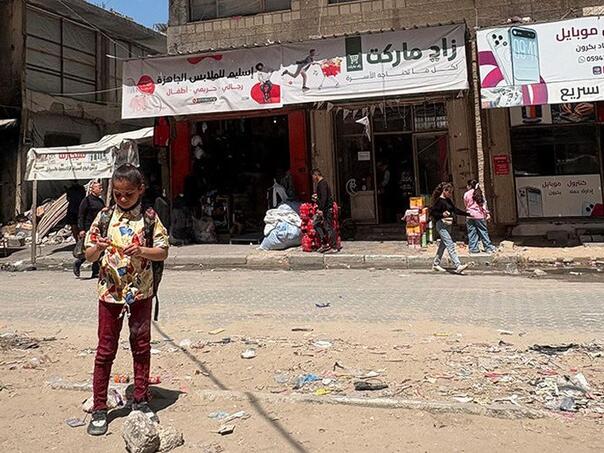
The sky is constantly torn by the buzzing of drones, explosions and gunshots occasionally echo, and residents live in uncertainty that does not end even when the guns are temporarily silenced. Many parts of the Gaza Strip were reduced to rubble, and life as they knew it disappeared along with thousands of homes, schools, shops and workplaces, Index writes.
For a large number of people, days pass by waiting for water, food and medicine. Children are growing up without regular schooling, families are sleeping in tents or makeshift shelters, and many residents have lost their jobs after factories and businesses were destroyed.
In conditions of scarcity, poverty and exhaustion, tensions between people grow, so conflicts break out more and more often within communities that have been fighting for bare survival for years.
Life among the ruins
Gaza City, the former center of the Gaza Strip, is now almost completely turned into ruins. The streets have disappeared under the destruction, and what was once an urban and administrative center is now a space where traces of everyday life are hard to recognize.
What life looks like in that area from day to day, is described to us by an interlocutor who has been in Gaza for the past months, and whose information is known to the editorial office.
“Life in Gaza City seems like a constant struggle between crisis, resourcefulness and trying to maintain at least a little bit of normality in extremely difficult conditions. Most people live among the ruins or in tents, because many buildings have been destroyed or are no longer safe to live in. Every day boils down to the same thing – looking for drinking water, food, fuel for generators and any place to sleep,” the interviewee tells us.
There is either no electricity or it comes at a trickle, so people often live in complete darkness. However, the city did not stop completely.
“They have opened small improvised shops, bakeries, markets, hairdressing salons. Children occasionally gather in temporary classrooms or learning centers, although a large number of them still do not go to school regularly. All this together creates an everyday life in which attempts to live a normal life constantly collide with insecurity.”
Food shortages and high prices
The shortage of water and food is one of the most serious problems in Gaza, and the situation is further aggravated by the high prices of basic foodstuffs such as meat, fruit and vegetables. The supply is highly dependent on what the Israeli authorities allow into the Gaza Strip at any given time, so food availability changes from day to day.
“Recently, eggs and bananas have been particularly difficult to come by. Although eggs can occasionally be obtained, they are generally not displayed on store shelves. Customers have to contact a certain seller, and only if he judges that he can sell them, the eggs are separated and wait at the cash register, often in a black bag. The quantity is determined by the seller, depending on what he has at his disposal at the time. Because of this way of selling, buying eggs in stores is done discreetly.
On the market, you can mostly see products with declarations in the Hebrew language, while domestic Palestinian products are becoming less and less.
Some restaurants are still open, where you pay around 100 ILS (approximately 30 euros) for a portion of rice and chicken, while other dishes are around 15 euros, and desserts around 3 euros. A haircut in an improvised salon costs 100 ILS, although the price is much lower for local residents,” the interviewee said.
The local population faces a big problem of finding work and earning, which is why many try to get involved in humanitarian organizations. Such jobs are often the only possibility of income, but they are also limited and insufficient for basic life needs.
There are also restrictions on people who have been granted entry into Gaza, such as medical staff or aid workers. Especially when it comes to money and technology.
“The controls at the borders are very strict. It is limited to bring in a large number of personal devices such as mobile phones, watches and chargers. Also, one person is allowed to bring in a maximum of 1000 ILS, which is about 300 euros in cash, and if a larger amount is found, the money is confiscated. It is a serious challenge when you stay in such conditions for a long time,” says the interviewee.
Life under the constant sounds of war
The sounds of drones, explosions and rumblings have been echoing in the Gaza Strip for more than two years. According to the interlocutor, people have adapted to a certain extent to life in conditions that last too long and without a clear end.
“Although a formal cease-fire is in effect, the war in Gaza has in reality never completely stopped. Shots are often heard in the morning, sometimes from a distance, and sometimes from close range, in situations where there is a conflict between the population. The sounds of drones and detonations are most often heard in the evening hours, but they are not rare even during the day.”
Humanitarian aid has become the main survival system. Food, water, medicine and hygiene items often come through distribution points, and everyday life revolves around queues and waiting.
“In the lines, you can often see children who have taken on the roles of adults, waiting for water or doing necessary tasks for the family.
Many families were forced to move multiple times from north to south or between camps and shelters. Despite everything, scenes of everyday life also appear: children playing, people fishing and wedding celebrations in the street.”
Despite occasional traces of normality, everyday life in Gaza remains defined by shortages, displacement and insecurity. In such conditions, life does not return to normal, it only adapts to the limits of survival, even if there are clear indications when that limit could be moved.
(Vijesti.ba)

Chat readers
Join the discussion