
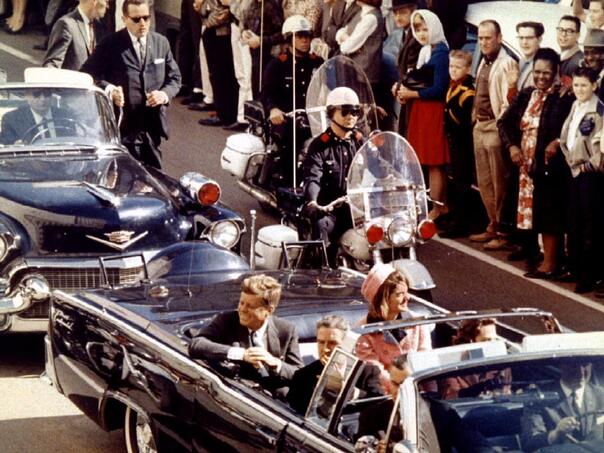
Millions of documents related to the assassination of US President John Kennedy in Dallas in 1963 have already been released, and President Donald Trump has ordered the release of thousands more classified files.
Many who have studied what has been released so far say the public should not expect earth-shattering revelations, but there is great interest in the details of the assassination and the events surrounding it. In addition, the possibility of accessing significant new information is attractive to researchers.
On Thursday, Trump ordered the Director of National Intelligence and the Attorney General to prepare a plan to release documents related to the Kennedy assassination within 15 days. However, it is not clear when those documents could be released.
The goal of the order is to declassify remaining federal records related to the 1968 assassinations of Senator Robert F. Kennedy and civil rights leader Martin Luther King. For the publication of these documents, the plan must be drawn up within 45 days.
Robert F. Kennedy, Trump’s nominee for health secretary, said he was not convinced a lone gunman was solely responsible for the assassination of his uncle.
When Air Force One landed in Dallas with the president and first lady that year, they were greeted by clear skies and an enthusiastic crowd. With next year’s election campaign on the horizon, they came to Texas to drum up political support. But as the procession finished its parade route downtown, gunshots rang out from the Texas School Book Depository building. Police soon arrested 24-year-old Lee Harvey Oswald, who was on the sixth floor, a spot a sniper would want. Two days later, nightclub owner Jack Rubi shot and killed Oswald in front of the police during his transfer to prison.
A year after the assassination, a commission established by President Lyndon B. Johnson to investigate concluded that Oswald acted alone and that there was no evidence of a conspiracy. But that hasn’t quelled the web of all kinds of theories in the six decades since.
In the early 1990s, the federal government ordered that all documents related to the assassination be placed in a single collection at the National Archives and Records Administration. The collection of over five million documents was supposed to be opened in 2017, unless the president decides otherwise.
Trump, who took office for his first term in 2017, said he would allow the release of all remaining documents, but ultimately withheld some because he judged that release could potentially be harmful to national security.
Most researchers agree that 3,000 documents have not yet been released, either in whole or in part, many originating from the CIA.
There are still documents in the JFK collection that researchers don’t believe the president will be able to release. About 500 documents, including tax returns, were not subject to the disclosure request in 2017.
Some of the documents that have already been released detail how intelligence services operated at the time, including CIA cables and memos detailing Oswald’s visits to the Soviet and Cuban embassies during a trip to Mexico City weeks before the assassination. The former Marine previously defected to the Soviet Union, from where he returned home to Texas.
One CIA memo describes how Oswald telephoned the Soviet embassy while in Mexico to request a visa to visit the Soviet Union. He also visited the Cuban embassy, apparently interested in a visa that would allow him to visit Cuba and wait there for a Soviet visa on October 3, more than a month before the assassination, but returned to the United States via the Texas border crossing.
Another memo, dated the day after the assassination, says that, according to a wiretapped phone call in Mexico City, Oswald communicated with a KGB officer while at the Soviet embassy.
However important the details may or may not be to the public, researchers say their release adds to the understanding of the Cold War period.
(Vijesti.ba)


