
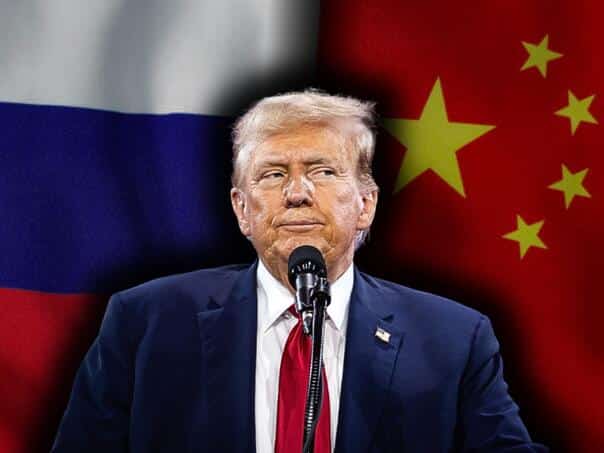
This time he faces a different challenge: a more united group of American adversaries who have come together since Russia’s invasion of Ukraine in February 2022.
Trump, who took office on Monday, has vowed to end Russia’s war in Ukraine, curb Iran’s nuclear program and stand up to China, while strengthening the US military.
But in the past few years, Chinese President Xi Jinping and Russian President Vladimir Putin have entered into an “unlimited partnership” and Beijing is providing Russia with the economic support it needs to wage war in Ukraine. Putin and Xi proposed further strengthening their strategic partnership yesterday, in a lengthy telephone conversation after Trump’s swearing-in.
Russia also signed strategic agreements with North Korea in June 2024 and Iran on Friday. The coming together of four American adversaries, which Biden’s ambassador to China recently called an “unholy alliance,” has led to a loss of leverage for the U.S. and its partners, analysts said.
“The dilemma for Trump, who expresses his desire to ‘get along with Russia’ and pressure China on trade, is that Moscow’s partnership with Beijing limits both Russia’s willingness to cooperate with Washington and China’s vulnerability to American pressure,” he said. Daniel Russell of the Asia Society Policy Institute in Washington, D.C., who led East Asia policy for former President Barack Obama.
Russia is resisting strong Western sanctions largely thanks to China’s massive purchases of Russian oil and sales of dual-use civilian and military goods, which the Biden administration says are being used to bolster Russia’s defense industrial base, which China denies.
North Korea is sending Russia soldiers and weapons for the war in Ukraine and is rapidly developing its nuclear missile program. And experts fear that Iran, although weakened by Israeli attacks on its regional arms such as Hezbollah and Hamas, could renew its efforts to develop nuclear weapons.
Members of the new US administration acknowledge that the challenge exists.
“China buys oil from Iran at a much lower price, Iran uses that to send missiles and drones to Russia, and then they target Ukrainian critical infrastructure,” Mike Waltz, Trump’s nominee for national security adviser, said in an interview with Fox News in November. .
In a Senate hearing last week, Secretary of State nominee Marco Rubio singled out China as the biggest threat to the US and accused Moscow, Tehran and Pyongyang of sowing “chaos and instability.” Zack Cooper, senior fellow for Asia at the American Enterprise Institute, said he thinks Trump’s team will “try to separate those countries from China.”
“They seem to want to separate Russia, North China and Iran from China, which means they see them as distinct, rather than interconnected, threats. So it seems most likely to me that they will push for a deal with Pyongyang and another deal with Moscow,” Cooper said. .
“Partnering is not going to be easy. North Korea may, in my view, have less incentive to engage directly with the US,” said Michael Froman, who was the US trade representative in the Obama administration and is now chairman of the Council on foreign relations, think tank.
And while Trump in his first term thought he could make a deal with Pyongyang, Froman said it’s not clear whether North Korea is interested in cooperating with the US now that it has more support from Russia and China. In his first term, Trump held historic summits with North Korean leader Kim Jong Un and boasts of their relationship.
Trump’s team is reconsidering the possibility of resuming direct talks with Kim. But it seems that there are cracks in the relations between these countries.
Former deputy US ambassador to the UN under Biden, Robert Wood, questioned whether Tehran could rely on Moscow’s help, citing as an example the lack of Russian support for former Syrian President Bashar al-Assad before his fall from power.
“If I were Iran and I saw Russia abandoning Assad, I would be very worried,” Wood said. When it comes to Iran, it seems likely that Trump will continue the policies he pursued in his first term, seeking to crush Iran’s economy in order to force the authorities to agree on its nuclear and ballistic programs and regional activities.
Wood is convinced that it will go more smoothly if the new administration focuses on strengthening American alliances, an American asset that Trump downplayed during his first term.
“Try to divide them wherever you can,” he said, referring to China, Russia, Iran and North Korea.
“It’s critical to have and be able to rely on the alliances that we have because the United States cannot face all of these players alone,” he concluded.
(Vijesti.ba / HINA)


