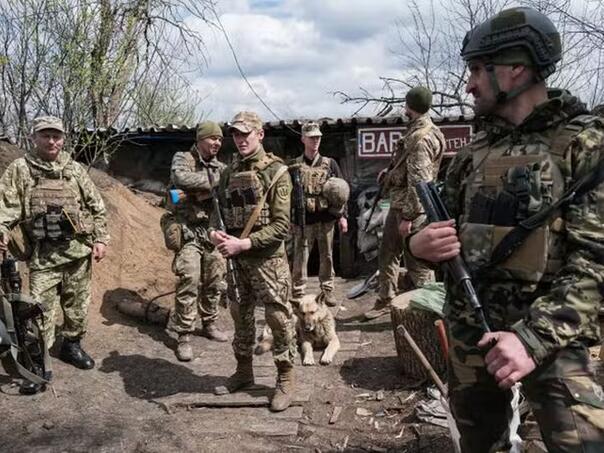
Anatolij (59) asks a simple question: “If someone took a piece of territory from him, what would he say? The same applies to us.” His words reflect the deep skepticism with which the front lines are welcoming Trump’s peace plan, which envisages Ukraine handing over the regions of Donetsk and Luhansk to Russia, Sky News reports.
The desire for peace, but not at any price
Anatoly, like many Ukrainians, voluntarily joined the territorial defense when Russia launched an invasion nearly four years ago. He has been fighting ever since, but next year, when he turns 60, he will have the option to leave the service. Due to the weight of the bulletproof vest he can no longer wear, he now operates away from the front lines, in a small workshop on the outskirts of Kramatorsk, where he helps repair and upgrade drones – a key weapon on the battlefield.
“I want this war to finally end,” he said. “I want to go home, to my family, to my country.” But, he emphasizes, not at all costs. He and other soldiers from the 107th Brigade view Trump’s efforts with disbelief. The proposal to cede Donbas to Russia also includes large parts of the territory that are still under the control of Ukraine and for the defense of which thousands of soldiers have given their lives.
“I feel negative about it,” says Anatolij. “So many people have already fallen for this country… How can we hand over our country? It would be like someone coming to my house and saying, ‘Give me a piece of your home.’” Nevertheless, he is aware of the difficult reality and adds: “I understand, we have nothing to return it. Maybe with some political means… I don’t want more people to suffer, more people to die. I want the politicians to somehow come to an agreement.”
Meanwhile, Ukrainian and US negotiators will meet in Miami to discuss peace efforts, following a meeting of US and Russian teams in Moscow earlier this week.
If we stop, our children will fight
Not far from Anatoly’s workshop, in a hidden bomb factory, soldiers from the same unit are focused on a different kind of war effort. Surrounded by 3D printed gadgets, metal ball bearings and plastic explosives, they make improvised bombs, including anti-personnel mines. The production line is run by Vadim, 41, who has been fighting since Vladimir Putin first invaded eastern Ukraine in 2014.
When asked if he feels tired, he answers: “We are always tired, we don’t have any special motivation, but there is an understanding that the enemy will keep coming until we stop him. If we stop fighting, our children and grandchildren will fight. That keeps us going.”
Vadim also opposes the surrender of Ukrainian land. “If we hand over the borders now, we hand over Donbas, what then?” he asks. “Any country can come to any other country and say: This is our country. Let’s make an agreement, trade and live like before. That’s not normal in my opinion.”
The city of Kramatorsk testifies to the Ukrainian will to fight. It remains firmly in Ukrainian hands, even as the Russian war looms ever closer. Nets stretched along the main road protect vehicles from drones, while fields around the city are fortified with barbed wire, earthen embankments and concrete blocks. Many civilians remained here, as well as in nearby Slavyansk, despite the fall of cities such as Mariupol, Bakhmut and Avdijivka.
However, the toll of living in a war zone is obvious. On Sunday, traders were cleaning up the rubble after a Russian missile hit the central market. Some, like Ella, 60, decided to reopen their stalls despite the destruction. “It’s scary. We have to make a living. I have a mother, I have to take care of her, help my children. That’s why we do what we have to do,” she said.
Her grown children live in Kiev and beg her to leave, but Kramatorsk is her home. “We’ve been living like this for four years. We’re so used to it. A drone flies overhead and we keep working,” she says. When asked how she felt about what the war had done to her city, her voice shook as she wiped away tears. “We keep everything inside, but it still hurts. It’s scary and painful. I just want things to be the way they were before. We don’t want anything to change here.”
Asked what she would do if a peace deal forced Ukraine to hand over the area, Ella said: “That’s a tough question… I wouldn’t stay. I’d leave.”
(Vijesti.ba)