Ahead of the summit, the resource-rich eastern part of DR Congo saw an escalation of conflict between government forces and rebels believed to be backed by Rwanda.
DR Congo’s army accused its opponents of trying to “sabotage” the peace process, while rebels from the M23 group claimed that the army had launched an offensive in violation of the ceasefire.
At the beginning of the year, the M23 rebel group seized large parts of eastern DR Congo in an offensive that left thousands dead and many forced to flee their homes.
DR Congo presidents Felix Tshisekedi and Rwanda’s Paul Kagame have often traded insults in recent years, accusing each other of starting the conflict.
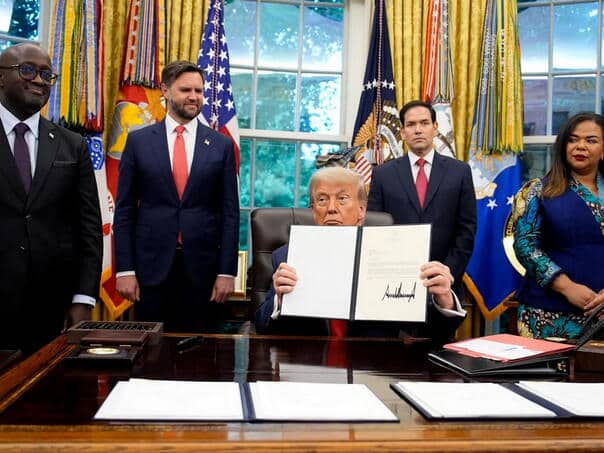
In June, Trump ensured that the foreign ministers of the two countries signed the peace agreement, calling it a “glorious victory”.
Tshisekedi and Kagame will now officially confirm it, and several other African and Arab leaders are expected to attend, including the leaders of Burundi and Qatar.
The M23 rebels will not be present, as they are leading a parallel peace process with the DR Congo government through the mediation of Qatar.
Donald Trump’s administration has led talks between the DR Congo and Rwanda, with the hope that resolving differences between the neighbors will pave the way for increased US investment in the resource-rich region.
Rwanda denies supporting M23, despite claims by UN experts that its military “de facto controls M23 operations”.
M23 captured key towns in eastern DR Congo earlier this year, including Goma and Bukavu.
The spokesman of the Congolese army, General Sylvain Ekenge, said that on Tuesday the rebels launched a new offensive on villages in the province of South Kivu, about 75 km from the town of Uvira, which lies on the border with Burundi and from where the administration of Bukavu was taken over from the rebels.
M23, for its part, claims that the Congolese army launched an air and ground attack in coordination with Burundian forces. Burundi has not commented on the allegations, although there are several thousand troops in eastern DR Congo who support the government.
Although the signing ceremony and the presence of the leaders in Washington are attracting attention, some analysts doubt that the agreement will bring lasting peace.
A DR Congo researcher at South Africa’s Institute for Security Studies think-tank, Bram Verelst, told the BBC that “there is currently no ceasefire and the M23 rebel group continues to expand and consolidate its control”.
– The signing ceremony will probably not change this situation, although there is little hope that it could increase the responsibility of the Congolese and Rwandan leaders to fulfill their obligations – he said.
Rwanda claims it has taken “defensive measures” in eastern DR Congo due to the threat posed by the FDLR militia, which includes fighters responsible for the 1994 Rwandan genocide.
Kagame insists on disarming the group, while DR Congo demands the withdrawal of Rwandan troops as a condition for peace. The agreement that will be signed foresees that both of these requirements are fulfilled.
However, several peace agreements in the 1990s failed after Rwanda accused the previous Congolese government of defaulting on its commitments to the FDLR, which remains one of the main obstacles in current efforts to end the conflict.
The DR Congo government is also demanding that M23 hand over territories it has seized, which the rebels have so far refused to do in Qatar-brokered talks.
Qatar and the US are coordinating their mediation efforts. Qatar has close ties to Rwanda, while the US is considered closer to DR Congo.
In 2023, the US State Department estimated that the DR Congo has mineral reserves worth about $25 trillion, including cobalt, copper, lithium, manganese and tantalum – key components for the production of electronic devices, electric vehicles, mobile phones, wind turbines and military equipment.
“For the United States, we’re getting a lot of mineral rights from the Congo as part of the deal,” Trump said before signing the deal in June.
Prof. Jason Stearns, a Canadian political analyst specializing in the region, told the BBC that the US is pushing for an economic agreement that would allow DR Congo and Rwanda to cooperate in hydroelectric power, mining and infrastructure development.
– The logic is that it will bring peacetime gains – he said.
However, DR Congo has made it clear that while it will sign the agreement, it will not “progress on the matter until the Rwandan troops withdraw from eastern DR Congo”, Prof added. Stearns.
(Vijesti.ba / FENA)