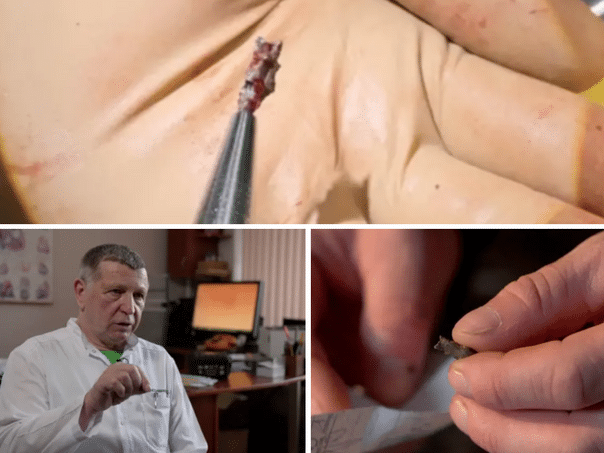
From the pocket Sergej Melnik, removing a small rusty debris, neatly wrapped in paper.
He raises her to see better.
“He brushed my kidney, pierced the lung and heart,” says Ukrainian recruiting quietly.
Traces of dried blood are still seen on the shrapnel from the Russian drone that stuck in his heart as he fought in eastern Ukraine.
“I didn’t even realize what happened – I thought I had run out of breath under my armor,” he says.
“They had to take my heartbreak out of my heart.”
With the increase in the warrant of drones in Ukraine, these wounds become more often.
Drons often carry weapons and materials that fall apart and cause complex wounds of shrapnel.
According to the Ukrainian military paramedics, shrapnel wounds now consist of about 80 percent of all wounds on the battlefield.
Untreated, Sergeeva injury would become deadly.
“The fragment was as sharp as a blade. The doctors said that it was a big piece and that I was lucky I survived,” he says thoughtfully.
But he didn’t just save him luck, there was a new medical technology.
Magnetic extractor.
‘I make a short cut and insert a magnet’
Cardiovascular surgeon Sergei Maksimenko shows a shot of a metal fragment of the stuck in Serge’s heart that knocks before he gently removed a thin device with a magnet at the top.
“You don’t have to make long cuts in your heart,” explains Dr. Maksimenko.
“I only make a small incision, I insert a magnet and he pulls out the shrapnel.”
In just a year, the Doctor Maksimenka team performed 70 successful hearts operations with the help of this device, which changed the face of Front Medicine in Ukraine.
The development of these pullers followed the paramedics from the first line of the front pointed to the urgent need for safe, fast, minimally invasive way to remove the shrapnel.
Oleg bulls – who used to work as a lawyer – was the driving force behind this developments.
Since 2014. He helps in the army as a volunteer.
He met with paramedics on the front and the magnetic puller was made on the basis of his conversations.
This concept is not new.
Magnets are used to extract metal from the wound since the 19950 criminal war.
But Oleg’s team has modernized that approach, creating flexible models for abdominal surgery, micro-extractors for delicate work, and strong bone tools.
Operations thus became more precise and less invasive.
The magnet can be driven over the surface of the wound to pull the fragments out.
Surgeons then make a small incision and then a piece is extracted.
Holding a thin tool in the form of a pen, Oleg demonstrates his strength by raising his magnetic top.
His work commented on other warpitals, including David Not, a veteran of war zones from all over the world.
“There are usually things in the war, things that would never let anyone in mind in civilian life,” he says.
The fragmentation wounds increased due to the changed person of war and because it takes a long time to find them, he believes that this device can bring a big change.
He says that the search for shrapnel in patients as “Seine’s needle searching” – is not always successful and delayed the treatment of other victims.
Search for fragments manually ment to be dangerous and requires larger cuts that can cause more bleeding – “and that is why the possibility itself is to be found with the help of magnet ingenious”.
What started as a Polish tool is now used across Ukraine – 3,000 copies are divided by hospitals and frontpanies, such as Andrej Alban who says he started depending on this device.
He often works under armed fire, in trenches or planes outdoors, and sometimes remains without local anesthetic.
“My job is to save lives – to rewrite the wounds and evacuate soldiers,” he says.
The magnetic extractor did not receive official certification.
The Ukrainian Ministry of Health says that medical devices must be fully in line with state technical regulations.
However, in exceptional cases, such as a state of war or state of emergency, the use of officially unauthorized devices is allowed to smell the needs of the army and security forces.
At the peak of the war, there is no time for paperwork, explains the brain behind the entire of this story Oleg.
“These devices save lives. If someone thinks my works are crime, I’ll take responsibility for them. I’m even ready to go to jail if it happens.”
“But then they need to be closed and all doctors who use these devices,” he says in the semi-joke.
David Not agrees that certification is not the main priority for now and believes that the device will prove useful in other war zones such as Gaza.
“In the war, it’s not really necessary. You’re just doing things that are important for life saving.”
In Lvovo, Sergeeva’s wife Julia is just grateful that her husband survived.
“I just want to praise those people who invented this puller,” she says in tears.
“Thanks to them, my husband is alive today.”
(Vijesti.ba / bbc)