
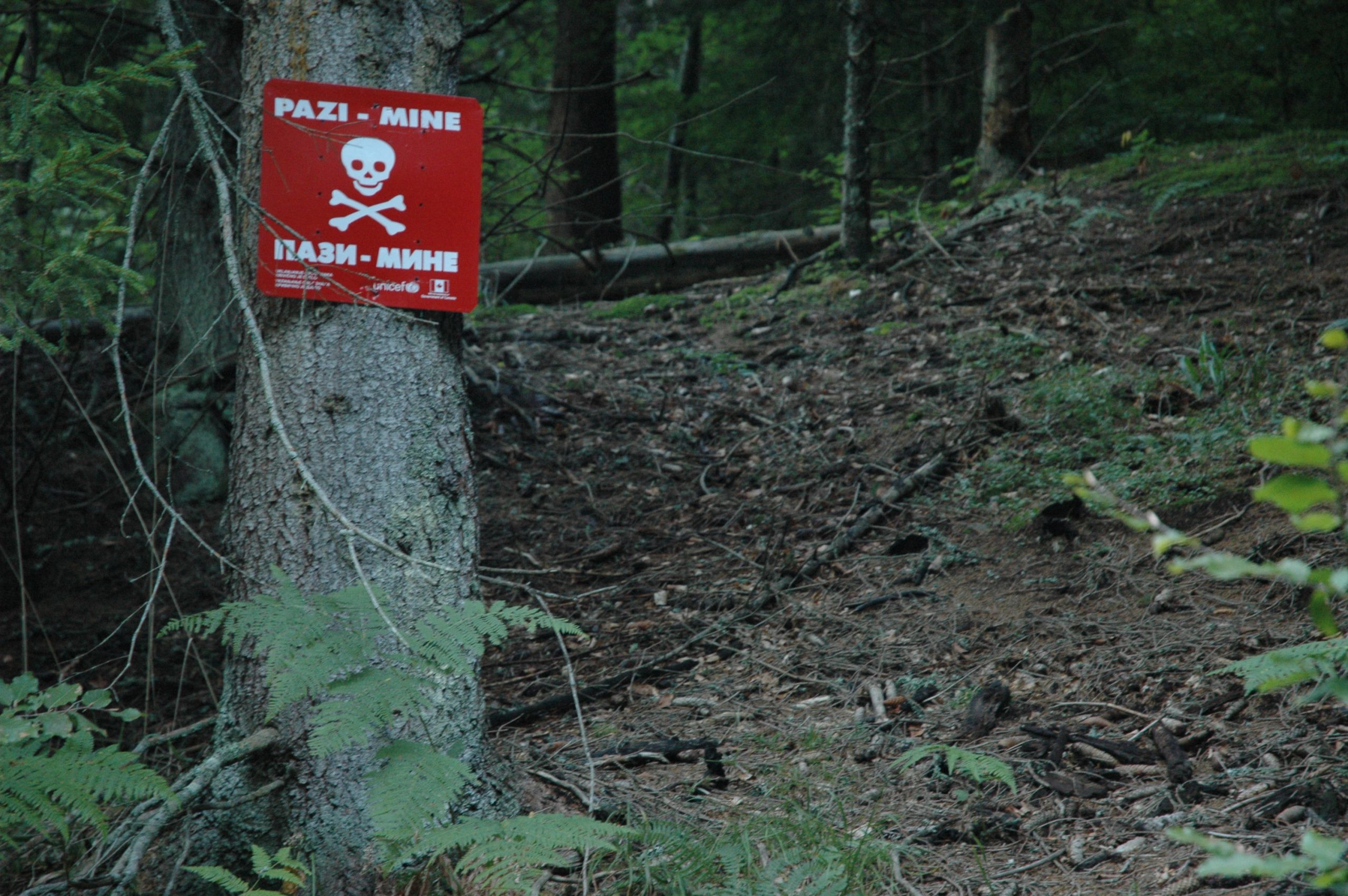
The first Mine Action Strategy from 2002 predicted that BiH would be cleared of mines by 2009, which was not realized, and today, 16 years later, according to estimates, 110 municipalities with 845,163 inhabitants living in these communities are threatened by mines.
Demining is slow, expensive and very dangerous
This stems from the explanation of the new Law on Mine Action in Bosnia and Herzegovina, where it can be seen that the next deadline has also been missed, and there will be another one.
“The Mine Action Strategy in BiH 2018 – 2025 predicted that BiH would be cleared of mines by 2025, which was also not realized considering the remaining suspect area of 802.57 square kilometers. The revised Mine Action Strategy in BiH 2025 – 2027, considering the remaining suspect area, will also not be realized and the deadline for demining BiH will probably be extended for the next ten years”, it was highlighted in this document of the Ministry of Civil Affairs of BiH, which is in the process of consultation.
BiH is highly contaminated
As emphasized, the spatial extent of mine contamination in BiH is still considerable, ranking BiH among the countries that, according to the criteria of the International Center for Humanitarian Demining, are highly contaminated with mines and other explosive devices left over from the war.
“The extent of mine contamination can be seen from the data that so far around 3,379 square kilometers of mine-contaminated areas have been cleared, and that in the BHMAC database there are still 8,544 mine records on minefields in operational use, while the mine danger has been removed from 10,560 mine records since the beginning of demining. The focus of demining was on urban and densely populated areas, so that many arable lands, mountains roads and forest areas are still inaccessible due to the danger of mines”, the explanation emphasized.
Complicated locating
Solving the problem of mines, as pointed out, complicates their complicated location, given that in many cases the placement of mines is not documented or not properly documented in mine logs.
“In such cases, terrain reconnaissance is carried out in order to detect mines, using different methods, in order to locate minefields that are of unknown layout, with individual mines or groups of mines in a wider area. All this further complicates the process of demining in a technical and financial sense, in addition to the fact that there is currently no perfect method of demining and that after each method there remains a risk of residual explosive devices”, the explanation stated.
In addition to the primary security threat to people’s lives and health, as has been pointed out, mine contamination directly limits the economic, infrastructural and economic development of local communities.
“This is particularly pronounced in the fields of agriculture, animal husbandry, forestry, construction and tourism. Also, mine contamination affects the return of displaced persons, bearing in mind that war zones are areas from which a significant number of persons were forced to leave their homes”, it was emphasized.
A dangerous job
The Center for Demining in Bosnia and Herzegovina (BHMAC) tells “Nezavisne novine” that demining is difficult, slow, painstaking and, above all, dangerous work.
“There are 8,544 mine records on minefields in operational use in the BHMAC database, while the mine danger has been removed from 10,560 mine records since the beginning of demining. The mine records record groups of mines or individually placed mines of usually unknown layout,” said BHMAC.
The problem, they add, is the quality of mine records, according to which in many cases it is not possible to determine the exact location of the minefield, the shape and layout of the mines on the ground. Also, they note, the exact direction and position of the mines is made difficult by the change in terrain configuration due to the passage of time.
BHMAC points out that the unavailable or non-functional records of minefields, the increasingly difficult identification of the remaining minefields, which are mostly in hilly and mountainous inaccessible areas, and the lack of relevant information due to the passage of time, make it difficult to identify suspicious areas.
What was (not) done
“From the beginning of technical reconnaissance and mine clearance operations in Bosnia and Herzegovina from 1996 until June 30, 2025, an area of 3,379 square kilometers was returned to safe use, and a total of 76,458 anti-personnel mines, 8,841 anti-tank mines and 71,876 explosive devices left over from the war were found and destroyed,” said BHMAC.
In about 1,261 endangered communities, as they emphasized, 93,071 inhabitants of BiH live under direct threat from mines.
“In terms of solving the problem of remaining mines and other explosive devices, the Mine Removal Center promptly undertakes all measures within the framework of the prescribed competences in order to ultimately get closer to the goal of a mine-free country in which the entire population will carry out all necessary life activities without endangering their own safety”, claim BHMAC for “Nezavisne novine”.


