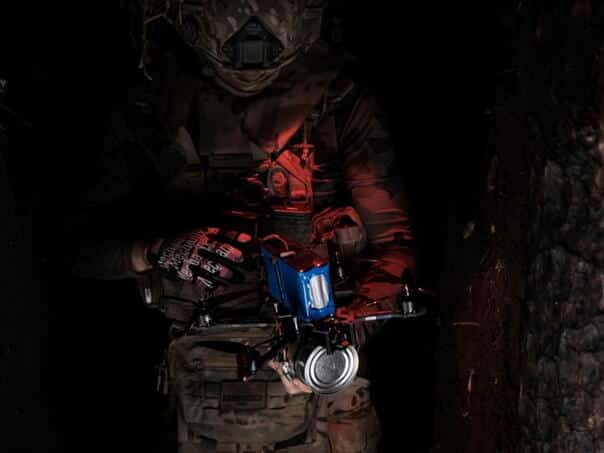
Foreign drone manufacturers hrle in Kiev in the hope that there will be part of one of the most dynamic centers of production of ideless aircraft in the world. However, there is a problem: exports remain limited, and each spacecraft is needed by the Ukrainian army, the Washington Post reports.
The war led to an explosion in the use and production of drones. Low price, deadly efficiency and constant testing on the battlefield accelerated the development in the rhythm that has been unimaginable until then. “The speed of innovation is so large that the cycle lasts six weeks, and then the drone is already obsolete,” he said for the Washington Post one European diplomat, who wanted to remain anonymous, reports index.hr.
Ukrainian models bypass Russian interference
In particular, the Ukrainian drons of long range, maritime drones and those with advanced electronic warfare systems. Unlike many foreign models, they showed resistant to sophisticated Russian interference systems.
“If NATO countries want a gold standard in drones, then they want Ukrainian drones. But I can’t get them,” said British Manufacturer of Drones Alexander Fergusson. The export is allowed on paper, Ukrainian companies. In practice, the procedure is slow, and bureaucracy makes it difficult to measure that in fact that it becomes impossible.
Companies are looking for opening exports
In Ukraine, more than 500 producers of drones, mostly private start-ups. They argue that exports are necessary to increase production and compete with Russia with a much larger industrial base. Moscow, thanks to collaboration with Iran, is already sending hundreds of drones in one wave, and by the end of the year, they could launch them and two thousand at once.
Ukrainian companies say they lack finance, labor and resources for research. Additional export revenues would enable them to spread production and investment in new technologies.
Green promising cooperation with Europe
President Volodimir Green in June announced that Ukraine will soon sign agreements on the opening of production lines in European countries through the program “Build with Ukraine”. This would produce drones and other weapons “for us and for them,” said Green.
The opening of joint facilities in Denmark and Britain was agreed, and Kiev also presented a proposal for a large five-year agreement with the United States worth $ 50 billion. But that plan will not be realized before the end of the war.
New law is waiting for a signature
Ukrainian parliament in August has adopted the Law on Creation of the “Defense City”, a special legal structure that would enable military manufacturers to assemble joint jobs with partners from the west.
The law provides for tax relief, accelerated customs and export procedures and increased security measures for the protection of industry. “We have a growth potential, but we need money and orders. Someone has to pay for this weapon to work for our companies,” Danilo Getmancev is said, one of the authors of the law.
Despite optimism, the part of the government continues to hinder exports. The new Minister of Defense, also former Prime Minister, Denis Schmihal said in July for the BBC that “direct exports were impossible to imagine”. Instead, he proposed partner projects in which weapons would be kept in the warehouses of partner countries. “Our armed forces must first get 100 and more percent of what they need,” Shmihal said. His statements caused frustrations among the manufacturers who expected the abolition of restrictions.
Industry pressure
Representatives of the defense industry warn that without exporting Ukraine loses the opportunity for joint projects with Western companies and the newly needed technology. “When exports are closed, you cannot share experience with European companies or run joint projects,” Katerina Mihalko said from Tech Force Association. It has signed an open letter to Zelenia with 36 other companies in May, seeking the restrictions.
Even if exports open, the question remains who could be a customer. “Exporting a double-use product is always a political issue,” said Jaroslav Ajnjuk, director of the company Fourth Law, which develops artificial intelligence for drones.
Ukrainian officials emphasize that Asia and Africa can be forbidden markets for fear that technology could end in Russian hands. “It’s not just about money, it’s about political influence,” said Oleksandr Homijak from Drone Space Labs.
Risks Pandora’s box
Part of the expert warns that mass exports of drones could have serious consequences. “Opening exports can be like opening Pandora’s box,” said one Ukrainian manufacturer for Washington Post. “We’re getting inquiry for sale in a weekly basis, and many are very suspicious.”
He added that he did not want the Ukrainian brand to be associated with wars and terrorism in Africa or other regions.
“The killing of people in Africa is not something I want to identify politically,” he said.
Thus Ukraine remains a large dilemma – without exports and new income is difficult to follow Russian mass production. But the market opening carries the risk of misuse and strengthening conflicts in other parts of the world. Will Ukraine find a balance between their own war needs and world demand for her “gold standard” in drones, the question that could determine the future of the war and the global weapon market.
(Vijesti.ba)