
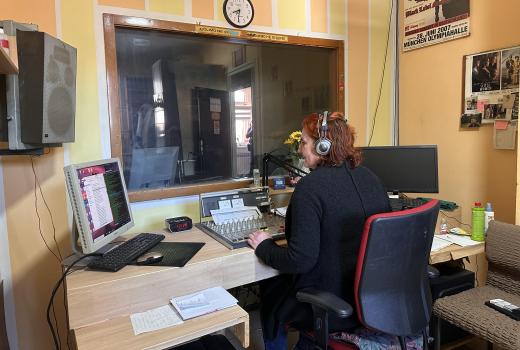
Radiotelevision Maglaj is facing bankruptcy. The reason? It cannot pay off debts incurred at the beginning of the 21st century, more precisely between 2001 and 2008.
Debts of less than 200,000 convertible marks, which mostly relate to outstanding obligations to the pension and health insurance fund, have grown, with interest, to almost half a million marks.
The tax administration from Zenica recently offered RTV Maglaj two options for payment: repayment of the principal debt for 18 months or settlement of the total amount with accrued interest over a period of ten years.
None of the offered options for the budget of this media house is acceptable, because it is in an unenviable financial situation.
“On November 10, we managed to pay the September minimums and other obligations. We now have a month’s worth of certified health cards. This does not mean that the difficult financial situation in our house has changed for the better. Now we expect the account to be blocked,” says journalist Admira Mulalić, who is also one of the owners of RTV Maglaj.
All this means that the initiation of bankruptcy proceedings is a matter of days.
“An inspection control of the business for the last four or five years was announced. We were controlled for the last 20 years, and that’s how we arrived at that figure, which didn’t stand all the time. We tried to settle the arrears according to our capabilities. However, the state said that it can’t be done that way and now we are facing bankruptcy,” she explains.
A company where profits are never shared with the owners
RTV Maglaj is a private media that has 11 owners – four current employees and the same number of retired employees, and three former employees, who in the meantime left home and got jobs in other companies.
“This is the only private company in which the profit, no matter what it was, was never distributed to the owners. We never had a dividend. That money was left behind, because we knew about the debts from 2001 to 2008 and that they would come due. We think that the state will let us continue to work, and to pay off our obligations to someone who has met the conditions for a pension so that he can retire. That’s what we’ve been doing all this time, and now we can’t even do that.” adds Mulalić.
“In 2000, we bought RTV Maglaj, which at that time cost 80,000 convertible marks. We took out loans, which we paid back for three years. There was a glimmer of hope that by buying the company, that is, by paying back those loans, we would buy ourselves a job. However, 25 years later it turned out that this was not quite the case,” she recalls.
RTV Maglaj needs about 18,000 convertible marks per month for normal operations. From the municipal budget, this media house received 66,000 convertible marks per year for monitoring the work of the local government, and ten thousand marks per year from the Zenica-Doboj Canton budget for public invitations to the media.
“We managed to earn the rest until this solution about debts for taxes and contributions. It was not easy to provide those 18,000 per month, but we provided them. People who used our services no longer come, because it was heard that we are facing bankruptcy,” says Mulalić.
Everyone works for minimum wage
“We have to say that we have been working for the minimum wage all these years. All employees, including the director, receive the minimum wage, which changed as the state made decisions on the increase of the minimum wage. We barely cover the basic expenses. In the last four years, we have not owed anyone a penny, except ourselves,” emphasizes radio presenter Merima Pračić, who is also among the 11 owners of RTV Maglaj.
Radio Maglaj was founded 55 years ago, while the television program was launched during the war in 1992. Today, RTV Maglaj employs eight people.
“This is not about keeping these eight people at work. At this moment, it is about Maglaj keeping its radio and television,” says Mulalić.
“Those who are in this business know what a work permit means. For all these years, we haven’t had a single complaint about our work. The best solution for us would be a buyer, who would be ready to settle the debts. It doesn’t matter if we stay at work. Let the new owner decide on that, but the unpaid work experience is important to us,” adds Pračić.
RTV Maglaj does not own any property, the eventual sale of which could pay off the debts to the pension and health fund. Modest and outdated equipment is located in a space owned by the Municipality of Maglaj.
“If I tell you that in the TV implementation we have a cable, which was installed by people in June 1992, when television was formed, I don’t think I have to say anything more about our equipment,” says Mulalić.
“We are working on equipment that is older than us,” adds Pračić.
Politicians do not tolerate criticism
In Bosnia and Herzegovina, there is an unwritten rule that media funding from the budget is mostly connected with political influence on editorial policy. This means that any criticism of the current government, which at that moment decides on the spending of public money, can call into question the functioning of the media, which receive part of the necessary funds for their work from the budget.
For media experts, such a practice is harmful and inadmissible, and at the same time it is an indicator of the attitude of BiH politicians towards the media, which operate on the poor domestic market.
Government representatives at all levels in BiH do not want media that will objectively and critically report on their work.
For Enes Osmancevic, a professor of communication studies at the Department of Journalism at the University of Tuzla, such practice is the result of “a dilettante’s understanding of the authority of local and other powerful people”. He believes that they misuse public funds to finance the media, which “will apologetically work in their interest.”
“People from the government have a very bad attitude towards professional media and the public. They would be happiest if there were no media at all, and if there must be, then let it be bribed media,” Osmancevic told Media.ba.
According to him, this is also a consequence of the overall poverty in Bosnian society.
“We have both poor media and poor democracy. In this way, by not caring about the media and the public, not caring about public information and pluralism of communication, we are, in fact, putting ourselves in a state that resembles a kind of anthropological regression, that is, a return to some previous forms of life before the creation of the media. This speaks of the inertness of society, but also of the dilettantism of the government,” Osmancevic believes.
Politicians do not only want control over public broadcasters, but also over local media
Velida Kulenović, president of the Club BH Journalists in Zenica and vice president of the Association of BH Journalists, says that in forums where the media scene in Bosnia and Herzegovina is discussed, she cites the example of RTV Zenica.
“The mayor of Zenica can threaten at any time that he will not transfer the tranche from the budget for monthly financing. This is direct pressure and endangering their work, regardless of who is in power. This is worrying,” Kulenović points out.
“Allocating those funds can be conditional, because you are not allowed to write against the founder of the public media. You cannot write anything against him. Everything must be subordinated to the head of the city treasury,” adds Kulenović.
On the other hand, these media are not financed from the pockets of the government representatives, but from the budget filled by the citizens, and they would have to work in the interest of those citizens, that is, the taxpayers.
“Politicians don’t want to understand that. They don’t want to understand the role of the media and the importance of public interest. It should be part of their political agenda, and I think they need education about it. It’s a key thing,” emphasizes Kulenović.
The call to citizens to help went unheeded
Employees of RTV Maglaj, who found themselves in a difficult situation due to debts incurred twenty years ago, called on citizens to help them.
“We are asking you to help us, according to your possibilities. Let’s try together – like all these decades that are behind us. It is not easy to send you this appeal. All these years, stories about helping others have been started or followed – by us. Just so you know right away, dear viewers and listeners, you do not owe us anything. Contributions are on a voluntary basis”, according to a post on the Facebook page of the only electronic media in Maglaj.
The appeal for help did not cause significant reactions among citizens.
“We received about twenty symbolic payments, which will be returned to the citizens, if bankruptcy is initiated. In the meantime, we withdrew the appeal for help,” says Admira Mulalić.
Shutting down the local RTV would be a great loss for Maglaj, according to the municipal head Maid Suljaković.
“I hope that a quality solution will be found for them to survive. The municipality of Maglaj has been providing the largest financial support to local television for years,” says Suljaković.
“Payments from the local budget of RTV Maglaj were regular. We followed the activities of the local government and broadcast the sessions of the Municipal Council. We also pointed out communal problems. I can freely say that this did not affect the funding from the budget, which was not enough for all monthly expenses,” says Admira Mulalić.
The information about the possible bankruptcy of RTV Maglaj is “devastating, because it is, after all, a local public service, regardless of the fact that it is a private media.”
“Unfortunately, this may be an indicator that such cases may occur in the coming period with other media as well. I remind you that we previously had bankruptcy proceedings at RTV Visoko,” reminds Kulenović.
Initiating bankruptcy is not a common practice
Although there are numerous analyzes by professional associations, media experts, and journalistic reports on financial (dis)opportunities in the Bosnian media, the initiation of bankruptcy in media houses in the last 30 years has not been frequent.
Although it is conducted according to the current legal regulations on bankruptcy proceedings, there are differences between public and private media.
The examples from Ključ and Visoko show that after the procedure was completed, the media owned by the local self-governments stopped their independent operations and continued to broadcast programs within the local cultural centers.
According to Alen Jazić, the former editor-in-chief, the bankruptcy of RTV Visoko is characteristic, because it was not initiated primarily because of financial problems.
“In our case, it was practically forcing undesirable people out of their jobs. It was indicative that all of us who remained redundant had a university degree,” says Jazić.
In 2018, Mediacentar wrote that the then government in Visoko made a decision to initiate bankruptcy in the public company RTV Visoko, and that the broadcast of the program should continue as part of the Public Institution “Centre for Culture and Sports”.
Jazić says that he has not yet managed to collect his claims from RTV Visoko.
“That case is before the Constitutional Court of Bosnia and Herzegovina. It is interesting that the Municipal Court and the Cantonal Court in Zenica ruled against us, even though the defense witness, the former director of that Center, in that case in which we, former workers, were the plaintiffs, said that everything she did was contrary to her principles and that those people should be compensated,” reminds Jazić.
“I have nine years of unpaid seniority left, salary difference, retrogression, hot meals. According to me, that debt in 2018 was almost 85,000 marks. It’s not interesting that I can’t collect my claims, but the state can’t collect debts for taxes and contributions either,” says Jazić.
New public RTV in Bosnia and Herzegovina?
While the media in Bosnia and Herzegovina are facing financial problems, the Government of Zenica-Doboj Canton announces the establishment of a cantonal television. In the middle of this year, a decision was adopted on the establishment of the Public Enterprise “Television of the Zenica-Doboj Canton”.
“By forming this company, we will certainly make a step forward and have a better media image of the work of the ZDK Government and all activities in the coming period, and the sessions of the ZDK Assembly will be broadcast. This will allow us to have better communication with citizens and everyone else,” said Adnan Šabani, Cantonal Minister for Spatial Planning, Transport and Communications and Environmental Protection.
Marko Divković, president of the BH Journalists Association, has no doubts about the background of this decision.
“The government never does it for the sake of the citizens, but for itself. There is no exception, because if the citizens needed it, an earlier government would have established it. It is just a struggle for power through the disposal of public money, the appointment of people and influence on work. It is a scheme that has not failed anywhere,” says Divković, reports Media.ba


