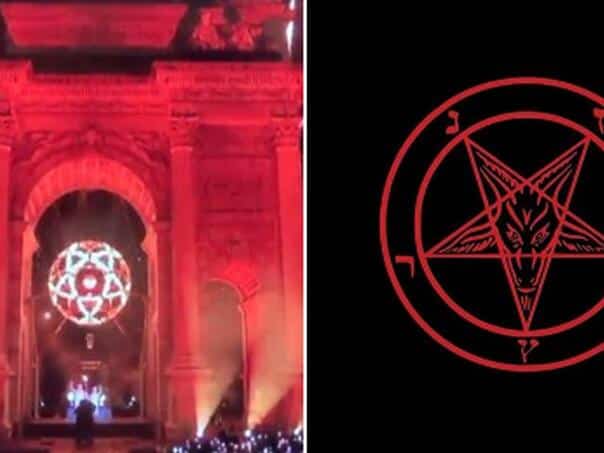
At the center of the accusations was the design of the Olympic torch, which some internet users interpreted as an “inverted pentagram”, as well as certain artistic elements of the ceremony, which they described as an “occult ritual”.
But the available information suggests that these are interpretations based on impression and visual guesswork, rather than on the documented intent of the designer.
The opening ceremony of the Winter Olympic Games in Milan, Italy, went viral for featuring Satanic symbolism pic.twitter.com/f5bswyqppr
— Daily Romania (@daily_romania) February 7, 2026
The opening ceremony took place on February 6 at the San Siro stadium in Milan, with associated events at alpine locations, which was officially announced as part of the wider concept of the opening. During the evening, two Olympic torches were lit, one in Milan and one in Cortina d’Ampezzo, which the organizer presented as a symbolic connection between the hosts, and in the official materials it is pointed out that this is the first time that two torches are lit and extinguished simultaneously in two different locations during the Games.
Where do the claims about satanic symbolism come from?
Some critics focused on the transient geometric shapes that can be seen as the burner opens and closes. As it is a kinetic construction that expands and contracts, star-shaped patterns emerge from certain angles, which part of the audience interpreted as a pentagram.
In such discussions, the broader historical context is often skipped, because the pentagram is not exclusively or originally a satanic symbol, but has had different meanings throughout history and appeared in various traditions. In this case, there is no official indication that the design was intended to convey an occult or religious message.
The burner was designed by a man of Croatian origin
According to official announcements by the organizers and accompanying materials, the burners were designed by Marco Balich in partnership with Fincantieri.
Marco Balich is an Italian creative director and executive producer specializing in major events, especially the Olympic opening and closing ceremonies. He was born in Venice and has his roots in Split, and in interviews he often points out that his family is deeply connected to those two cities.
Inspiration was found, among other things, in the geometric motifs and interlocking patterns associated with Leonardo da Vinci, with an emphasis on ideas of unity and continuity.
Media descriptions of the design also mention the technical side of the structure, with a variable diameter of about 3.1 meters in the closed position to about 4.5 meters when fully open, and a mechanical system with 244 points of rotation and 1,440 components.
Dante, Italian culture and misinterpretations
The opening was conceived as a tribute to Italian culture, and the media highlighted references to Italian heritage and artistic motifs that included dramatic lighting and scenes reminiscent of literary images of fire and battle.
In such a framework, red and orange lighting or “hell” visual language can be pure scenography and literary allusion, but on the Internet they often become material for theories that interpret abstract elements as hidden messages.
(Vijesti.ba)