
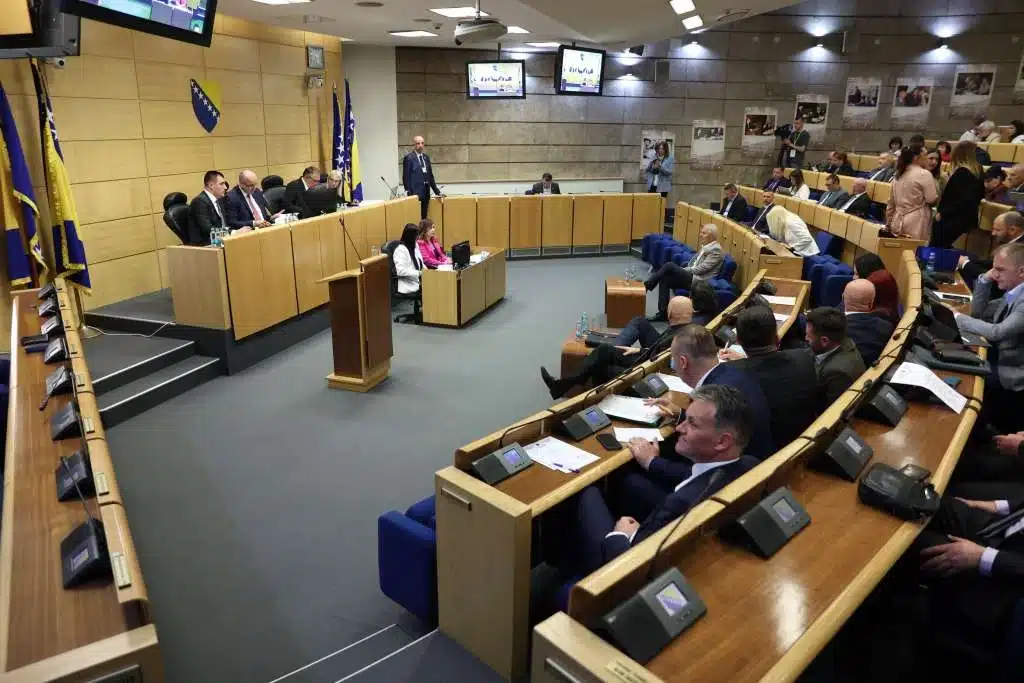
At today’s session, the House of Peoples of the Parliament of the Federation of Bosnia and Herzegovina did not support by a majority of votes the Federation of Bosnia and Herzegovina’s indebtedness to the European Bank for Reconstruction and Development (EBRD) for the construction of the road subdivision Poprikusa – Nemila on Corridor Vc.
The majority of votes was neither in the secret electronic voting nor in the requested repeated, oral declaration based on the individual roll call of the delegates.
The House of Representatives recently approved this decision, but it cannot enter into force without the support of the House of Peoples.
The decision stipulated a debt of 95 million euros to the Federation of Bosnia and Herzegovina, with a repayment term of 11 years and a four-year grace period. The anticipated length of the Poprikusa – Nemila subsection is 5.5 kilometers, and the ultimate debtor and implementer of the project would be the company Autoceste Fédération BiH.
In contrast to this decision, the House of Peoples today gave majority support for a loan of 79.9 million euros from the International Bank for Development and Development (IBRD), for the implementation of the Project related to the regions rich in coal in the FBiH, specifically the areas of the Zenica, Tuzla and Banovići mines.
The House of Representatives recently withheld support for that decision, so its advocates today in the House of Peoples expressed hope that it will be adopted there, because otherwise, it cannot enter into force.
Of the EUR 79.9 million debt, about 50 percent refers to the Federation, about 20 percent to the Public Company Elektroprivreda BiH and about 30 percent to the Banovići Lignite Coal Mine.
The anticipated loan repayment term is 32.5 years, the grace period is seven years.
According to the explanation of the Federal Government, which proposed this decision to the Parliament, as well as of the Federal Minister of Energy, Mining and Industry, Vedran Lakić, who addressed the delegates of the House of Peoples today, the task relates to the implementation of the Project called “Just transition in selected regions rich in coal in the Federation of Bosnia and Herzegovina”.
The essence is that the development of micro, small and medium-sized enterprises in coal-rich regions should be supported, the institutional framework for the Just Transition should be strengthened – the closure of the Zenica brown coal mine, the reclamation and conversion of land for new use, the introduction of clean energy, as well as support to miners and communities for the economic transition.
In the Project, priority was given to the mine that is ready to be closed, namely the Zenica Brown Coal Mine, which is not the case with the Tuzla and Banovići mines.
The gradual closure of inactive areas is planned in Banovići, while the Kreka mine in Tuzla already has closed surface mines, but with potential for renewable energy.
According to Minister Lakić, the Zenica mine has an urgent need for support in order to responsibly close the Raspotočje pit and support for finding new jobs for workers. By the way, the project provides money for obligations to workers, including those for PIO.
The installation of a photovoltaic power plant (FNE) will be launched in the Banovići brown coal mine, as well as pilot activities in the community aimed at early measures of economic diversification.
The installation of the photovoltaic power plant will be carried out by the Public Company Elektroprivreda BiH, as well as in the area that includes the Kreka mine in Tuzla, as foreseen in this project.
The session of the House of Peoples continued with the following agenda items after the aforementioned decisions, it says Factor.


