
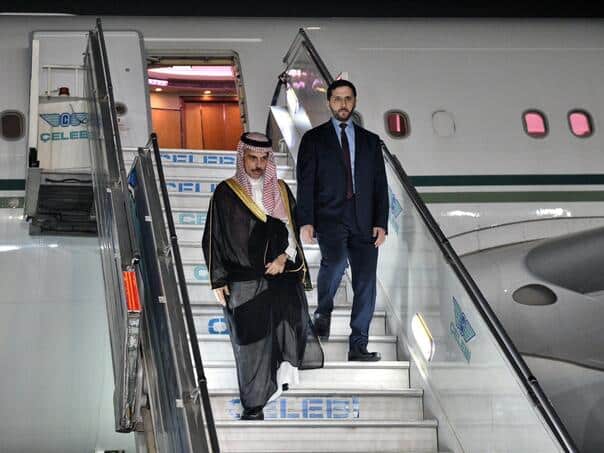
Saudi Arabia’s foreign minister said on Tuesday that he does not expect the new administration of Donald Trump to increase the risk of conflict between Israel and Iran, addressing an issue that has preoccupied the region since the start of Israel’s war in Gaza.
Prince Faisal bin Farhan Al-Saud also expressed hope in Davos that Trump’s approach to Iran will be met with Tehran’s willingness to cooperate positively with the US administration and resolve the issue of the nuclear program.
“Of course, a war between Iran and Israel, like any war in our region, is something we should try to avoid as much as possible,” Prince Faisal said during the World Economic Forum’s annual meeting in the Swiss mountain resort.
“I don’t see the arrival of a new US administration increasing the risk of war, on the contrary, President Trump has been quite clear that he does not favor conflict.”
Fears of war between Israel and Iran grew after the Palestinian Hamas, backed by Tehran, launched a deadly cross-border attack on Israel on October 7, 2023, triggering an Israeli military offensive that drew Iran’s allies into the conflict, including Lebanon’s Hezbollah and the Yemeni Houthis.
Israel launched a devastating war against Hamas in Gaza and Hezbollah in Lebanon, destroying both groups’ military infrastructure, destroying Iran’s network of influence in the Middle East and upending powerful alliances that led to the ouster of Syrian President Bashar al-Assad, another Iranian ally.
Fifteen months after the October attack, a cease-fire agreement was reached between Israel and Hamas. Prince Faisal was speaking at the World Economic Forum’s annual meeting in Switzerland, on a panel alongside Qatari Prime Minister Sheikh Mohammed bin Abdulrahman Al Thani, who helped broker the ceasefire agreement.
The Qatari prime minister said the decisive involvement of Trump’s Middle East envoy, Steve Witkoff, made a big difference and led to significant progress in reaching a deal. He added that he hoped the Palestinian Authority would return to take an administrative role in Gaza after the end of the war with Israel, stressing that the people of Gaza, not any other country, should decide how the area is governed.
How to manage Gaza after the war was not directly addressed in the deal between Israel and Hamas.
Israel rejected the possibility of Hamas having a governing role, but was almost equally opposed to the rule of the Palestinian Authority, a body established under the Oslo interim peace accords three decades ago, which has limited governing powers in the West Bank.
Saudi Prince Faisal also said the new Syrian government inherited a broken country with no real institutions and needed international help to rebuild and make a fresh start.
“It is necessary to get involved, show patience and provide effective support to the administration in Damascus by extending a helping hand,” he said.
Lifting the burden of sanctions imposed on Syria because of the actions of the previous Assad government would be a key step forward. Although the US and Europe approved
certain exceptions, additional action is needed, the minister added. “Syria is a destroyed nation that desperately needs reconstruction. The sooner we get involved and the more support we offer, the greater the chances for a successful and stable transition,” he said.
Qatar’s Sheikh Mohammed said Trump’s return to the White House presents significant opportunities for cooperation, highlighting the potential to work together to transform the Middle East into a region of stability and security. “Trump’s idea of making America strong again is something very important. We also want to see the Middle East great again,” he said.
Prince Faisal, whose country has avoided Lebanon for years because of Hezbollah’s strong influence on state affairs, also said he would visit Beirut this week, the first such visit by a Saudi foreign minister in more than a decade.
He said that the election of the Lebanese president after years of political paralysis is a positive step, but that Riyadh must see real reforms in order to increase engagement in that country.
(Vijesti.ba)


