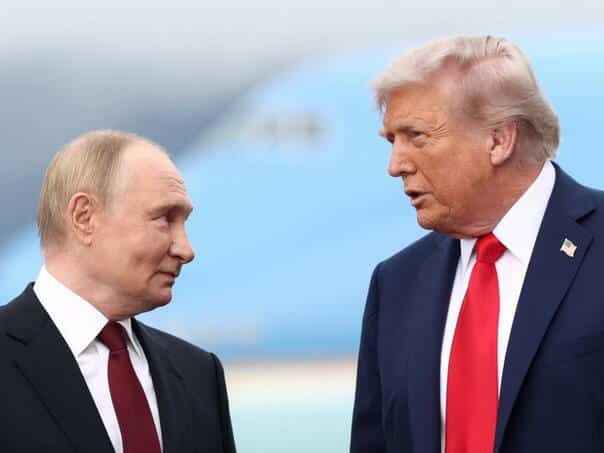
According to sources familiar with the negotiations, the Kremlin proposed to the White House that peace be achieved through business arrangements, and Washington, to Europe’s surprise, reportedly agreed.
A key meeting took place last month in Miami between Steve Witkoff, Jared Kushner and Kirill Dmitriev. Then they agreed on a plan by which American companies could use about 300 billion dollars of Russian funds frozen in Europe for Russian-American investment projects and the post-war reconstruction of Ukraine.
American and Russian companies would also join forces to exploit the mineral wealth of the Arctic, and the possibility of a joint mission to Mars with Musk’s SpaceX was also considered. The European allies found out about the plan later, not from the Americans, but from their own intelligence services, he writes Morning paper.
A common language
The Kremlin’s strategy, devised even before the Trump administration, was to convince Americans that they saw Russia as a country of abundant opportunity, not a military threat. By proposing lucrative deals in the rare minerals and energy sectors, Moscow could reshape Europe’s economic map and drive a wedge between the US and European allies, while economic projects could “revive” Russia’s $2 trillion economy.
Dmitriev, a former employee of Goldman Sachs, very quickly found a common language with Witkoff and Kushner. “Russia has so many vast resources and territorial expanses. If we can get Russia, Ukraine and America to become business partners, everyone will prosper; it will be a natural bulwark against future conflicts,” Witkoff said.
Dmitriev is convinced that their business relationship is starting to bring results: “We can transform an investment fund into a political trust.” Witkoff trusted Dmitriyev so much that he even lobbied for him to be allowed to enter the US, where he was declared persona non grata for running the Russian Sovereign Wealth Fund, which they called the “Vladimir Putin Fund”. Treasury Secretary Scott Bessent opposed his entry into the US, but Trump overrode him and Dmitriyev was eventually allowed to enter.
The art of negotiation
Instead of focusing on the complex geopolitical problems of post-Soviet Europe, Trump approached the challenge with his own logic – his priority is economic interests, and territorial issues are put on the back burner. In order to realize the plan, traditional diplomatic channels and established methods of negotiation were bypassed. For example, on the eve of the summit in Alaska between Trump and Putin, Witkoff and Dmitriyev discussed the largest exchange of prisoners in the history of their countries without the knowledge of the CIA, the intelligence agency that manages the exchange of prisoners with Russia. Witkoff sometimes did not inform his American counterparts in the Treasury Department about his meetings with the Russians. They learned the details only from their British colleagues.
For many in the White House, a business-like approach to solving the war is seen as a positive thing: American investors could profit in post-war Russia and become commercial guarantors of peace. Russia has made it clear that it prefers American companies to European ones. One source told the WSJ: “It’s Trump’s ‘art of the deal,’ when he says, ‘Look, I’m solving this issue, and there are huge economic benefits for America, right?’”
Some analysts believe that Moscow does not intend to conclude a real peace agreement at all, but rather uses the negotiations to prolong the conflict. However, a sign that Putin may be seriously considering an end to the war may be the fact that some sanctioned Russian billionaires, Gennady Timchenko, Yuri Kovalchuk and the Rotenberg brothers, have been quietly exploring mining and energy projects in cooperation with American partners.
American investors were already preparing in secret. Exxon’s Neil Chapman met with Rosneft’s Igor Sechin to discuss Exxon’s return to the Sakhalin project. Investor Todd Boehly considered buying a stake in Lukoil, while Russian businessmen offered gas concessions and mining projects in Siberia. Gentry Beach, a friend of Donald Trump Jr., has negotiated a stake in Novatek’s Arctic LNG project if sanctions are lifted.
Investor Stephen Lynch paid $600,000 to a lobbyist close to Trump Jr. to help him get permission to buy the Nord Stream 2 gas pipeline. Also, in July, the head of Roscosmos, Dmitry Bakanov, visited NASA, Boeing and SpaceX for the first time since 2018.
Witkoff tried to speed up negotiations, but a summit between Trump and Putin in Alaska in August ultimately collapsed. In October, when Zelenskiy asked for American Tomahawk missiles, Trump spoke with Putin the day before and decided not to sell them. Instead, Witkoff advised Kiev to ask Trump for a 10-year tariff exemption to boost its economy.
(Vijesti.ba)