
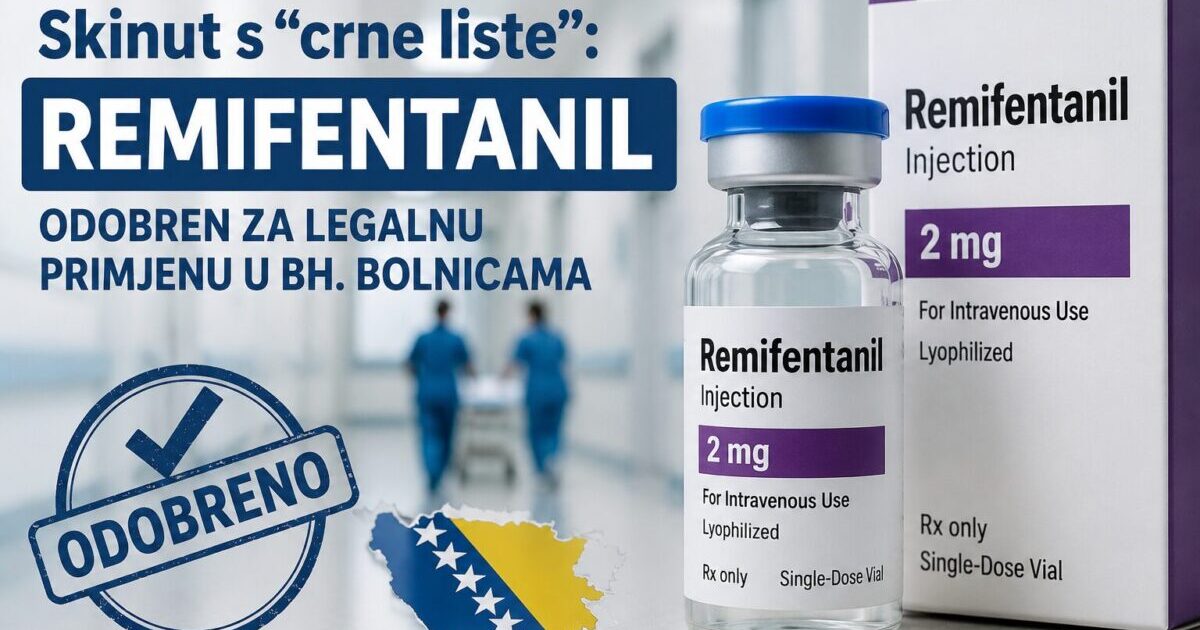
The Council of Ministers of Bosnia and Herzegovina (BiH) made a decision moving the narcotic drug remifentanil from the group of prohibited substances to the category under strict control, thus opening the door for its legal use in hospitals throughout the country.
At the proposal of the BiH Ministry of Security, the Decision on Amendments and Supplements to the List of Narcotic Drugs, Psychotropic Substances, Plants from which Narcotic Drugs and Precursors can be obtained was officially adopted.
With this decision, remifentanil is moved to the list of “Substances and plants under strict control”, which after years of waiting allows its use for therapeutic and medical purposes, just as it is the case in most countries of the European Union.
In EU countries, this drug has been in daily clinical use for more than 20 years, where it is considered indispensable during operations under general anesthesia.
Unlike other strong analgesics, remifentanil breaks down in the human body at an incredible speed. Its action begins almost immediately after it is injected into a vein, and after the infusion is stopped, the drug completely loses its effect within just a few minutes, regardless of how long the operation lasted.
Anesthesiologists can perfectly control the depth of anesthesia and the strength of analgesia in every second of the operation.
Since the drug does not accumulate in the body or burden the liver and kidneys, patients wake up much faster after surgery, are more aware and experience significantly fewer side effects (such as nausea or postoperative confusion).
It is irreplaceable in neurosurgery, cardiac surgery, but also in short, extremely painful procedures where the patient needs to be put to sleep quickly and woken up even faster.
Due to the previous rigid legal regulations in BiH, this drug was treated exclusively as a “forbidden drug”, which put domestic doctors in a subordinate position and forced them to use older generations of anesthetics.
With this decision of the BiH Council of Ministers, domestic healthcare is finally catching up with European medical standards, he writes Zenica blog.


