
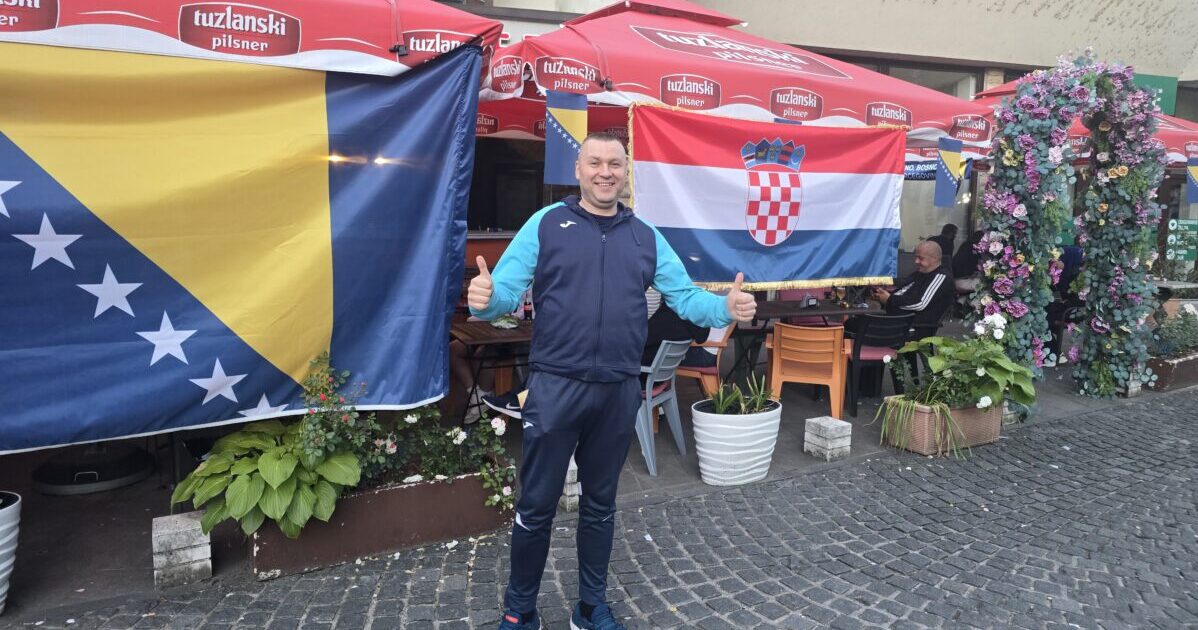
People usually remember bankers for foreclosures, interest and plastic smiles. He is remembered for saving things in Turkey in the dead of night, donating to a church and a mosque, and standing dead-cold in front of the lens where the Balkan cynics on duty see only a problem.
Written by: Hajrudin Redžović
The World Cup shakes the planet. Bosnia and Herzegovina opened its story against Canada a few days ago, and tonight at 10 p.m. Croatia opens its story against England. Out of the entire former, defunct state, only BiH and Croatia received visas for the best review. And that’s exactly why, according to the good old custom, football here is rarely seen as just football. “Who will root for whom” — it almost became a matter of life or death.
Here in Tešanj, the owners of Cafe Restaurant “Teša” did not wait for political instructions from the top about who should be laughed at and who should not be cheered on.
While ours were chasing the Canadians on the field, they coldly unfurled the Bosnian and Croatian flags. One to the other.
And just when, with that old journalistic reflex, I raised the lens to immortalize that rare normality in the sea of Balkan madness, Nermin Ćostović jumps out of the bar. He stands straight in front of the lens, spreads his arms with that smile of his, two flags protect his back, and throws:
“Take a picture, Redžović! Feel free to publish it, this is a very beautiful scene.”
But who is actually a man who has the guts and cheek to stand between two flags with a smile in the middle of Bosnia, without a calculator in his head and without fear of comments under the post?
In our transitional darkness, bankers tend to be about as popular as dentists. Faces in gray suits that seal contracts with plastic smiles, while the tiniest letters slowly and thoroughly peel the skin off your back.
Nermin Ćostović, however, is a mistake in that corporate matrix.
Shock absorber for corporate shocks
In 2008, when the banking sector went through tectonic upheavals — HVB Central Profit banka and UniCredit Zagrebačka banka merged — hundreds of workers found themselves in the grind. They shoved new procedures, frantic targets and cold western rules under their noses.
While other managers sold the fog through sterile PowerPoint presentations and piled the pressure on terrified staff, Nermin pulled the trigger.
He stood in front of these people, took an ordinary felt-tip pen and a blackboard, and began to break down the banking specter into simple factors. He was not an executioner with a tie, but a shock absorber. A therapist in a suit who explained that the system should serve the people, not the people the system. That is why it is no coincidence that he was considered one of the favorite internal trainers at UniCredit Bank BiH.
Midnight call from Turkey
This defense mechanism of his for the “ordinary man” was quickly recognized by those who run a heavy game. Real, raw business does not know working hours from eight to four, nor does it rely on useless info phones where a robot keeps you on hold while your life slips through your fingers.
When one of our big players, a man whose signature is worth millions, lost his wallet with cards and documents in the middle of the night in Turkey, he didn’t call the Turkish police first. He didn’t even call the embassy. He called Nermina.
In the dead of night, Ćostović picks up the phone. Don’t panic. There is no “call tomorrow during business hours”. There is no official tone to hide behind when the going gets tough.
“Calm down. Cards are blocked. Money is on the line.”
The fire was extinguished in ten minutes. A businessman in Turkey could sleep more peacefully, and Ćostović, on this side of the wire, did what systems usually promise in advertisements, but rarely deliver when they really need it.
A hunt that doesn’t count blood cells
And to make it all the way in the style of harsh realism, where every stamp given for someone else’s sanctuary in the Balkans is usually measured by blood cells and charged with political points, this man plays by his own rules.
His money goes to both the church and the mosque.
No cameras. No press conferences. Without those forced PR texts in which the donor loves himself more than the good deed he has done.
That’s why Nermin can stand in front of the chessboard and the Bosnian stars in Tešnje, spread his arms and say:
“Take a picture, Redžović.”
Only someone who does not have fine print in his biography can stand in front of the lens with such calmness.
Hajrudin Redžović is a journalist and publicist, author of the books “Cunning Business” and “Operation Cardiff – The Story of a Country They Said Didn’t Exist.”


