
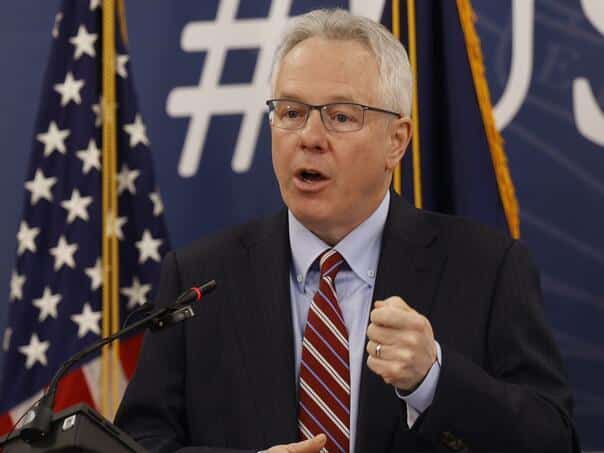
The former American ambassador to Bosnia and Herzegovina, Michael J. Murphy, spoke ahead of the session of the Steering Committee of the Peace Implementation Council (PIC), which should discuss the future of the Office of the High Representative (OHR) and the possible appointment of a new High Representative next week.
Murphy pointed out that the protection of the territorial integrity of Bosnia and Herzegovina cannot be based solely on the process of European integration.
In a post on the X platform, Murphy stated that the PIC member states must ask themselves several key questions before making decisions: what is their strategic interest in BiH, can the OHR with Bonn powers advance that interest, and who would be the most suitable candidate for the post of high representative.
– During the past 30 years, the United States of America considered the territorial integrity of Bosnia and Herzegovina to be its fundamental strategic interest in the country. It reflected not only American values but also their specific security interests. The reason was that for three decades the USA believed that challenges to the territorial integrity of Bosnia and Herzegovina carried the risk of violence within the country and in the Western Balkans – Murphy pointed out.
Yesterday, the US administration reported to Congress on policy towards the Western Balkans. The short report said several things about BiH. The administration says it remains committed to the DPA and BiH’s territorial integrity. It also claims to have resolved the most “acute…
— Michael J Murphy (@MidlifePlaylist) May 24, 2026
Murphy states that signals from the current US administration suggest a possible turnaround in that long-standing policy, with a stronger reliance on the concept of “local ownership”. In this context, he also mentions the political views of Milorad Dodik, whom he claims has repeatedly questioned the territorial integrity of Bosnia and Herzegovina and advocated ideas that include strengthening the entity’s independence.
He also pointed to the growing demands for the formation of a third entity, as well as proposals for the reorganization of the Federation of Bosnia and Herzegovina, which, in his opinion, further complicates the political situation in the country ahead of the PIC session.
– At the same time, demands for the establishment of a third entity are getting louder, while a prominent Bosniak ethno-nationalist politician proposed the formation of a megacanton within the Federation of Bosnia and Herzegovina. It is very reminiscent of the support for the idea of a third entity. This is precisely why such a political context is considered crucial for the discussions that will be held at the PIC session next week – according to Murphy.
He assessed that the results of that approach are limited, stating that various political actors in Bosnia and Herzegovina use the European path as a means of political pressure or conditioning.
Speaking about the role of the OHR, Murphy emphasized that this institution was not conceived as a tool for “nation building”, but as a mechanism for the implementation of the Dayton Peace Agreement and the protection of state institutions.
He also warned that the OHR cannot operate effectively without the active support of the PIC and the readiness to use Bonn powers when necessary. If it is concluded that this role is no longer needed, he adds, then another strategy would have to be sought to preserve the stability of Bosnia and Herzegovina.
(Vijesti.ba)



Chat readers
Join the discussion