
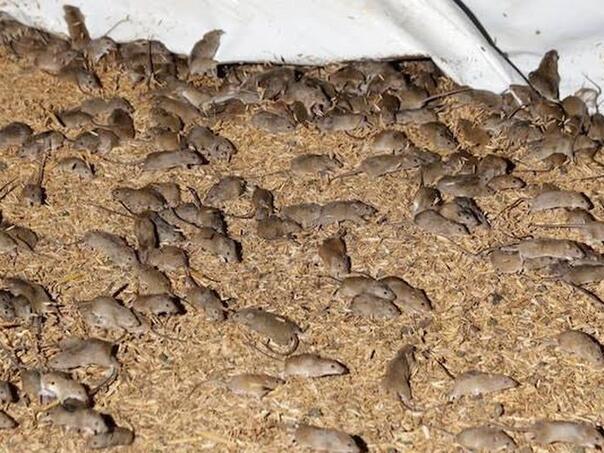
“It’s a huge expense, but worse is the mental drain. You hear them in the ceilings and air conditioners at night, and their stench is everywhere,” says Geoff Cosgrove, who farms 14,000 hectares in Western Australia.
He describes this infestation as worse than the one in 2021, when mice ravaged parts of Australia and caused millions in damage.
why did they not eat all these mice
Australian farmers fear potential mouse plaguehttps://t.co/5uooghuDiY
Invasivehttps://t.co/FUJWZdx4m2
Feral House Catshttps://t.co/w8gfaR3YeU
and New Wildcat Specieshttps://t.co/qhTtS104v6
the most damaging invasive..https://t.co/RBYft3pykN— iglooo101 (@iglooo101) May 28, 2026
Agronomist and farmer Belinda Eastough explains that last year’s record harvest left plenty of food in the fields, while summer rains further favored rodent breeding. On some plots, he estimates between 8,000 and 10,000 mice per hectare.
Autumn sowing is particularly at risk because mice eat the seeds from the furrows during the night. Farmers therefore spend large sums on toxic baits and reseeding, while at the same time being hit by high production costs.
Steve Henry from the Australian Science Agency CSIRO says that the infestation is considered to be 800 mice per hectare, while there are many times more in the affected areas. The problem is further compounded by the fact that mice reproduce very quickly.
In addition to economic damage, farmers also warn of psychological pressure. “When you’re dealing with a drought, you can run indoors. You can’t with mice—they’re in there,” says Henry.
After months of requests, Australian authorities approved the use of a stronger poison. Farmers have reported a decline in mouse numbers in recent days thanks to cooler weather, rain and new control measures, but many warn they haven’t seen an infestation like this in decades.
(Vijesti.ba)



Chat readers
Join the discussion