
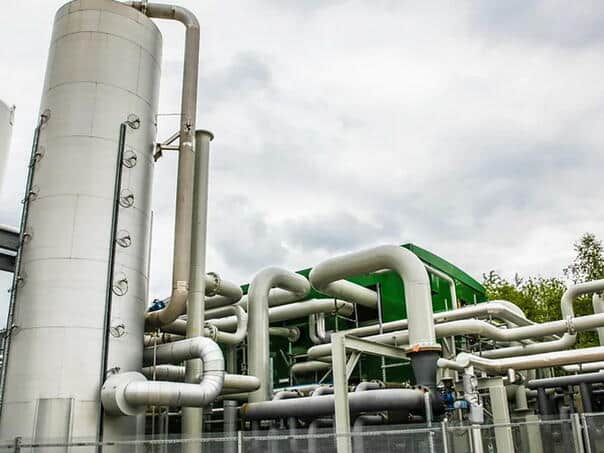
It aims to compete with lithium batteries and pump hydropower in storing clean energy and reducing fossil fuel need.
How to use renewable electricity around the world and the first time surpasses coal, grow and need for her storage when the sun does not shine and the wind blows. While some rely on large capacity batteries, and the other on pump hydropower, small but the growing industry believes that there is an even better solution – air-used batteries, writes BBC.
Near the village of Carrington in northwest of England are based on the first commercial power plant for storing energy from liquid air. The plant will consist of industrial machines and large air-filled containers that is compressed and cooled to liquid condition, using excess renewable energy. Stored energy can be released later when demand exceeds the offer.
If the project succeeds, others will follow. HIGHVIEW POWER, which develops a plant, is convinced that this technology will facilitate the transition from fossil fuels to renewable sources, although currently together. But with a growing need to storing clean energy, they believe that the balance will reverse in favor of liquid air.
The transition to renewable sources is crucial to reduce greenhouse gas emissions and avoiding the worst consequences of climate change. But it is a challenge for electricity networks. Coal and gas power plants can be included and excluded as needed, offering the predictable supply. In contrast, renewable sources are unpredictable – sometimes produce too little, and sometimes too much energy, which can jeopardize network stability.
The solution is to storage excess energy for later use, which ensures a reliable supply and reduces the risk of network damage. As the use of renewable sources increases, it becomes increasingly developing high capacity warehouses, says Shaylin Cetegen, a chemical engineer with a MIT that studies energy storage systems.
Decades is the main form of storage was pumped hydropower, excess electricity used to pump water uphill, which is later released through turbines. In 2021. years, the world had 160 gigavati capacity of pump hydropower.
Recently, as the demand for energy storage is growing, high capacity battery systems are being built. According to the International Energy Agency, energy storage via batteries increased from 1 GW in 2013. at more than 80 GW in 2023, with more than 40 GW added only last year.
Storage of energy using liquid air, in contrast, it is relatively new technology. The basic idea has existed since 1977. years, but only in this century attracted attention.
The process takes place in three phases – the first air is taken from the environment and clean. Then compresses up to very high pressure. Finally, it is cooled until it becomes liquid, using multiple heat exchangers, multi-channel devices and a pipe that allows you to control heat transmission.
– Energy that we draw from the network launches this charging process – says Cetegen.
When the network needs additional energy, the liquid air is used. He pulls out of the tank and evaporates, becomes gas again, and powered by turbines that produce electricity. After that, the air returns to the atmosphere.
There are also smart ways to save energy. For example, high pressure gases are heated, so heat caused by air compression can be used to help redeem the air.
– Without these thermal recovery cycles, the efficiency of the process is about 50 percent, but when we apply them, we can achieve more than 60, even up to 70 percent – says Cetegen.
The challenge is to build enough plant storage plants to accelerate green transition. The new plant in Manchester is first commercially that kind in the world. Builds him by HIGHVIEW POWER, who has been developing this technology for 20 years. Follows after a demonstration plant in nearby Pilsbury. The Carrington plant will be able to store 300 megawatt-hours of electricity, which is enough to cover a short-term deficiency for about 480,000 households.
The plant will be released in two phases, says the CEO of Richard Butland. In August 2026. The turbine will start operating, but will not produce electricity, but will serve to stabilize the network. Currently, Butland says, the network operators sometimes include gas power plants for stabilization, which is a high cost.
– It’s a huge cost for the system. Offering an alternative, we can prevent them from doing it. In 2027. year, the work of the liquid air warehouse is expected to be the work of the Butland.
HIGHVIEW plans to achieve income by selling the electricity network when the most needed. Although energy storage is key technology, economic sustainability is challenging, says Cetegen. In the study published in March, she and her colleagues analyzed the cost-effectiveness of energy storage through liquid air in 18 US regions. They compared eight different decarbonization scenarios, with a variety of levels of use of renewable sources. In all cases, they estimated how much money the project could earn by buying and selling electricity for 40 years.
According to the most aggressive scenario of decarbonization, the storage of energy using liquid air was profitable in Florida and Texas, but nowhere else.
– We did not record any economic sustainable system in other scenarios – says Cetegen.
Although this could be superficially interpreted as a negative result, Cetegen emphasizes that this does not mean that technology is bad. Her methods were intentionally conservative, and the study showed that other storage technologies, such as pumping hydropower and batteries, are even less economically sustainable. The key problem was that the warehouses could not achieve significant income in early years, because there were not enough renewable sources on the US network to cause price volatility.
(Vijesti.ba / Fena)