
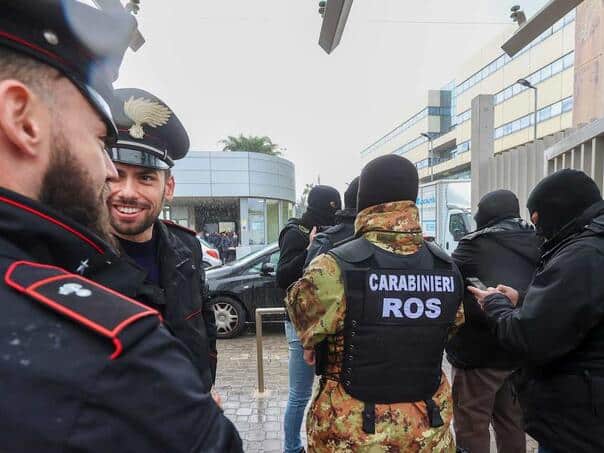
Families of victims killed by Sicilian mobsters have expressed fears that more than 20 high-ranking mobsters, freed in the past three months, could retake control of the neighborhoods they once ruled.
Most of these bosses, some of whom held leadership roles in the main mafia families of Palermo, the capital of Sicily, have never denied their association with Cosa Nostra, the Sicilian mafia, and have always refused to cooperate with judicial authorities.
They were released on leave or for good behavior, writes the Guardian.
Salvatore Borsellino, brother of legendary anti-Mafia judge Paolo Borsellino, who was killed by Cosa Nostra in 1992, said: “The release of mobsters who have always refused to cooperate with justice is extremely dangerous. It is a fatal blow to the fight against the Mafia.”
Nino Morana Agostino, the nephew of police officer Nino Agostino, who was killed by mobsters on the street in 1989 along with his wife Ida, who was five months pregnant, told La Repubblica newspaper: “We cannot afford to let our guard down in the fight against the mafia nor is to be underestimated. Mobsters who were sentenced to life sentences, and now released on parole, are still hiding big secrets about unsolved mob murders which they refused to acknowledge. So releasing them sends a bad message.”
In October, Raffaele Galatolo (74), a mafia boss from the Acquasanta neighborhood in Palermo, was released after a court declared him a “model prisoner” for good behavior. Galatolo and his brother Vincenzo, who were both convicted of murder, were the leaders of the so-called the “death chamber”, the room where the victims were strangled on the orders of the head of Cosa Nostra at the time, Salvatore “Totò” Riina. After Vincenzo’s death, Raffaele remained the sole heir to the throne of the Acquasanta mafia family.
In early October, an appeals court in Palermo acquitted nine bosses from Trapani on similar grounds. They were linked to former Sicilian mob boss Matteo Messina Denaro, who was arrested in January 2023 after 30 years on the run and died in September of the same year.
Palermo’s chief prosecutor, Maurizio de Lucia, recently appealed to keep the focus on the fight against the mafia, as investigators fear that Cosa Nostra, after a long period of decline, may try to reorganize the so-called Cupola, its governing body.
“It’s a perfect storm,” said Federico Varese, professor of criminology at the University of Oxford and author of Mafia Life. “Recent changes in Italian law allow mob bosses who have never confessed to their crimes or testified against the mob to benefit from ‘good behavior’ laws. Prison authorities do not consult prosecutors to assess the risk of their release, but simply grant them privileges. Their return will greatly facilitate the reorganization of Cosa Nostra. It is becoming more likely that Cupola will be able to meet now.”
The fear of prosecutors and victims’ families stems mainly from the fact that many of these bosses refuse to cooperate with authorities, signaling their desire to remain part of the mafia.
“These mobsters will leave prison to regain their power within the clan,” Borsellino said. “Furthermore, they will enjoy even more prestige among mob members and their sympathizers because they can claim to have been in prison without any recognition or naming of other clan members.”
Varese added: “Entry into the Sicilian mafia is lifelong and takes place through a ritual. During the ritual, a burning image of a saint is placed in the hands of a new member, and the assembled mobsters declare: ‘You will burn like this image if you betray or try to leave this organization.’ Leaving is possible only by death or expulsion for testifying for the state (death is the penalty for those who become witnesses for the state). Therefore, those who return to the neighborhoods of Palermo and Trapani are expected to continue their mafia activities.”
(Vijesti.ba)


