
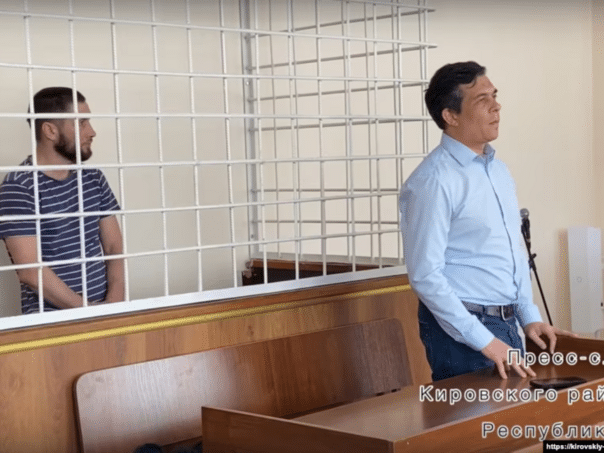
After more than a decade under Russian occupation, the Ukrainian peninsula of Crimea has become a place with less freedom – especially for those who dare to stand up to the Kremlin.
However, the judges under the control of Moscow these days are not only judging the cases of the residents of Crimea, writes the editorial office of Radio Free Europe (RSE) in English.
Since the launch of Russia’s unprovoked all-out invasion of Ukraine in February 2022, penal institutions in Crimea have become home to dozens of politically active Ukrainians forcibly transferred from other parts of the country that fell under Russian occupation.
RSE analyzes some of the most significant trials that took place on this Black Sea peninsula in 2024.
In August 2023, Crimean resident Dilaver Salimov expressed his outrage when he saw a worker at a gas station in the small town of Stari Krim wearing a cap bearing the symbol “Z” – a symbol that promotes and justifies Russian military aggression.
Salimov demanded that the worker take off his cap and allegedly threatened to pay someone to “set him on fire.”
A video of the incident was released on a Telegram channel allegedly linked to Russia’s Federal Security Service (FSB), and news of Salim’s arrest followed soon after.
At first Salimov was punished for “discrediting the Russian army”.
Charges of death threats were brought only after Salimov refused a request to issue a video apology while in custody, according to the Crimean Human Rights Group.
His trial began in February 2024 and was closed to the media.
Salimov’s lawyers criticized the linguistic analysis, arguing that it contained numerous errors in spelling, punctuation and basic logic.
Judge Georgy Tsertsvadze ignored these appeals and sentenced the accused to one year in a penal colony.
Salimov is a Crimean Tatar, a Turkic-speaking, predominantly Muslim population indigenous to Crimea.
In a report marking 10 years of Russia’s occupation of the peninsula, human rights organization Amnesty International accused Russia of “(trying to) change the ethnic composition of Crimea while suppressing non-Russian identities on the peninsula”.
Moscow achieved this by “restricting education in the Ukrainian and Crimean Tatar languages, attacking religious minorities, stifling media and culture, as well as undermining representative institutions and abusing the judicial system,” according to Amnesty International, while pointing to “evidence that Russia was moving its own population to Crimea, in violation of international law”.
Peninsula for prisoners
According to the civil rights group Irade, which deals with Crimean issues, threats of violence against Crimeans known to support Ukraine were common during the occupation.
Formal prosecutions, like the case of Salimov, are rarer.
However, since the start of Russia’s invasion of Ukraine in 2022, there have been a number of cases of forcibly transferring residents of other occupied Ukrainian regions to Crimea to face seemingly arbitrary justice.
Ukrainian activist and writer Serhiy Tsihipa was forcibly taken from his hometown of Nova Kahovka, in Ukraine’s Kherson region, by Russian forces in March 2022 after the city fell under Russian control.
At that time, Cihipa volunteered and delivered food and medicine to the elderly in the occupied territories.
Cihipa was held without charge, legal representation or contact with his family for nine months before being forced to plead guilty and charged with espionage.
In October 2023, a Russian-controlled court called the “Supreme Court of the Republic of Crimea” sentenced Tsihipa to 13 years in prison.
In February 2024, that verdict was confirmed.
Cihipa is now serving his sentence far from Nova Kahovka and Crimea, in a maximum security prison in Russia’s Ryazan region.
Oleksandar Tarasov, another Ukrainian activist, was together with Tsihip in the remand prison in Simferopol, Crimea.
Tarasov, who was released in 2023 and joined his family in Germany, said Tsihipa suffered particularly brutal torture and abuse because of his past service in the Ukrainian army and security services.
Much less detail is known about the trial of Irina Horobtsova, an IT expert and human rights defender, who publicly opposed the Russian occupation of the city of Kherson and disappeared in May 2022.
Russian authorities initially denied involvement in her disappearance, but confirmed in August 2024 that Horobtsova had been sentenced to 10 and a half years in prison on espionage charges.
Prosecutors alleged that Horobtsova “collected and transmitted (to Ukrainian intelligence) information on the locations, times, routes and movements” of Russian military units in her region.
She reportedly did so “from February 2022 to March 2023,” but Ukrainian and international human rights organizations have previously expressed concern about her abduction and alleged transfer to Crimea during that period.
Dmytro Shaynoga, a resident of Ukraine’s Zaporozhye region, which is partially under Russian occupation, disappeared in October 2022 and was later located in a pre-trial detention center in Crimea thanks to the human rights group ‘Tribunal. The Crimean Episode’.
In October 2024, the Russian State Prosecutor’s Office announced that Shaynoga had been sentenced to 12 years in prison on charges that he provided geolocation for operational use to the Ukrainian intelligence service.
It is not clear how he pleaded guilty or whether he had access to a lawyer. The verdict was attributed to the court in Zaporizhia.
Revenge for the incident with the ship ‘Nord’?
In March 2018, Ukrainian authorities detained a Russian fishing vessel named the Nord in the Sea of Azov for violating Ukrainian laws, as it illegally left the occupied Crimean port of Kerch.
The incident caused a lot of attention in Russian propaganda.
In May 2022, two Ukrainian border guards, Ivan Tereshchenko and Vasyl Dmitruk, who allegedly participated in that operation, were captured by Russian forces during the siege of Azovstal in Mariupol.
Accused of hijacking the ship and kidnapping its crew, both men claimed during their trial in Simferopol that they were acting on official orders to protect Ukraine’s borders.
Despite the inconsistencies in the prosecution’s accusations and the court’s refusal to accept the defense’s evidence, the two border guards were sentenced to 17 years in prison.
Russian media reported in June 2024 that the verdicts were upheld on appeal in November.
(Vijesti.ba / RSE)


