
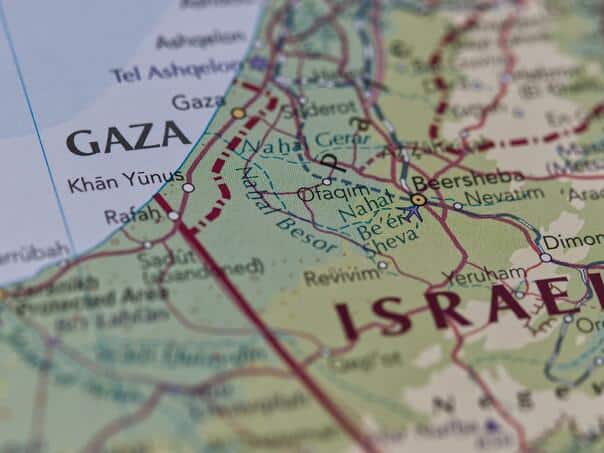
The Trump plan predicts that it will be released from the agreement from reaching the agreement, all the remaining hostages – either live or dead.
One of the key points of the plan is the request that the Palestinian militant organization Hamas is disarmed. According to the plan, Hamas will no longer manage the trigger – there would be a role over the temporary transitional body of the Palestinian managers, which would supervise the Peace Committee.
At the head of that board should be located exactly the Donald Trump and former British Prime Minister Tony Blair. The Gaza belt management would eventually be handed over to the Palestinian Administration.
The plan also states that the Israeli army will withdraw from Gaza according to pre-agreed phases and deadlines that all parties should be harmonized. The three-phase withdrawal is envisaged – in the first phase of Israel would retain about 55 percent of Gaza territory, in the second 40 percent, and in the final 15 percent.
This is another attempt to find the way to peace in the Israeli-Palestinian conflict that lasts more than a century.
Agreements from Camp David in 1978 were represented by the first peace process between Israel and one Arab country – Egypt. Then Sinai was returned to Egypt, while East Jerusalem and Golan Veryvan became parts of Israel, which most of the international community did not recognize.
These agreements also obliged Israel to expand Palestinian autonomy in Gaza and on the west coast, but they did not resolve conflict permanently.
Palestinians were not directly involved in these negotiations, and key issues such as Palestinian statehood, refugee rights and Jerusalem status remained unresolved. This later led to an increase in tension and the first Intifada – Palestinian uprising against Israeli occupation.
In the early 1990s, with the mediation of American President Bill Clinton, the Palestinian Lider Jaser Arafat and Israeli Prime Minister Jicak Rabin signed agreements from Oslo – the first serious attempt to establish Palestinian self-government.
DRAEL then withdrew from a larger part of Gaza and Jericho, which enabled the formation of the Palestinian national authority under the Arafat leadership. However, violence and mutual mistrust continued.
In an attempt to revive the peace process, 2007. The Conference in Annapolis was held, at the initiative of the US President George W. Bush. Then Palestinian President Mahmoud Abbas and Israeli Prime Minister Ehud Olmert met.
The main topics were a decision on two countries, boundaries, security, refugee status and Jerusalem.
However, neither the process has led to a permanent solution – violence continued rocket attacks from Gaza and Israeli military answers.
Israel was still withdrawn by the year in 2005, but retained control of external borders, airspace and maritime access. Although Hamas in 2006. came to power through the elections, the situation soon complicated. After the Fatah Conflict in 2007. years, Hamas became de facto ruler of Gaza.
Despite that, Israel retained a blockade that limits the movement of people and goods, which still has a significant impact on the daily life of Gaza residents. Hamas has not organized new elections since then, transmits HRT.
(Vijesti.ba)


