
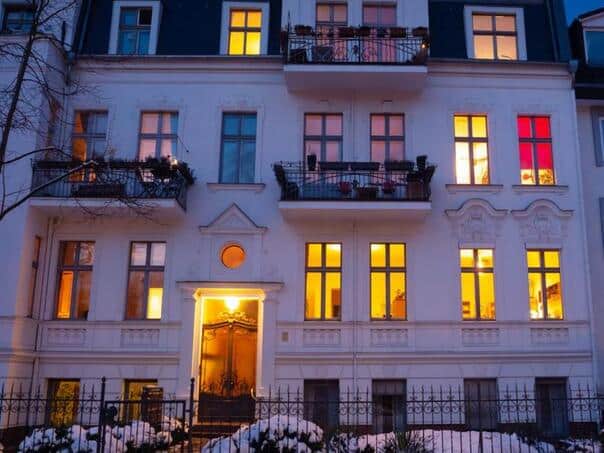
New construction is still weak, and rents are rising. In Mainz, they are trying to at least somewhat reduce the pressure in the housing crisis with an attractive apartment exchange model.
And in Mainz, the capital of the Rhineland-Palatinate state, the rule applies: whoever has a roof over his head, tries to keep it – even if the apartment no longer suits his needs.
Fewer and fewer people are moving in the city of just over 220,000 inhabitants.
The communal housing company Wohnbau Mainz manages around 11,000 apartments.
“Currently, only between 45 and 55 apartments are canceled per month,” says director Roman Becker. The rate of change of subtenants (o) fell below six percent, which indicates that the apartment rental market has almost completely “stagnant”.
In addition, too little new housing is being built in Mainz, so the chances for those looking for an apartment are getting worse, writes DW.
New apartment, old rent
Wohnbau Mainz has therefore launched a new program called “Future at Home 55+”.
Older people who need less space, because their children have moved away in the meantime, exchange their large apartments with young families.
The key thing: “We are one of the few housing companies in Germany that guarantees tenants that when they move to a smaller apartment, the current rental price (Kaltmiete) will remain the same, and we additionally pay a bonus for moving in the amount of 1,500 euros,” explains Becker.
For example: a four-room apartment of 85 m² with a monthly rent of €850 can be exchanged for a 2.5-room apartment of 65 m² with a monthly rent of €650, which brings an annual saving of €2,400.
In addition, less square footage means less costs for heating, electricity and more.
The residential utility company from Mainz improved the earlier model with this concept. For five years, there was a “Program for the exchange of apartments for seniors”, but without significant success.
The main problem: after moving from an apartment where you lived for a long time, the price per square meter of a new and smaller apartment was often significantly higher. Keeping the “old” rental price, for example in a new small apartment, can mean savings of several thousand euros per year.
In addition, the new apartment is delivered renovated with few or no barriers. Also, “double” rents are not paid during the moving phase, nor does the usual notice period apply.
It is estimated that about 2,700 old tenants could move to a smaller space, while on the other hand, about a thousand families are unsuccessfully looking for four-room apartments. The company is currently contacting potential candidates. It is planned that the project will last 24 months and “cover” 100 apartments.
Wohnbau Mainz does not benefit financially from this. “We do this because as a utility company we also have a social task,” adds Becker.
Who “blocks” housing?
Reiner Braun carefully studied the model from Mainz. He is the Chairman of the Board of Directors of Empirica, a private institute in Berlin, which is funded by studies for clients such as banks, insurance companies, ministries and associations from the construction sector.
“The problem in all attractive big cities is that the existing rents, due to price regulation, are far below the actual market value,” says Braun.
He says that not only seniors stay in old apartments, but also people who change their place of residence. “They don’t cancel the apartment because they might come back after a trial period in another city – then they wouldn’t find anything affordable anymore. The existing contracts have become a kind of securities whose value is sure to increase,” Braun believes.
Brown mentions another group that contributes to the shortage of (affordable) housing: “These are people over 40, often divorced, mostly urban intellectuals, who are in a relationship but still live separately,” he explains.
Such a household can afford two apartments not only because of high incomes, but primarily because of low rents according to old contracts. They both know – in the event of a breakup, they would no longer find a comparable apartment.
That’s why Braun doesn’t see a concept for the future in the model from Mainz. “For the participants in the exchange process, it is of course worth it. But the model only fights the symptoms, not the root of the problem”.
On the contrary: if the idea were to be applied en masse, there would be a lack of capital for new construction or rehabilitation, the expert believes and points out:
“High rents in new contracts have two causes: high costs and shortages. The state and municipalities are jointly responsible for both, because they set the rules for construction and constantly tighten them”.
(Vijesti.ba)


Chat readers
Join the discussion