
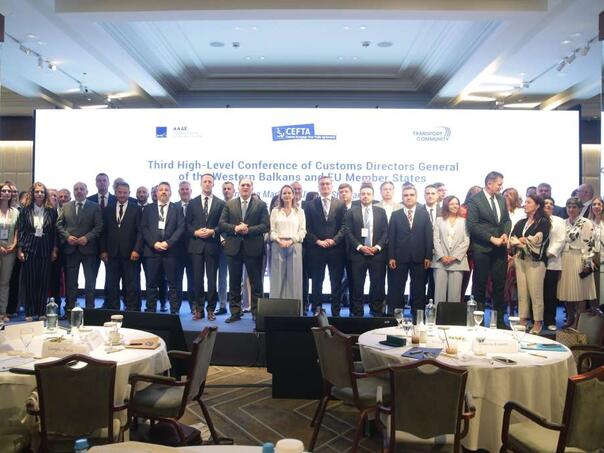
The third high-level conference of general directors of customs administrations of the Western Balkans and EU member states was held today in Athens, which made a significant step forward from political support for the Green Belts to their broad, operational integration with the EU Single Market.
The event was jointly organized by the Independent Public Revenue Authority of the Republic of Greece, the CEFTA Secretariat through the SEED+ action and the Permanent Secretariat of the Transport Community.
On that occasion, it was pointed out that the Green and Blue Ribbons, supported through SEED+, represent a concrete step towards smoother trade and closer economic integration between the Western Balkans and the EU.
The Governor of the Independent Public Revenue Administration (IAPR) George Pitsilis stated that the Third High-Level Conference of General Directors of Customs Administrations of the Western Balkans and EU member states emphasizes the strategic importance of customs cooperation for regional stability, economic resilience and the European perspective of the Western Balkans.
He added that in today’s environment, the customs administration is not only border authorities. They are key institutions for protecting public revenues, facilitating legitimate trade, strengthening the security of supply chains and supporting convergence with and within the European Union.
– For Greece and the Independent Public Revenue Authority, this cooperation is both a responsibility and a strategic priority. Through initiatives such as Green Lanes, pre-arrival information exchange, interoperable systems and alignment with EU standards, we build practical trust and create the conditions for a more connected and secure customs environment. IAPR will continue to support this joint effort through digital modernization, technical cooperation and active regional engagement, contributing to a stronger, more resilient and integrated European customs area – Pitsilis said.
Director General of the Greek Customs and Excise Administration Dimitrios Bourikos pointed out that the Third High-Level Conference of General Directors of Customs Administrations of the Western Balkans and EU Member States represents an important milestone in raising awareness and improving customs cooperation among the participating administrations.
– During the panel discussions, we, the heads of the customs administrations, together with senior officials of the EU, CEFTA and the Transport Community, successfully reviewed the progress, evaluated the achievements and identified the next steps in the process of integration of the customs administrations of the Western Balkans into the EU customs ecosystem. To that end, we focused on improving the interoperability of IT systems and harmonizing customs standards and procedures – he stated.
We have confirmed, he added, that the Green Stripes initiative, combined with the regular exchange of information at border crossings, contributes to more efficient customs controls, while enabling smoother and faster trade flows.
According to him, these efforts strengthen the resilience of customs administrations and support the gradual integration of the Western Balkans into the European Union, which is a perspective that inspires both customs administrations and private actors.
Director of the CEFTA Secretariat, Pranvera Kastrati, emphasized the mature role of the regional digital infrastructure.
– Thanks to the technical strength of SEED+ and the commitment of customs administrations across the region, we have successfully transformed the Green Belts from an emergency instrument created during the pandemic into a successful, durable and data-driven corridor framework connecting CEFTA and the EU Single Market. By accelerating digital transformation, interoperability and automated data exchange, we are building a reliable ecosystem of trust that helps our compliant business entities to progress, while at the same time we are gradually harmonizing our customs administrations with strict European standards – said Kastrati.
Concluding the introductory session, the director of the Permanent Secretariat of the Transport Union, Matej Zakonjšek, said that when the Green Belts first appeared during the COVID pandemic, supply chains were under enormous pressure, borders became bottlenecks, and uncertainty affected everyone.
– However, what happened after that was truly extraordinary. Customs administrations cooperated closely, transport authorities coordinated efforts, information was exchanged, and trust was gradually built. Today, the Green Ribbons represent one of the most tangible examples of practical regional cooperation in Southeast Europe – he stated.
The conference in Athens confirmed the joint commitment of CEFTA parties, EU member states, the European Commission and regional partners to strengthening customs cooperation as a key element of the EU enlargement process and gradual integration into the EU Single Market.
Participants emphasized the importance of interoperability, real-time data exchange, coordinated risk management, partnerships with trusted traders and closer alignment with EU customs standards, to ensure safe, resilient and predictable trade flows.
The conference also confirmed strong support for the further implementation of the Green and Blue Ribbons, with the support of SEED+, as practical tools for improving connectivity, reducing barriers and strengthening operational cooperation between the Western Balkans and the EU – the organizers said.
(Vijesti.ba/Fena)



Chat readers
Join the discussion