Especially when this view includes not only 30. Anniversary of the crime, but also earlier events are written phase.
Vučić in Srebrenica 2015
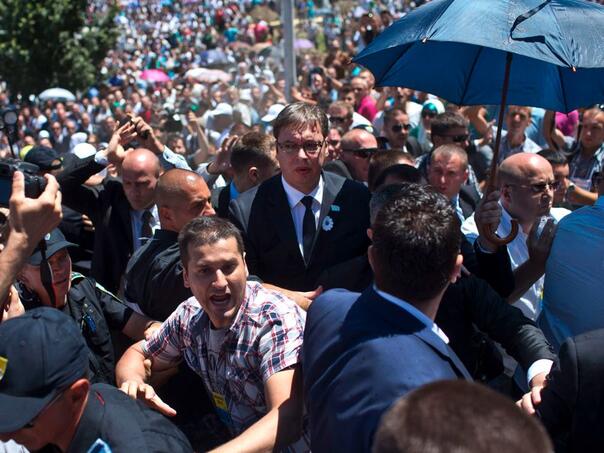
For example, 11. July 2015. years. At that time, on the occasion of 20. The anniversary of the crime in Srebrenica came to Niko second to the present president of Serbia, Aleksandar Vučić. Then he was still the Prime Minister, but the most powerful man in Belgrade. The very fact that he came to this little place in the east of Bosnia, she acted almost incredibly given his past.
Vučić began his political career in the middle of the 1990s in the “Serbian Radical Party” of the Chetnik leader of Vojislav Seselj, whose name is everything he says. He showed zeal and obedience, quickly became one of the most faithful Seselj’s executors.
In one of his speeches during the war in BiH, young chauvinista Vučić instructed a bloody threat to Bosnian Muslims:
“If you kill a Serb, we’ll kill a hundred Muslims.”
This threat to the Republika Srpska army, under the command later, a lifelong criminal criminal criminal criminal, Ratko Mladic, carried out in many Bosnian places. Srebrenica became synonymous with “ethnic cleansing” policy.
Clear words at the crime scene
Still, Vučić was in 2015. visited the crime scene to pay tribute to the victims of the policy that he has been supporting him for years. How was that possible? Due to the political context. The visit was followed by Vučić tried to distance himself from his nationalist past because he wanted to introduce Serbia to the European Union. He claimed that his statement of murder of 100 Muslims “was drawn from the context”, although he never clarified in which context, such a statement would be acceptable.
Before arriving in the former “UN protected zone”, Vučić published a statement:
“There are no words that could express anger and bitterness towards those who committed this monstrous crime. Serbia clearly and unequivocally condemns this terrible crime, disgust all who participated in it will take place to account for responsibility.”
In the book of mourning in Srebrenica, Vučić then enrolled in the words:
“I hope that this crime will never happen again. Convinced in a different and better future of the Serbian and Bosniak people, expressing deep condolences to all victims and their families.”
What a message wrote by the Cyrillic was considered a small concession of his nationalist supers.
At the commemoration, he talked to two mothers whose family members were killed in 1995. years. One even hugged him and hugged him. It seemed as if a symbolic moment was created that day, similar to the one when Willy Brandt knelt in Warsaw.
Former American President Bill Clinton, who was also present, praised Vučić for the courage to come to Srebrenica.
Compared to the then Prime Minister of Turkish Ahmet Davutoğlu, who called the massacre of genocide, but he did not use that word for murder hundreds of Armenians in 1915. in the Ottoman Empire, Vučić looked like a moral winner.
Vučić also got applause – and oysters
But the event got a completely different flow. After Clinton laid a wreath, Vučić laid a flower, but soon the atmosphere escalated. The gauge began, then the bottles and stones were taken towards Vučić. Looking at the recordings today, a miracle is that no one is seriously injured.
Day later, in an interview for Frankfurter Allgemeine Zeitung, Vučić said:
“I will not change my politics. I will continue to provide a hand of reconciliation. We must think of the future and build the foundations for the better life of Serbs and Bosniaks.
He attacked him, as he said, just further convinced that the efforts to reconciliation were necessary – and for those who attacked him.
Vučić defended his visit and from criticism of Serbian nationalists:
“Most citizens of Serbia were not happy with my decision to go to Srebrenica. But I wanted to – to give it to the victims.”
In November of the same year, he visited Srebrenica again – this time with a group of Serbian businessmen. He promised a donation of five million euros to the local community. He received spontaneous applause – and for a moment that something unimaginable was happened: former Serb ultranationalists want repentance and forgiveness in Srebrenica.
“We want to spend in the next hundred years in peace. We want good, friendly and fraternal relations with the Srebrenica.”
What does Srebrenica have with Brussels?
Reports from 2015 sounds like they come from another world. In the meantime, a tone reminiscent of Vučić’s early days was re-established in official Belgrade. Although numerous commemorations are held in Belgrade on the occasion of the 30th. Anniversaries – Tribune, performances, street actions – everything comes from civil society, not from the authorities.
His Party Saborac Vladimir Đukanović was still in 2019. Written on Twitter:
“Congratulations to the Serbian people day of Liberation of Srebrenica,” thanked Ratko Mladic at the “Brilliant Military Operation”. He did not have any consequences – he is still a member and a member of the Presidency of Vučić’s party.
Return to nationalism
Was Vučić’s phase of repentance just a lie? We can only guess. But one thing is for sure: in the summer of 2015, two years after Croatia’s entry into the EU, the prospects of EU access for the Western Balkans was still realistic. Only later – especially since 2019. and French Veto for North Macedonia – it has become clear that membership was far away.
The more that perspective was fading, the Vučić reset the nationalist rhetoric and the preservation of power. Although it is not possible to prove a direct cause-and-effect relationship, time match is obvious. Today, the state media in Serbia is re-characterized by the nationalist discourse, and the judiciary goes up: A few days ago, the Serbian officer was acquitted in the genocide in Srebrenica writes in the review of the reputable phase.
(Vijesti.ba)