
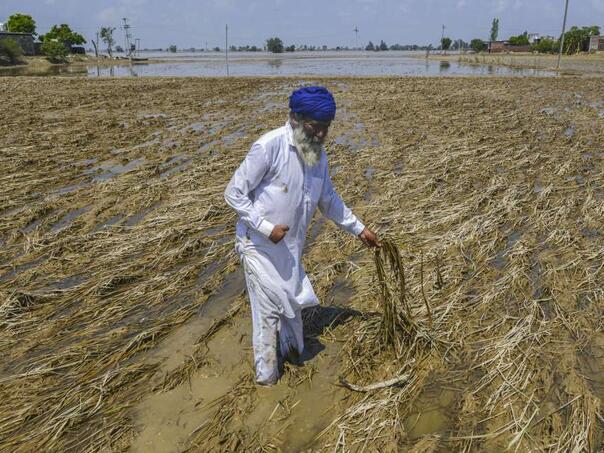
The fields are full, but the rice is brown and introduced, and the air is filled with stench of rotten crops and cattle. The consequences are these record monsoon rain that devastated by the Indian Žitnica.
In Punjab, often called “Žitanica Earth”, the damage is unprecedented – floods swallowed agricultural land almost size London and New York together, reports France24. The Minister of Agriculture India said during a recent visit to this Federal State that “crops were destroyed and failed”, while the Chief Minister of Punjab, the flood called “one of the worst disasters in recent decades.”
Older locals agree.
– The last time we saw this destructive flood was in 1988. years – said 70-year-old Balkar Singh from the village of Shehzada, 30 kilometers north of the Holy Sikski city of Amritsar. Crowded water turned Singh’s rice field in a swamp and created cracks that threaten his house.
Floods and landslides are common during the monsoon from June to September, but experts say that climate change, together with poorly planned development, increase their frequency, strength and proportion. According to the State Meteorological Service, in Punjab, in August, almost two-thirds of more rain occurred in relation to the average, which killed at least 52 people and affected more than 400,000 people.
Prime Minister Narendra Modi announced a package of assistance worth about $ 180 million for Punjab. The village of Tior, located between Rijeka Rava and Pakistan, was destroyed – the crops, corpses and crashed houses were destroyed everywhere.
– Water came a little after midnight 26. Augusta – said the Surjan Lal farmer.
– It grows up to at least three meters in just a few minutes – he added.
Lal said that the village was cut off in the hardest affected district of GurdaSpur almost a week.
– We were all on the roofs, “he said he pointed out that they couldn’t do anything while the water was all – from livestock to bed.
In the adjacent village of Lassia, the last Indian village before the border, Farmer Rakesh Kumar counted losses.
– Apart from the country I own, this year I took still lease. All my investments simply went down the water, “said this 37-year-old.
Even worse, Kumar said the future looks silent. It is afraid that his fields will not be ready on time to sow wheat, the main winter crop in Punjab.
– First, all the sludge must be dried, and only then can the big machines clean the inflicted causes, “he said.
Even in the best circumstances, bring heavy machines to that area is a big challenge, because the pontoon bridge connecting to the mainland only works during the dry months. For landless waters, like 50-year Mandeep Kaur, uncertainty is even bigger. Her house took the water, so he slewed in the yard below tarpaulin – a solution a lot of danger because the snakes broke on the wet country.
Punjab is the largest supplier of rice and wheat for the Indian food safety program, which ensures subsidized grain for more than 800 million people.
Analysts say that this year’s losses are unlikely to endanger domestic supplies thanks to large reserves, but the export of Premium basms will suffer.
– The main effect will be on the production of basmati rice, prices and exports due to lower yield in Indian and Pakistani Punjab – said Avinash Kishore from the International Food Policy Research Institute in New Delhi.
Criminal American duties have already made Indian basmati rice less competitive, and floods threaten to exacerbate pressure.
Analysts say that the recovery path for hardly affected pandge farmers will be especially difficult because the Federal State withdrew from the government’s insurance program, citing high costs and low risk thanks to the robust irrigation network.
Singh, an older farmer, said the water on his property was “still up to his knees.”
“I don’t know what awaits us in the future,” he said.
(Vijesti.ba / Fena)


