
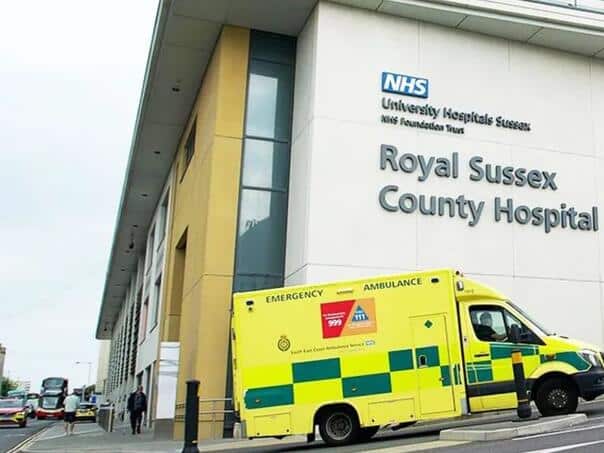
Sussex Police began investigating an initial 105 cases in 2023 but now has more than 200. The police say the investigation is “active and ongoing” but “will not be giving specific details of case numbers at this time”.
The police became involved after two whistleblowers made allegations of medical negligence in two hospital departments – neurosurgery and general surgery. At least 40 deaths are suspected. The increase in cases is linked to a greater number of families contacting the police.
Separately to this investigation, the BBC spoke to the family of a patient who claims they were misled by a general surgery surgeon before carrying out an operation which left her with life-threatening injuries.
Wendy Gibbs, 80, was due to undergo pelvic prolapse surgery by surgeon Marc Lamah at a private hospital in Brighton run by Nuffield Health. But Lamah told her he wanted to transfer the procedure to another Nuffield facility because Brighton Hospital did not have the scanner he might need. But it turned out that the device was not available in the other hospital either.
Lamah also failed to disclose to Wendy Gibbs that all surgeons were barred from performing such operations in Brighton, as Nuffield Health was concerned about safety concerns. When Gibbs finally underwent surgery in March 2024, Lamah mistakenly cut her intestine, causing internal bleeding that went undetected for hours. Gibbs developed life-threatening sepsis.
An emergency second operation was needed – also carried out by Lamah – at the Royal Sussex County Hospital in Brighton, which is part of the NHS under investigation. This was followed by a stay in intensive care and 11 days of sedation.
Gibbs now has a permanent ostomy and says she was traumatized by the experience:
“He betrayed my trust. Most of my hair fell out. My nails fell off. Now I am slowly recovering, but the trauma of what happened remains.
The case of Wendy Gibbs is not part of the police investigation because her treatment occurred after the period under investigation by the police. Nuffield Health – the private healthcare provider at whose hospital the first operation took place – responded that it was carrying out a “thorough investigation into the particular doctor”.
However, the former director of clinical services at Brighton’s Nuffield Hospital – where Lamah also worked privately – said in 2023 the company was concerned about the rate of complications following his operations.
Michael Turner told the BBC that the data showed that one third of Lamah’s patients experienced “moderate impairment” over a 12-month period. Turner said that figure should be less than 5%. Three months ago, Nuffield Health sacked Michael Turner for misconduct after he used a swear word to describe the actions of another doctor.
Lamah still works at the Royal Sussex County Hospital. Sussex University Hospital responded that its operative outcomes were within the expected national range.
Speaking anonymously, a former NHS colleague of Lamah’s told the BBC that the surgeon had been “reprimanded on a number of occasions for things that were grossly unprofessional”. This colleague says that one of those occasions involved an emergency operation, which Lamah, out of self-challenge, decided to complete in 45 minutes, despite the fact that there was no need for it.
Police are currently identifying relevant cases and sending them to medical examiners to consider whether there are grounds to open a formal investigation into the care these patients received – a process expected to conclude in early 2025. The investigation is at an early stage and there are no suspects at this time.
Most cases seem to involve the neurosurgery department. Police are considering charges of manslaughter and corporate manslaughter.
The BBC understands that one of the cases being examined by medical experts is that of Stephen Coles. He was operated on by neurosurgeon Carl Hardwidge, who spent 31 years at HNS before leaving in 2023. He was criticized by the family of Stephen Coles, who died in 2021 after Hardwidge operated on him for a brain tumour.
After the surgery, Coles, then 66, was unable to swallow due to cranial nerve damage. He spent several weeks in hospital where he eventually died, after contracting pneumonia due to poor care in the general ward.
His sister Julie Rhodes says Hardwidge never explained to the family why Coles was so unwell after the surgery. The audit found no irregularities in Coles’ care, which Rhodes was not happy about.
However, a neurological expert who analyzed the case told the BBC that Stephen Coles’ death could have been avoided and criticized post-operative care. He claims that Coles should have had a tracheostomy inserted to help him breathe: “The responsibility for protecting the patient’s airway must rest with the operating surgeon.”
There are concerns about the care Carl Hardwidge gave to at least three other patients while working in the NHS. One judge also said he was “somewhat concerned” that Hardwidge tried to minimize delays in care for another patient who died in 2012 during his testimony.
Sussex University Hospital said its neurosurgery department faced significant challenges after 2012, resulting in some patients waiting longer than they should have, for which it apologised.
(Vijesti.ba)


