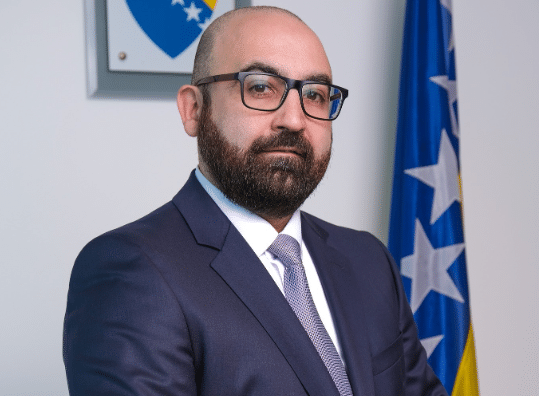
Muhamed Hasanović, Deputy Minister of Finance and Treasury of BiH will also be discussed, who will present an overview of institutional and technical preconditions for the development of electronic invoicing systems, with a review of experiences from the region.
In the interview, Hasanovic speaks of the benefits of e-invoices, institutional challenges and the importance of harmonized cooperation. Given the complex institutional structure of Bosnia and Herzegovina, it is crucial to the distribution of jurisdiction: At the state level, the BiH Ministry of Finance and Treasury, leads the Treasury with International Partners, but does not exceed the platform for interinstitutional dialogue and technical coordination. For VAT, excise and customs, the Directorate for the Indirect Taxation of BiH (UIH), which operates at the level of the entire state. On the other hand, the entities – Federation of BiH and Republika Srpska – have legislative and operational competencies when it comes to direct taxes, fiscalization and implementation of electronic invoicing systems. Brcko District has its own direct tax system, while using the ITI in indirect taxes. Therefore, e-invoicing in BiH cannot be viewed as centralized reform, but as a process that requires coordinated cooperation of all levels of government, without interfering in their constitutional authority. That is exactly the foundation of the conversation that will be conducted on the GS1 conference.
Mr. Hasanovic, everything is more common in public about electronic invoicing. How do you see space for harmonized access to this topic within BiH, respecting its complex institutional structure?
Hasanovic: The complex constitutional structure of Bosnia and Herzegovina requires a carefully designed, inclusive and coordinated approach to digitization through electronic invoicing. Although the entities and the Brcko District have legislative jurisdiction in this area, there is a significant space for the establishment of joint technical and legal standards through inter-institutional dialogue. In this case, the Ministry of Finance and Treasury of BiH could play a key role in encouraging that dialogue, ensuring the platform for the exchange of experiences, good practices and harmonization with international trends. In this sense, e-invoicing does not have to be centralized, but it can be standardized.
What are the key benefits of electronic invoicing for the business community, public institutions and citizens?
Hasanovic: For the business community, e-invoicing means greater efficiency, faster payment, smaller administrative costs and better tax transparency. Public institutions can achieve significant savings through process automation, stronger control over public consumption and reduction of space for errors and abuses. Citizens, although indirectly, benefit through the modernization of the economic system, improved fiscal discipline and more efficient services that the public sector provides.
Are there currently initiatives that could lead to a harmonized, but flexible framework for e-invoicing in BiH – with respect for the competencies of the entities and the Brcko District?
Hasanovic: Yes, certain talks and technical exchanges between entity and state institutions are already being conducted, and conferences such as the GS1 conference represent exactly one of the forums where these initiatives are concretized. It is important to build an interoperable frame that allows each level of government to maintain its competencies, but with the use of common standards that enable each other to identify and exchange e-invoices within the whole BiH.
In the upcoming panel, we will also look back on experience from the region. What practices can we be especially useful or inspiring to us?
Hasanovic: Serbia is a positive example of gradual implementation – the first public sector, then VAT bonds, and all entities. Croatia has improved transparency through the eracun in public procurement. The experiences of Montenegro and northern Macedonia indicate the importance of parallel development of the legislative framework and technical infrastructure. These lessons are extremely important and useful for BiH.
The Ministry of Finance and Treasury of BiH has no direct jurisdiction over fiscal policy, but can play an important role in supporting inter-institutional dialogue. How do you see your role in encouraging cooperation between different levels of government? Can standards be helpful to us?
Hasanovic: Our role is to be a bridge between levels of government – to enable coordination, facilitate the exchange of information and ensure imports with international standards. Standards – like those developed by GS1 or coming through the EU directive – help us define the joint language among institutions that have different competencies. We can build compatibility without compromising the constitutional structure through standardization.
The vision of the initiative (VAT in the Digital Age) at the level of the European Union brings a number of changes when it comes to the digitization of VAT systems, including compulsory electronic invoicing. How do you assess the importance of this initiative and will its implementation in the EU have an impact on countries such as Bosnia and Herzegovina? Are there deadlines that our decision makers should keep in mind?
Hasanovic: VIDA Initiative means the transition to proactive, digital VAT management based on real-time automation and exchange data. As a country that strives for EU membership, BiH should follow these trends. Although we are not mandatory to implement directives immediately, their structure and deadlines can be an important signpost. The time to act is now – the delay could cost us expensive.
What will be your key message to the GS1 conference participants when it comes to the future of e-invoice in BiH?
Hasanovic: Electronic invoicing is not a question of “whether”, but “how” and “when”. BiH has the opportunity to create an important step forward with compliance with the competencies and adoption of common standards towards a more efficient, transparent and modern business environment. The GS1 conference is the right place for the initiation of concrete steps – from strategic commitments to technical implementation.
Digitization through e-invoicing requires coordination and mutual respect for the competence. This dialogue is expected at 9. GS1 conference – where there will be considered and challenges and concrete opportunities for the modernization of the business environment in BiH.
See you at 9.GS1 conference – 29.05.2025. year – 30 years of leadership in innovation and digital transformation.
(Vijesti.ba)