
That’s not a surprise. To imagine Chinese revolutionary leader Mao Zedong sitting at the same table with US President Gerald Ford and other leaders was unimaginable at the time.
China was in turmoil at the time and far from becoming the economic giant it is today. Mao also helped defeat French and American forces in Vietnam, militarily supporting the Communist Ho Chi Minh takeover. That’s why Mao would have been a complete outsider if he had attended the first six-nation Rambouillet summit, which later grew into the G7 when Canada joined a year later.
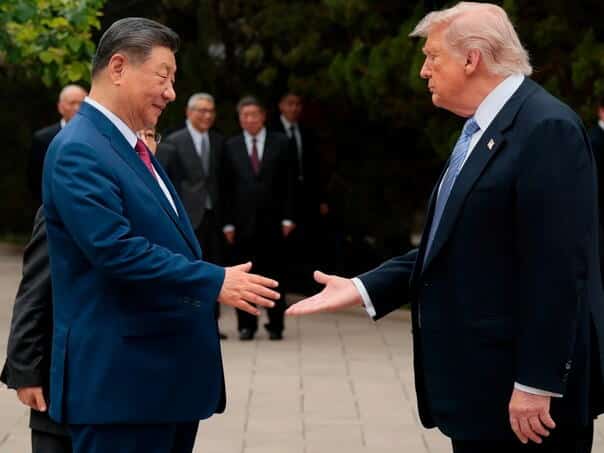
But as US President Donald Trump and his G7 colleagues reconvene in France from Monday, China’s exclusion from the informal club seems increasingly unusual, given its enormous influence on the world economy and global developments.
A simple question arises: Without China, does the G7 make sense?
Economically, China would certainly be a member
If economic success is considered exclusively, China would have been a part of this club long ago.
Its economy, which grew rapidly for decades after the death of Mao Zedong in 1976, now outpaces the economies of G7 countries such as Germany, Japan, the United Kingdom, France, Italy and Canada — leaving only the United States ahead.
By this criterion, the G7 without China is like the World Cup without Brazil, the five-time champion.
From being a “small, harmless panda bear” in 1975, China has become, according to University of Toronto expert John Kirton, “a great global dragon.”
“Many people rightly ask: Would the G7 and the global community be better off if China became a member of the G7? The possible answer is ‘yes,’” says Kirton.
But the G7 is a club of democracies
A year ago, Trump considered expanding the club to China, saying it was “not a bad idea” when asked about it by reporters.
However, the unwritten rule of the G7 has always been that it is a club for democracies only.
“We are responsible for the governments of an open and democratic society, dedicated to individual freedom and social progress,” stated the founding leaders at Rambouillet in 1975.
China then, during Mao’s rule marked by a large number of victims through famine and political turbulence, would not have met those criteria.
Even today, under President Xi Jinping, China does not meet those standards. According to a number of measurements, including Freedom in the World, the World Press Freedom Index and economic freedoms, China lags significantly behind the G7 countries when it comes to civil liberties.
China as a central topic of the G7
China’s influence is reflected in all G7 countries in a number of areas.
It exports far more than it imports, and in 2025 it posted a record trade surplus of nearly $1.2 trillion, creating tensions with industrial powers.
It also controls key raw materials such as rare minerals, while its technological advances and growing military might are causing concern among rivals.
It is also the world’s largest emitter of gases that contribute to climate change.
All this means that China will be the “elephant in the room” at the summit, which takes place from Monday to Wednesday in the Alpine town of Evian-les-Bains.
As host, French President Emmanuel Macron devoted part of the summit to talks on balancing trade with China, amid concerns that rising Chinese exports could threaten G7 industries.
Although relations between the G7 leaders have been strained at times, China could be a topic on which they can still agree, says expert Cédric Dupont of the Institute of International Studies in Geneva.
“They agree on one thing: China is the problem,” he says.
Beijing is watching with caution
China’s Communist Party government has previously criticized the G7 for its exclusivity, calling it a relic of the Cold War.
Ahead of the summit, China’s Ministry of Foreign Affairs said the G7 “should serve as a catalyst for solidarity and cooperation, not an amplifier of division and confrontation.”
Beijing-based analyst Wang Zichen says China sees the G7 as an extension of Western, American-led power, where it is often treated as a threat.
However, China cannot ignore this club.
“China recognizes that the G7 remains a huge concentration of economic, technological, military and financial power,” Wang said.
China as a threat to G7 unity
Analysts believe that China’s entry into the G7 could undermine the group’s unity, as its political system and views on Russia, Iran and other issues are not aligned with the G7 democracies.
“Getting China involved would be like a Trojan horse,” says Kirton. The presence of the Chinese leader could lead to certain G7 members seeking special economic and strategic concessions.
Chris Alden from the London School of Economics also believes that such a move would make it difficult for the G7 to function.
The Russian example as a warning
The last expansion of the G7 took place in 1998, when Russia was accepted as a member.
However, in 2014, after President Vladimir Putin annexed Crimea, Russia was kicked out of the loop, a prelude to a war that has been ongoing since 2022.
Trump previously said that excluding Russia was a “big mistake.”
Nevertheless, Kirton believes that this experience strengthened the position that the G7 should remain a club of exclusively democratic countries, without the risk of including authoritarian powers as full members, he writes. AP.
(Vijesti.ba)



Chat readers
Join the discussion