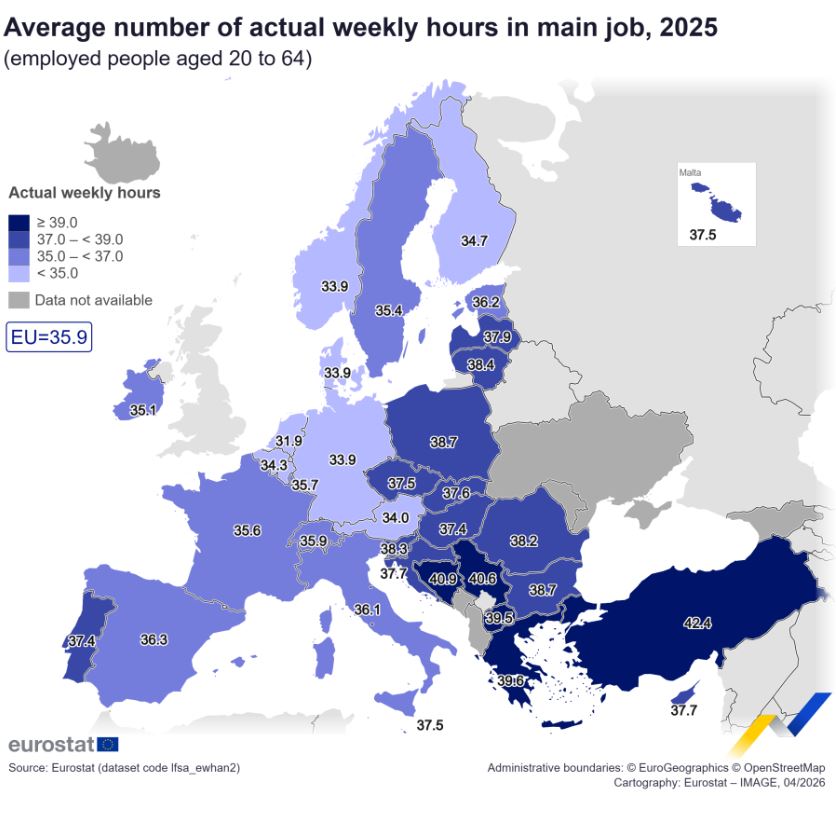
Employees in the countries of the European Union during 2025 worked an average of 35.9 hours per week at their main job, according to the latest Eurostat data. It is about actual working hours during the reference week, which includes only the hours that workers actually spent at work.
Among EU members, the highest average number of working hours was recorded in Greece, where employees worked 39.6 hours per week. Poland and Bulgaria follow with 38.7 hours each, Lithuania with 38.4 and Slovenia with 38.3 hours per week.
On the other hand, employees in the Netherlands had the shortest working week, where the average was 31.9 hours. Behind it are Germany and Denmark with 33.9 hours each, while in Austria the average was 34 hours per week.
Although not a member of the European Union, Bosnia and Herzegovina is shown on Eurostat’s map for 2025 with an average of 40.9 hours actually worked per week at the main job. That is even five hours more than the EU average, which is 35.9 hours. Among the countries included in the presentation, only employees in Turkey had a longer working week with 42.4 hours, while Bosnia and Herzegovina is ahead of Greece (39.6), Serbia (40.6) and most of the countries of the region and the European Union.
More than a third of employees work between 40 and 44.5 hours a week
At the level of the European Union, the largest share of employees, 37.6 percent of them, worked between 40 and 44.5 hours a week. Another 16.4 percent worked between 35 and 39.5 hours, while 9.2 percent of employees recorded a weekly fund of 30 to 34.5 hours.
The data also show that:
- 9.9 percent of employees did not work during the reference week,
- 7.2 percent worked between 0.5 and 19.5 hours,
- 6.6 percent between 20 and 24.5 hours,
- 3.4 percent between 25 and 29.5 hours,
- 4 percent between 45 and 49.5 hours,
- 5.8 percent worked 50 or more hours per week
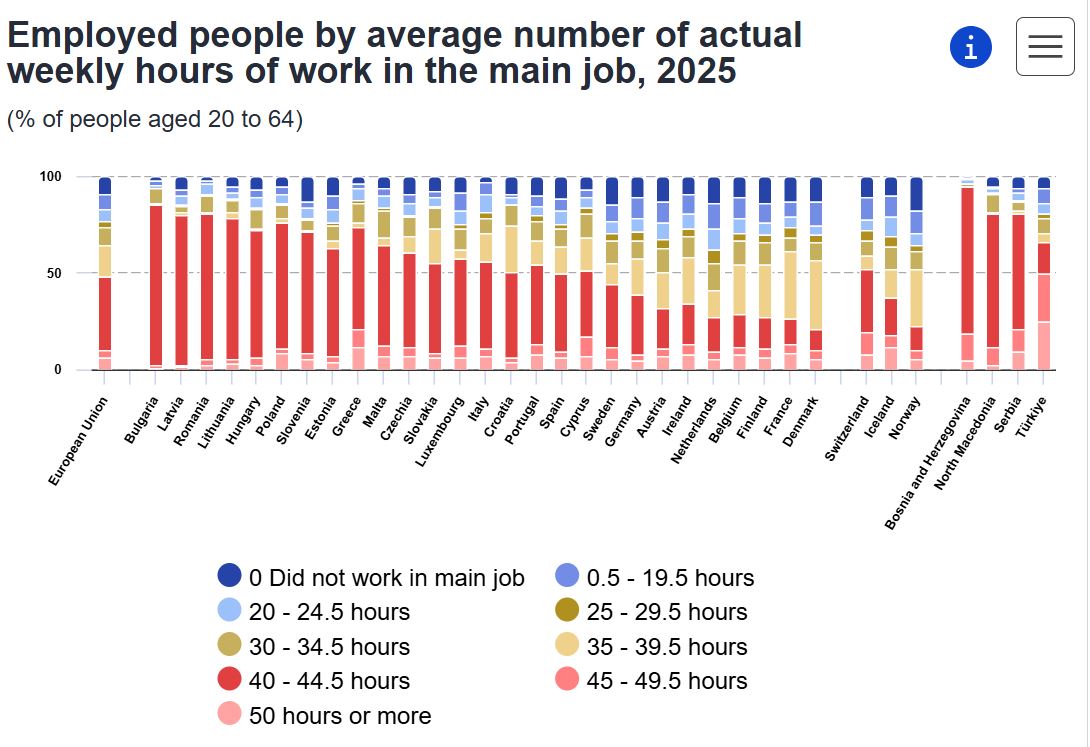
The category of 40 to 44.5 hours per week was the most represented in most Member States. The largest share of such workers was recorded in Bulgaria (82.8 percent), Latvia (77.1 percent) and Romania (75.5 percent).
The exceptions are Belgium, Denmark, Finland, France and Ireland, where the largest number of employees worked between 35 and 39.5 hours a week.
In BiH, almost half of the employees work between 40 and 44.5 hours a week
Eurostat data show that the most represented group of employees in Bosnia and Herzegovina is those who work between 40 and 44.5 hours a week at their main job. There are approximately 47 percent of such workers, which makes this category by far the largest among employees.
At the same time, BiH also stands out for its relatively large share of people who work very long hours. About a quarter of employees work 50 or more hours per week, while an additional approximately seven percent are in the group that works between 45 and 49.5 hours per week.
On the other hand, the proportion of employees working part-time is significantly lower. In the categories of up to 34.5 hours per week, only a small part of the workforce is found, while the percentage of people who did not work at their main job during the reference week is among the lowest compared to most European Union countries.
Such a structure of working hours helps to explain why Bosnia and Herzegovina, with an average of 40.9 hours of actual work per week, is among the European countries with the longest working week, just behind Turkey.
The self-employed work significantly longer than employees
Eurostat states that actual working hours are generally in line with normal working hours, although they are slightly lower due to holidays, sick days and other absences affecting the observation week.
The analysis shows that self-employed people more often belong to groups with longer working hours. While the largest share of employees worked between 40 and 44.5 hours per week (38.4 percent), only 6.4 percent of them worked 45 hours or more.
The situation is different for the self-employed. 32.2 percent of them were in the category of 40 to 44.5 hours per week, but also in the group that works at least 45 hours per week.
Men employed full-time work more than women
Among full-time employees, men worked an average of 39.4 hours per week in 2025, while the average for women was 37.6 hours.
The longest working week among women was employed in Slovenia with 39.2 hours, followed by Lithuania with 39.1 hours and Latvia and Poland with 38.9 hours each.
Women worked the shortest in the Netherlands, where the average was 35 hours a week. Followed by Finland with 35.6 hours, Ireland with 35.9 and Belgium with 36.4 hours.
For men, only four countries recorded an average of at least 40 hours per week: Greece (41.8 hours), Poland (40.6), Slovenia (40.2) and Cyprus (40 hours).
The fewest hours among full-time men were recorded in Finland and the Netherlands, where the average was 38.4 hours each, while Sweden and Hungary followed with 38.5 hours each.
The biggest differences between men and women were recorded in Ireland, the Netherlands and Greece. In Ireland, men worked an average of 39.9 hours a week and women 35.9 hours. In the Netherlands the ratio was 38.4 to 35 hours, while in Greece men worked 41.8 and women 38.8 hours per week.
The smallest differences between the sexes were recorded in Latvia and Bulgaria, where the weekly number of working hours was almost equal.
In BiH, both men and women work significantly more than the EU average
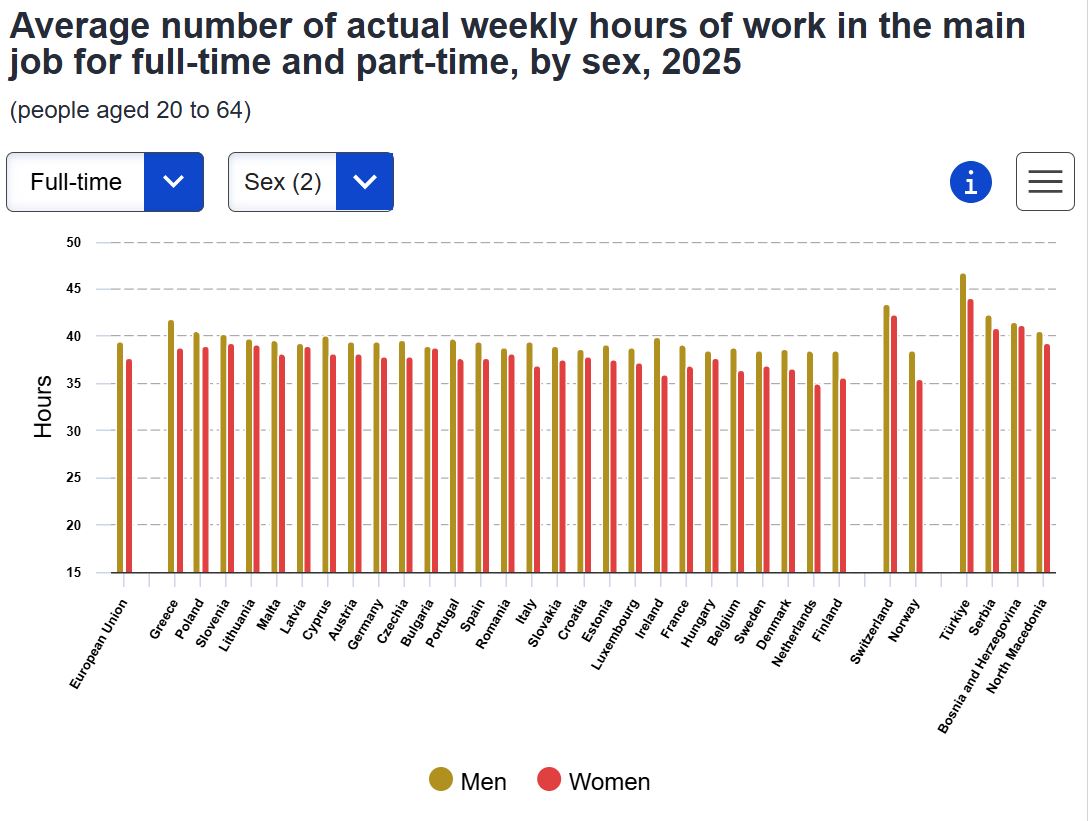
Data for the year 2025 show that men employed full-time in Bosnia and Herzegovina worked an average of about 41 hours per week, while the average for women was approximately 40 hours.
Both indicators are higher than the European Union average, where full-time men worked 39.4 hours per week and women 37.6 hours.
The difference between men and women in Bosnia and Herzegovina is relatively small compared to some European countries. While men worked slightly longer, the average number of hours for women remained among the highest on the continent.
A higher average number of working hours than Bosnia and Herzegovina was recorded mainly in Turkey, where men worked about 46 hours a week and women about 44 hours. On the other hand, in countries such as the Netherlands and Finland, both men and women with full-time jobs had significantly shorter working weeks.
The graph also shows that Bosnia and Herzegovina, together with Serbia and North Macedonia, is at the very top of Europe in terms of hours actually worked among full-time employees.
In part-time work, women often work more
When it comes to part-time employees, the EU-wide average was almost identical for both sexes. Men worked 21.7 hours a week, and women 21.9 hours.
However, in a number of Member States women employed part-time had a longer average working week than men.
The most pronounced difference was recorded in Denmark, where part-time women worked an average of 21.3 hours per week, while men in the same category worked 18 hours.
Latvia was among the few countries where part-time men worked more than women. Their average was 21.3 hours a week, while women worked 20.7 hours, it says Acts.