
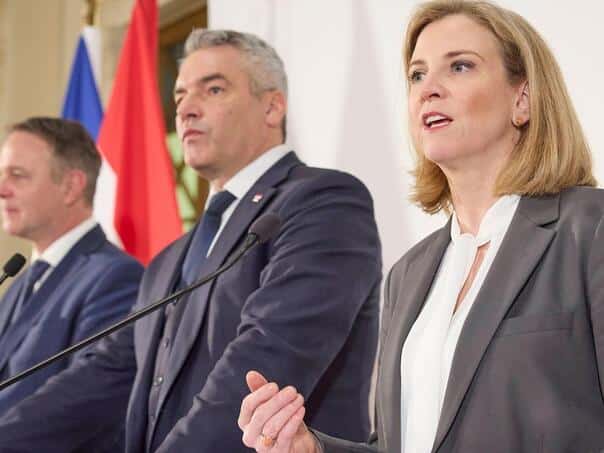
Negotiations about the government of the center in Austria have failed. Now President Van der Bellen has ordered the Social Democrats and the People’s Democrats to continue negotiations without the Liberals despite their narrow majority in parliament.
After the failure of negotiations on a three-party coalition in Austria, the conservative ÖVP and the social democratic SPÖ want to continue negotiations on a grand coalition bilaterally. This was announced by the leaders of both parties, Austrian President Alexander Van der Bellen said.
Earlier, the liberal Neos announced their exit from weeks of coalition talks with the governing party ÖVP and the social democratic SPÖ. “It was felt that there was a lack of much-needed will for reforms,” Neos leader Beate Meinl-Reisinger said. “It’s always been our goal to go above and beyond.”
Since mid-November, ÖVP, SPÖ and Neos have been negotiating to form a coalition government. Such a three-party coalition would be prime minister in Austria. The talks were also an attempt to keep the clear winner of the election, the right-wing Freedom Party of Austria (FPÖ), out of power even though it won about two percent more votes in the September election than the second-placed ÖVP of Chancellor Karl Nehemmer, writes DW.
“Our hand remains extended to the people,” said SPÖ head Andreas Babler. Now it is up to the chancellor and the head of the ÖVP Nehammer to continue bilateral negotiations “on an equal basis”, he said. During the negotiations, the Social Democrats demanded that the wealthier sections of the population bear the burden of budget consolidation, which was met with resistance from the liberals.
“We are ready to continue to take responsibility,” Nehammer said. He once again emphasized the importance of ensuring Austria’s economic competitiveness, a consistent asylum policy and easing the burden on the economy.
Whether the two parties will be able to come to an agreement is not clear for now. ÖVP and SPÖ must now negotiate “without delay”, Van der Bellen demands. “I want clarity about the negotiations and quick and comprehensive clarity,” he said. However, even if the Conservatives and Social Democrats reach an agreement on a grand coalition, they would have a very slim majority of just one vote in parliament.
The failure of the tripartite negotiations is a serious blow to Chancellor and ÖVP head Karl Nehammer. The prime minister strictly ruled out cooperation with the right-wing FPÖ under the leadership of its leader Herbert Kickl, referring to him as an extreme right-winger and proposed a three-member coalition as an alternative. “He’s on thin ice now,” said political analyst Thomas Hofer, alluding to the collapse of the talks.
The FPÖ celebrates and points to its predictions about the negotiations. “We have been warning for months about this ‘political freak of losers on the German model’,” said FPÖ General Secretary Michael Schnedlitz, taking aim at the failed coalition of the Social Democrats, Liberals and Greens in Germany. “Karl Nehammer ignored all these warnings, because in reality he only cares about one thing: his own position as chancellor!” The FPÖ therefore demands the resignation of the chancellor.
If the ÖVP-SPÖ coalition is not achievable, new elections are also possible. In that case, the right-wing populists could achieve an even more convincing victory. The latest polls indicate a significant increase in votes compared to the last parliamentary elections. According to those polls, the FPÖ could increase its score from 29 to around 35 percent.
At the end of September, the FPÖ won the parliamentary elections. However, no other party considered the FPÖ under Kickl capable of governing. According to his political opponents, Kickl has become radicalized in recent years. Since no one wanted to cooperate with that party, the so-called “candy coalition” was negotiated. This name comes from the party colors: turquoise (ÖVP), red (SPÖ) and pink (Neos).
The key point of the negotiations was the planning of the new state budget. Austria is in an economic crisis and at the same time must strictly save in order to meet the EU criteria for financial stability. The balance between savings and measures to stimulate the economy is considered the main task for the future government.
And from the perspective of the ÖVP, the SPÖ bears the main responsibility for the collapse of the tripartite negotiations. “While parts of the Social Democratic Party have constructively engaged and adapted, in recent days backward forces within the SPÖ have prevailed,” ÖVP General Secretary Christian Stocker said.
The tasks of the new government are enormous and require almost flawless cooperation. Structural problems include the pension system, which for a long time cannot be financed by contributions alone. The state must allocate a significant part of the budget to support pension payments.
Due to high wage increases, according to the Association of Industrialists, labor costs are no longer competitive. Unemployment is around seven percent. Many consider it too big a challenge for the government, which has only one majority vote in the parliament.
(Vijesti.ba)


