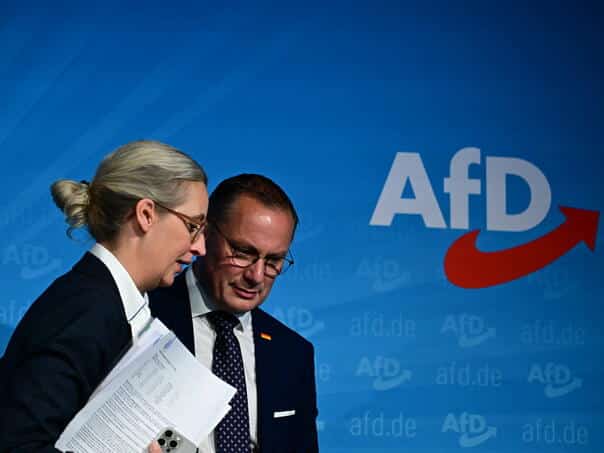
The results in the Federal State of North Rhine-Westphalia, in the west of Germany, stressed the growing attraction of the party to voters outside its strongholds in the Federal East German, where it is the strongest political force.
The AFD leaders now see the populated Western Western countries – the decaying industrial cities of northern Rhine-Westphalia, and less coal industry – as a key to the parties’ base.
According to the first results, AFD won almost 15 percent of the votes in this Federal State, taking the third place. In the last municipal elections in northern Rhine-Westphalia five years ago, the party won 5.1 percent of the vote. In the city of Gelsenkirchen, the former center of the heavy industry, the AFD candidate appears to face the politician of the left center in the second round for mayor.
The Conservative Christian-Democratic Union (CDU) of the German Chancellor Friedrich Merza is still clear in front of all other parties with 33 percent of the total number of votes, according to the first results. Merzo coalition partners in the Social Democratic Party (SPD) of the Left Center – once dominant political power in the industrial centers of northern Rhine-Westphalia – took second place with about 22 percent, according to the first data. These shares of votes are slightly lower than the results of these parties in the Municipal Elections in the Federal State five years ago.
Elections, although they did not have a direct impact on national policy, are mostly considered a barometer of national mood, given that about four months after Merz took office. Some of German conservative and centrist politicians have expressed a relief that the CDU and SPD achieved such good results, given that both parties recorded a decline in support in national surveys, while the support of AFD has increased.
(Vijesti.ba / Fena)